Canada as ‘associate member’ of EU? Why that’s easier said than done
Can a country in North America become part of a purely Europe-based grouping?
The notion would normally sound far-fetched. But in a world where US President Donald Trump has torn up the so-called “rules-based order”, Canada and the European Union (EU) may be viewing a deeper alliance as the best path towards some stability.
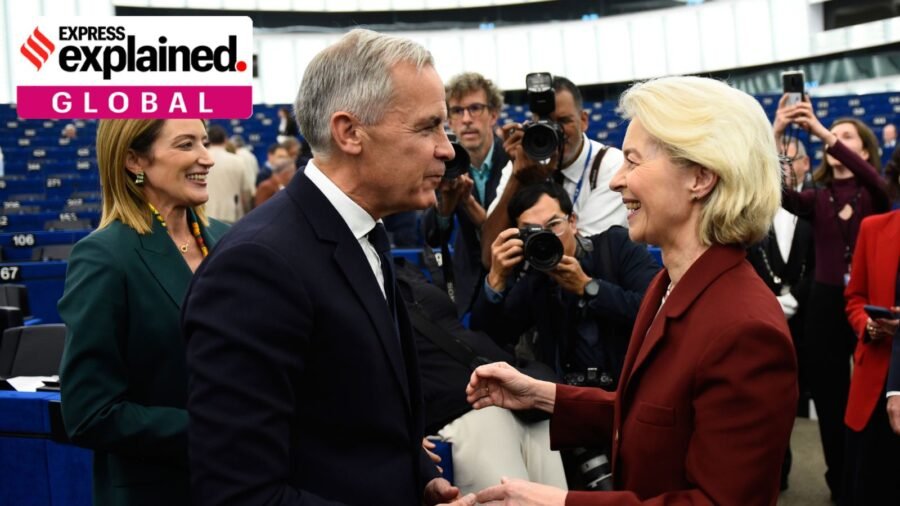
On Wednesday (September 16), European Commission president Ursula von der Leyen told Canadian Prime Minister Mark Carney that she was open to Canada becoming the EU’s first “associate member”. This came after Carney, on Sunday, said Canada was seeking a “unique alliance” with the European grouping. Any final decision, however, rests with EU member states. On Thursday, Carney said he welcomes the EU’s ambition for his country to become an “associate member”.
Story continues below.
Subscribe to see fewer ads.
While it is unclear exactly what being an “associate member” would imply, the coming together of the two parties holds significance for one reason: Trump.
The Trump factor
Canada’s proposal to join the EU raises several questions, yet, at the same time, makes sense. Both sides have a fraught relationship with the Trump-led US administration.
The already shaky US-Canada ties plumbed new depths after trade talks collapsed late in August, sparking reciprocal tariffs. In fact, Carney is the first Western leader to openly take on Trump and the future of Canada’s trade is being watched across the world.
Washington’s ties with the EU have also taken a hit, thanks to Trump’s repeated claims over the Danish territory of Greenland and his tariffs (on which the two sides reached an agreement last year). Trump has also publicly complained about other NATO members’ defence spending and the reluctance of some European countries to enter his war against Iran.
Story continues below this ad
At the European Parliament’s headquarters in Strasbourg, France, von der Leyen insisted that this would not be “a partnership against anyone else, but for our common strength”. Though she did not name Trump, the focus on him was clear.
Unsurprisingly, the US President threatened to impose tariffs on or stop trading with the EU if the “laughable” and “hostile” proposal went through.
Common ground
It is unclear what a closer relationship between the EU and Canada could look like as of now. Von der Leyen, however, attempted to lay out some common ground, saying the EU and Canada “see the world with the same eyes” — Ukraine, defence, AI, climate change, geopolitics, technology, raw materials and supply chains. She said: “Partnerships… also respond to the fracture in the international rules-based system.”
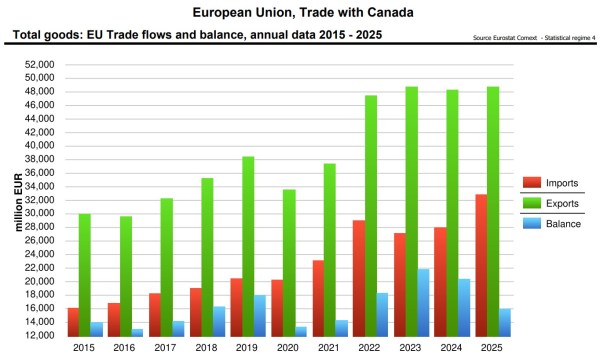
Von der Leyen said the alliance would be built upon the existing free trade agreement between the two blocs (the Comprehensive Economic and Trade Agreement, or CETA), which came into force in 2017 and has eliminated roughly 99% of tariff lines on goods between the EU and Canada.
Story continues below this ad
EU-Canada bilateral trade in goods and services touched €130 billion in 2025, up from €72.1 billion in 2016, when CETA was provisionally applied. EU’s goods exports to Canada have grown from €29.6 billion in 2016 to €48.8 billion in 2025.
The EU was also Canada’s second-largest trading partner, after the US and ahead of China, accounting for 7.9% of its total trade in goods with the world in 2024.
It sounds like a win-win situation. Closer ties could help Canada diversify away from the US, which accounted for 75% of its total exports, and secure access to European security technology and defence programmes.
And for the EU, it could mean easier access to resource-rich Canada’s mining sector which produces critical minerals.
Story continues below this ad
But what is an ‘associate member’’?
This is the part where the practical considerations come into play.
The EU is not just an economic but also a political grouping of 27 countries that have ceded sovereignty in certain issues to remain part of it. Nine others are official candidates for a full membership of the bloc — a process that normally takes years.
Two things complicate Canada’s case: First, it’s obviously not in Europe; and second, the term “associate member” does not exist within the EU as of now.
This means that such a status would first have to be created, with its legal and political contours clearly defined. Neither von der Leyen nor Carney have spoken about the political aspect.
Story continues below this ad
And getting all member states to agree on anything has been historically difficult. In fact, EU members have already pushed back against a proposal for “associate member” status for Ukraine floated by German Chancellor Friedrich Merz earlier this year.
“It [the term] has no legal basis,” Mujtaba Rahman, managing director for Europe at the Eurasia Group told The New York Times. “It’s more symbolism and signal.”
One EU diplomat expressed surprise at von der Leyen’s proposal, saying “nobody really knows what it means”. The diplomat told Reuters that there were concerns that the European Commission chief “is overpromising and won’t be able to deliver”.
Fabian Zuleeg, chief executive of the European Policy Centre think tank, told Reuters that he would not expect significant economic gains for either side, but that there was potential in “standing up together” against Trump’s economic coercion and in working together on economic security.
Story continues below this ad
However, he said one risk was that words were not followed by substance, which would “end up making us weaker rather than stronger.”


Surjit Bhalla writes: Release 2017-18 consumption data, put all doubt to rest
By Sohail Khan · 17 Sep
Delhi CM Rekha Gupta writes: An EV roadmap for a sustainable city
By Sohail Khan · 17 Sep
Leave a Reply