Can PSG win 3 Champions League titles, or does continuity and stability render them stale?
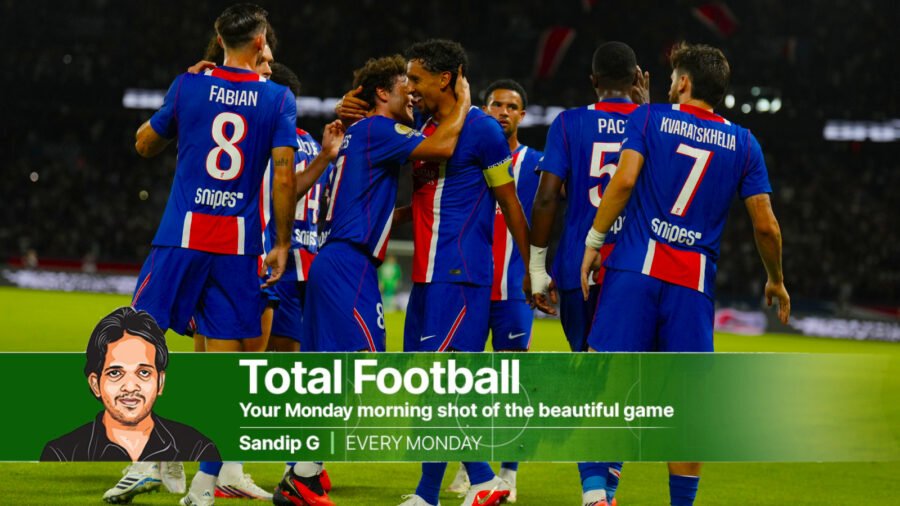
It was a night meant for celebrations. Banners of Luis Enrique, whose contract was extended that day with a staggering pay-raise that puts him in the 20-million-dollar stratosphere, rolled in the stands of Parc de Prince like a undulating wave. After all, the Spaniard was the man who brought joy into the stands, who transformed the upstarts into a continental elite.
Except the night ended mournfully, the surging Monaco upending the running five-time-champions ragged in a 2-1 win. Enrique called for calm—even though the defeat from their immediate competitors, stretching their winless streak to three games was hard for the devout to reconcile with. But Enrique’s words have a magic effect on those around. “I’m happy with what I saw. I saw a lot of positive things; for me, today, we deserved the win. But that’s football, it’s a wonderful sport,” he said after the game. Hope and belief sprung again.
Advertisement
But it was not the ideal preface to their Champions League opener. The fixture, as such, carries little fear or beads of cold sweat. The two-time champions encounter Slovan Bratislava, a club fifty years older than them which bore six different names through different eras, a reflection of territorial remapping in Central Europe. Managed by the familiar face of Yaya Toure. The game would be a footnote wherein the predominant theme would be if PSG could retain their crown and match the feat only three other clubs have achieved before (Real Madrid twice, Bayern Munich and Ajax).
The golden number is three. As much as in the immediate context of grabbing all three points for the first time this season as in the wider canvas of winning the Champions League for a third time on the trot. It’s a spectacularly elusive feat. In the Champions League era, only a wondrously star-dusted Real Madrid have achieved it. Not multiple AC Milan iterations of grandeur; not Lionel Messi’s Barcelona; not for Pep Guardiola, or Alex Ferguson. The Real Madrid squad was an ostentatiously gifted one; generational talents at their peak, shepherded by a name that breathes awe and respect in equal measure. Zinedine Zidane, whose philosophy fluxed but his commitment to winning strategies remained undimmed through his tenure.
After the third of the three titles, Zidane glorified “mentality” above other virtues that shone in them. “First, second, third… It was all about the mentality. Certainly, there was quality, all of them are world class, but to win three times, you need more. You need that mentality and belief.” Enrique could relate. There would be no shortage of motivation. That teams would not lose motivation to win once they become champions is a hollow myth as old as the hills. The core of his successive title-winning seasons at PSG remains the same. None are particularly old, injured or returning from injury. Barring French players, none had excruciatingly long World Cups. Apart from a rumoured rift between Enrique and French forward Ousmane Dembele, there aren’t any rumblings that threaten to disrupt the harmony in the squad. “Nothing, nothing. A perfectly happy squad,” he stressed at the start of the season.
PSG was quiet in the transfer market. The departure of Bradley Barcola headlined their window, where the incomings included Ferran Torres, Mika Godts and Maghnes Akliouche. All good players, but none that elevate their already lofty stature.
Advertisement
A happy side; but a stale one too in the opening games. PSG was quiet in the transfer market. The departure of Bradley Barcola headlined their window, where the incomings included Ferran Torres, Mika Godts and Maghnes Akliouche. All good players, but none that elevate their already lofty stature. None that could keep the first-choice players on their toes. A team that stayed pretty much the same over a long period brings stability and continuity, but it could, funnily enough, inject stasis too. Players in their comfort zones, over-familiar with each other, and unchallenged in their roles. Considering that their defensive bulwark, Marquinhos, is 32, it was surprising that they didn’t acquire a high-class centre back. But their biggest detriment to the holy third would be themselves, the enemy within, the subconscious ennui, the residual drain of those trophy-hoisting limbs, the heaving pressure, and Enrique himself said, “too much positive energy.”
Simultaneously, their rivals on the European stage have revitalised. Rodri’s acquisition has made Barcelona fearful. Barcelona, who PSG duel in the group stages and potentially later in the tournament, have rolled off to a shellacking start, pumping 17 goals in four league games. Real Madrid could find their groove in Champions League, under Jose Mourinho, less theatrical but more resolved in his demeanour. Last edition’s finalist Arsenal have steeled their midfield, but without adding attacking reinforcements. Nonetheless, they remain a side capable of mounting a serious title challenge. Manchester City’s last-dash shopping has stacked their midfield with glittering riches. If Enzo Maresca could beat them into a soulful tune, embed them with rhythms, City could be serious title challengers. Bayern Munich could be smarting for revenge after their semifinal exit in the last instalment.
The group stage pairings look straightforward with only Barcelona and Manchester City posing considerable threat. But the real business would begin in the knockouts, where the shadow of the figure three would assume a monstrous proposition. The immediate meaning of three would be gaining full points for the first time this season. The bigger three could wait. And bigger celebrations.



Leave a Reply