Can NRIs save tax by gifting shares to parents?

Synopsis
While giving shares to your parents who reside in your home country might appear as a thoughtful gesture, it has substantial tax considerations for NRIs. Although the gift itself isn’t taxable, comprehending the nuances of acquisition costs and the period they’ve been held is vital.

Gifting shares to your parents may look like a simple family transfer, but for an NRI, it can have important tax implications later.
There is also an important distinction between avoiding tax on the transfer and reducing the family's overall tax liability.
So, can an NRI legally reduce tax outgo by gifting shares to resident parents? Here is what you need to know.
Is gifting shares to parents taxable for the NRI?
The transfer of shares by way of a genuine gift does not itself trigger capital gains tax for the NRI, according to Aarjav Jain, NRI Tax Expert, Dinesh Aarjav and Associates Chartered Accountants.
“There's a common misconception that gifting shares to your parents is somehow a taxable event — it isn't, on either side. The moment of transfer itself is exempt: Section 47(iii) keeps it out of capital gains for the NRI, and Section 56(2)(x) keeps it out of the parents' income too, since parents are treated as relatives under the Act,” Jain said.
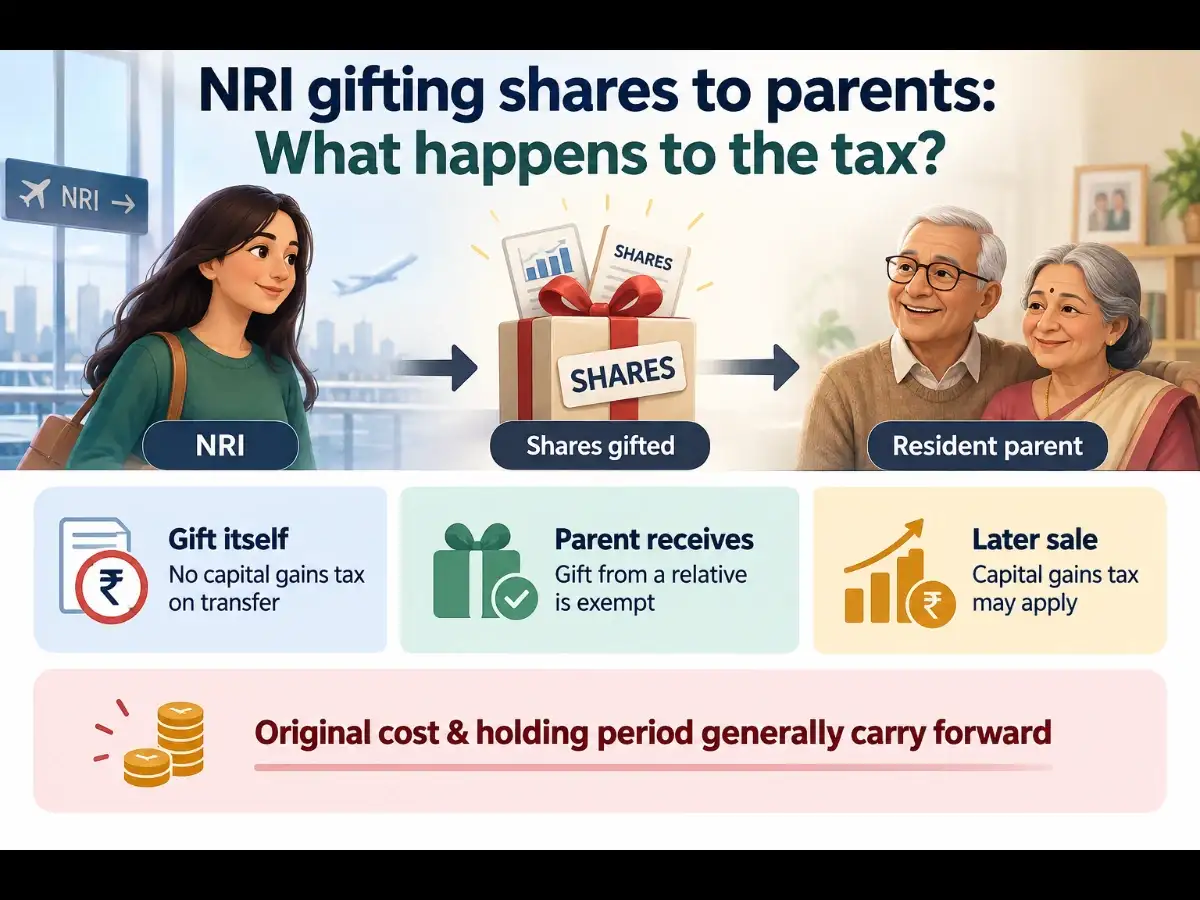
NRI gifting shares to parents: What happens to the tax?
For the parent, too, a genuine gift from a son or daughter is covered by the relative exemption under Section 56(2)(x). The value of the shares does not by itself make the gift taxable.
But this does not mean that the shares become tax-free forever.
What happens to the shares' original purchase price?
The parent does not get a new cost of acquisition equal to the market value of the shares on the date of the gift. Instead, the tax cost generally carries over from the NRI.
Under Section 49(1), the parent's cost of acquisition is linked to the cost at which the previous owner acquired the shares.
For example, suppose an NRI bought shares for ₹5 lakh several years ago. The shares are worth ₹12 lakh when they are gifted to the parent.
The parent's tax cost does not become ₹12 lakh merely because that is the value on the gift date. The original acquisition cost of ₹5 lakh continues to be relevant when the parent later calculates the capital gain.
This means the holding period is generally counted from the date the NRI originally acquired the shares, and not from the date of the gift. So, gifting the shares does not restart the holding-period clock for the parent.
Will the parents pay tax when selling the gifted shares?
Gifted shares do not automatically give the parents a capital gains tax exemption.
For listed equity shares, the applicable capital gains rules depend on the type of gain and the holding period. For long-term capital gains on specified listed equity investments, the applicable exemption and tax rate need to be considered for the financial year in which the parent sells the shares.

Tax benefit that may arise from the parent's overall tax position
Where the saving actually comes from is different, according to him:
·Basic exemption limit: If the parent has little or no other income, the ₹1.25 lakh LTCG exemption plus their basic exemption slab (which can absorb other income types) can mean a meaningful chunk of the gain escapes tax altogether — something that wouldn't happen if the NRI sold the same shares directly, since NRIs don't get the benefit of the basic exemption slab against capital gains in the same way resident individuals with no other income do.
·Deductions and rebates: Resident parent's basic exemption limit can, subject to applicable conditions, be adjusted against eligible long-term capital gains where the parent's other income falls below that threshold, potentially reducing the taxable portion of the gain. While the Section 87A rebate is not available against tax on such LTCG, it may apply to eligible tax on the parent's other income, depending on the applicable tax regime and total income — potentially affecting the family's overall tax liability.
·No clubbing back to the NRI: Unlike gifts to a spouse or minor child — where Sections 64(1)(iv) and 64(1A) pull the income straight back into the donor's hands — gifts to parents are not covered by the clubbing provisions at all. This is precisely why gifting to parents (or adult children) works as a strategy, while gifting to a spouse or minor child does not.
However, the exact benefit has to be calculated based on the parent's total income, type of shares, nature of capital gain, tax regime and applicable rules for that financial year.
That said, the transaction must genuinely transfer ownership to the parent. It should not merely be a paper arrangement where the NRI continues to control the shares and their proceeds.
The gift must be genuine, and documentation matters
A tax-exempt gift still needs a proper paper trail.
Jain cautioned that the protection depends on the gift being a genuine transfer of ownership. If the shares are transferred to the parent but there is an informal understanding that the sale proceeds will ultimately return to the NRI, the arrangement could invite questions.
“If the shares technically move to the parents but the money eventually finds its way back to the NRI — say, the parents sell and remit the proceeds abroad, or the whole thing looks engineered to just redirect income while the NRI stays in control — that's no longer a gift in substance,” Jain said.
For this reason, NRIs should ensure that the shares are actually transferred into the parent's own demat account and that the parent has genuine ownership and control over them.
A formal gift deed should clearly record the parties, the shares being gifted, the fact that the transfer is without consideration and the relationship between the donor and recipient.
Goel also recommended maintaining the supporting records, particularly for larger transactions.
The NRI should retain:
·the gift deed;
·details of the shares, including company and ISIN;
·original purchase contract notes and statements;
·proof of the NRI's ownership before the gift;
·records of the off-market demat transfer; and
·relevant KYC and banking documentation.
These records can become important years later when the parent sells the shares and has to establish the original cost and holding period.
For an NRI considering this strategy, the practical checklist is therefore straightforward: document the gift, actually transfer ownership, preserve the original purchase records, calculate the parent's potential tax before transferring the shares, and check FEMA and overseas tax rules where applicable.
(Join our ETWealth WhatsApp channel for all the latest updates)
Add 

(Catch all the Personal Finance News, Breaking News, Budget 2025 Events and Latest News Updates on The .)
…more

WATCH: iPhone 18 fever grips India from 5 am
By Sohail Khan · 18 Sep
Taxman jail defaulters now while recovering tax
By Sohail Khan · 18 Sep
Kore Digital shares crash10% on Sebi’s Rs 541 crore revenue charge
By Sohail Khan · 18 Sep
Leave a Reply