Bringing the margins into the mainstream
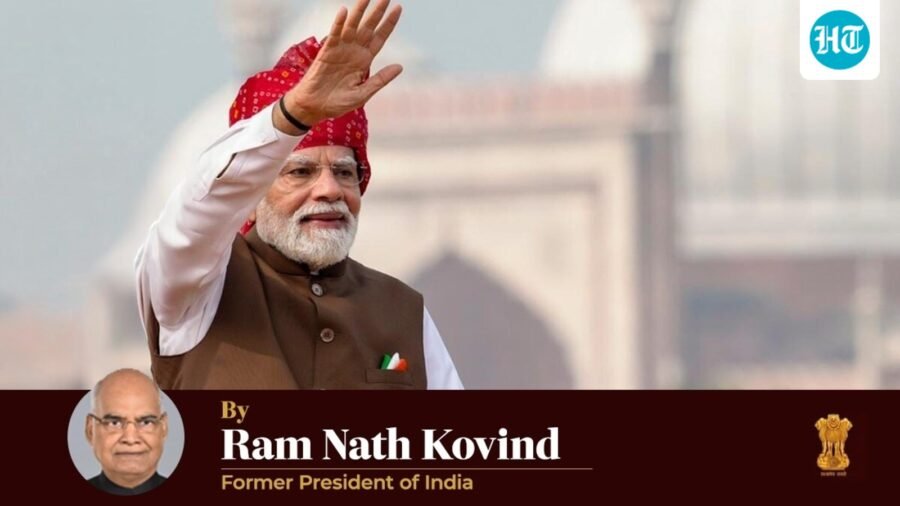
Inclusion of those whom governance delivery did not reach for decades marks the Modi era, writes Ram Nath Kovind
Updated on: Sep 17, 2026, 08:21:22 IST
Prefer HTon Google
Share via
Copy link
The most enduring achievement of the Narendra Modi era may not be found in any single road, scheme, reform or infrastructure project. It lies in the expansion of the Indian mainstream itself. I watched him closely as the Prime Minister (PM) for five years from 2017 to 2022, during my term as the President. I would like to share some thoughts on the occasion of his birthday. Over 25 years at the helm of elected governments — from Gujarat in October 2001 to the Prime Minister’s Office since 2014 — PM Modi has consistently advanced sabka saath, sabka vikas (everybody’s participation, everybody’s progress).
Another formulation defines his politics of inclusion: Jisko kisi ne nahi poocha, usko Modi ne pooja (Modi served those whom nobody asked after). Those who were unheard, unseen or underserved did not remain at the margins of India’s development story. And this is perhaps the most consequential shift in the Modi era.
For decades after Independence, India’s development imagination often had an implicit centre and a periphery. Some regions were seen as distant. Some villages remained too remote to receive the full benefits of State capacity. Some aspirations simply did not find a place in the national conversation. It is this hierarchy that the Modi government has sought to change.
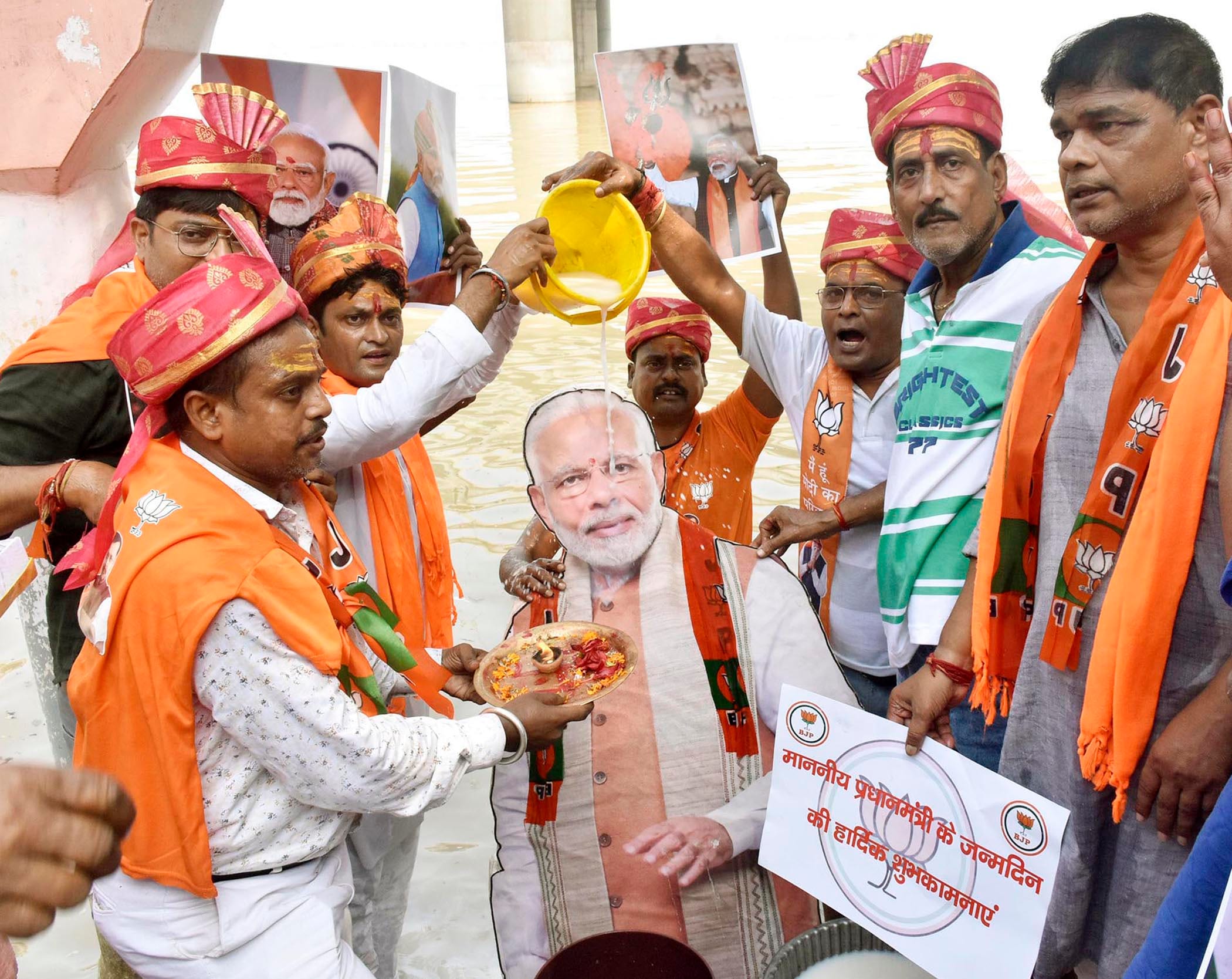
The governing ideal has increasingly been one of saturation rather than selectivity, inclusion rather than exclusion, and empowerment rather than mere entitlement. The question is no longer simply about the launch of programmes, but whether every beneficiary has actually been reached.
Few examples illustrate this better than the Northeast. For decades, the Northeast was too often discussed as India’s distant periphery. Under PM Modi, it has increasingly been articulated as India’s gateway to South-East Asia. His 83 visits to the region since November 2014 have underlined a sustained push for connectivity, infrastructure, investment and peace. The region has witnessed 12 major peace agreements, while more than ₹7 lakh crore has been allocated for development between 2014-15 and 2025-26, compared with around ₹1.4 lakh crore in the previous decade.
The infrastructural map of the Northeast is changing as well. The Bogibeel Bridge and Sela Tunnel have overcome formidable geographical barriers. Mizoram received its first direct railway connection to the rest of India when the Bairabi-Sairang line was inaugurated. Nagaland got its first railway station after Independence in the Modi era. AIIMS Guwahati became the first AIIMS in the Northeast.
Assam’s semiconductor plant represents the idea that one of India’s most technologically advanced industries can emerge from a region once treated primarily as geographically remote.
The same inversion of perspective is visible along India’s borders. For years, remote settlements were commonly described as the country’s “last villages”. The Modi government deliberately changed such vocabulary and the policy priority accorded to these villages. These are now India’s “first villages”.
The Vibrant Villages Programme gives this idea institutional form through roads, connectivity, tourism, livelihoods and essential services in remote border areas. The principle extends inland through the Aspirational Districts Programme. Instead of accepting 112 historically underdeveloped districts as permanent laggards, the programme introduced measurable outcomes, convergence and competitive development to accelerate progress in health, education, infrastructure and livelihoods. In 2023, this approach was taken deeper into the administrative system through the Aspirational Blocks Programme, covering 500 blocks across 329 districts.
The message is clear: geography cannot be a permanent disadvantage.
The same philosophy is visible in the treatment of tribal communities. The shift has been from episodic welfare to sustained, targeted and whole-of-government intervention. The ministry of tribal affairs budget has grown by 243% over the last decade. The Pradhan Mantri Janjati Adivasi Nyaya Maha Abhiyan covers all 75 Particularly Vulnerable Tribal Groups (PVTG), focusing on housing, roads, water, health care and other necessities. The Dharti Aaba Janjatiya Gram Utkarsh Abhiyan takes this approach further by addressing long-standing gaps in tribal-majority villages and PVTG habitations through coordinated government intervention.
The underlying philosophy is to give communities at the margins the capabilities to participate fully in the country’s future.
More than 59 crore Jan Dhan accounts have brought previously excluded households into the formal financial system. Government assistance reaches beneficiaries directly through the Direct Benefit Transfer, which has contributed to cumulative savings of more than ₹5.14 lakh crore by plugging leakages.
The scale of financial inclusion is matched by the scale of basic-service delivery. Saubhagya achieved 100% rural electrification. Ujjwala has provided clean cooking fuel to more than 10 crore households. Jal Jeevan Mission has extended tap-water connections to 13 crore rural households. These programmes embody one common principle: Find those left out and take governance benefits to them. The objective is to ensure that no eligible person is left out.
The transformation is equally significant in the case of women. For generations, women were often positioned primarily as recipients of welfare. The Modi government’s larger intervention has made them stakeholders instead of beneficiaries and entrepreneurs instead of recipients.
Swachh Bharat Mission addressed an issue intimately connected with women’s dignity, safety and health. MUDRA has enabled women to participate in entrepreneurship at unprecedented scale. Women also constitute 46% of PM SVANidhi beneficiaries. The Lakhpati Didi initiative places women’s economic empowerment at the heart of rural transformation.
Seen individually, the North-East, tribal communities, border villages, women, rural households and financially excluded citizens represent different policy challenges. Seen together, they reveal the larger architecture of the Modi government’s governance philosophy: Sabka saath, sabka vikas asks who has not been reached, who has not been heard, and who remains outside the opportunity structure of a rising India.
The lasting legacy of the Modi era, therefore, is the redefinition of the Indian mainstream. Development is no longer imagined as something that begins at the centre and eventually reaches the periphery. The periphery itself is now at the centre of India’s development ambition.
As India looks towards Viksit Bharat 2047, the ambition is to ensure that the India being built belongs equally to those who were once least visible in its development story. That is the Modi era’s defining proposition: Those who were once at the margins are no longer waiting to enter India’s mainstream; they are helping define it.
Ram Nath Kovind is former President of India. The views expressed are personal
Get Current Updates on India News, Elections 2024, Lok sabha election 2024 voting live , Karnataka election 2024 live in Bengaluru , Election 2024 Date along with Latest News and Top Headlines from India and around the world.
See Less

‘Is it normal to have a blood sugar level of 110 at age 54, or am I diabetic?’
By Sohail Khan · 17 Sep
Why are moths attracted to bright lights?
By Sohail Khan · 17 Sep
US Federal Reserve hikes interest rates — but will RBI follow suit?
By Sohail Khan · 17 Sep
Leave a Reply