Beat Federer twice, rattled Nadal on clay, and shocked a reigning Slam champion; then he tossed it all away
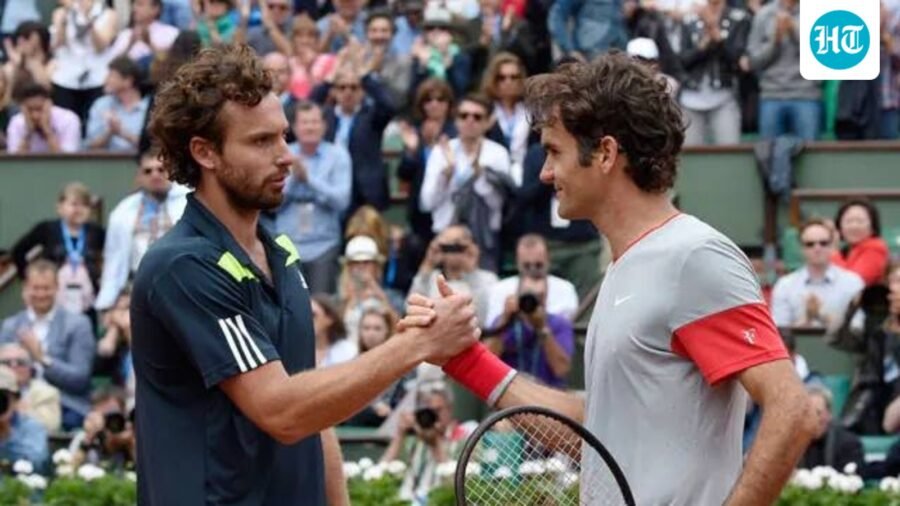
He was Nick Kyrgios before Nick Kyrgios: immense talent, giant-killing wins and endless controversy, but a career that never came close to its promise.
Updated on: Sep 2, 2026, 17:57:10 IST
Prefer HTon Google
Share via
Copy link
Sport has a habit of throwing up names who look destined for greatness — the technique that sets them apart, the flashes of brilliance that build a wave of hype — only for them to vanish before they ever get there. Most fade quietly into obscurity. A few crash spectacularly, taking down giants along the way. Few have captured that second kind of story better than Ernests Gulbis — in many ways, he was Nick Kyrgios before Kyrgios ever arrived on tour.
Gulbis had the game to trouble even the best on their day — a booming serve, a fearless backhand, powerful and aggressive from the baseline. And he proved it. The Latvian, who reached a career-high ranking of world No. 10, beat Novak Djokovic, with whom he had trained as a teenager in Munich, got the better of Roger Federer twice — one of those at a Grand Slam — and more than once pushed Rafael Nadal to the brink on clay.
But Gulbis cared little for the sport, and even less for his own talent. For a player who treated tennis like a hobby, an afterthought, the sport gave little back in return. The wave of promise that built around him crashed just as fast as it had formed, and he disappeared.
The kid who beat the reigning Australian Open champion
Gulbis and Djokovic trained together as teenagers at the Niki Pilic Academy in Munich, sharing courts long before either of them meant anything on tour. They eventually went different ways — but before that gap opened up, there was a moment in January 2009 when Gulbis first created real optimism around his game. Taking on defending Australian Open champion Djokovic, then the world No. 3, in the first round of the brand-new Brisbane International just weeks before Djokovic's title defence, Gulbis pulled off a 6-4, 6-4 upset — his biggest win to date.
It remains, to this day, his only win over Djokovic in eight career meetings.
The stunner in Rome
Gulbis went one better a year later, in his first real breakthrough. Ranked a modest world No. 40, he walked onto the Foro Italico courts in April 2010 and stunned top-ranked Roger Federer in three sets — the Swiss star's first opening-round exit at the tournament in eight years. Federer left the press conference admitting his game simply wasn't there that day.
In the same tournament, Gulbis ran into Nadal in the semi-final and pushed the King of Clay to three sets before falling 6-4, 3-6, 6-4. Nadal walked away rattled enough to call him "top-10 material" afterward — a fair admission of how close the Spaniard had come to an upset. The set mattered more than it looked at the time: Nadal went on to complete a perfect 22-0 European clay season that year, sweeping Monte Carlo, Rome, Madrid and the French Open without losing a single match — and dropping only two sets along the way. One of them belonged to Gulbis.
His clay-court pedigree carried through the years. Gulbis had reached the French Open quarter-finals in 2008, but bettered it in 2014, when he reached the semi-finals — beating Federer in a five-set fourth-round classic along the way, then dispatching Tomas Berdych to book his first, and only, Grand Slam semi-final. Djokovic ended the run there, but Gulbis left Paris with a career-high ranking of world No. 10 and, for a brief stretch, real belief that he belonged among the sport's elite.
The salty Nadal exchange
Like Kyrgios would later become known for, Gulbis also had a spicy history with Nadal. A year before his best-ever Grand Slam run, in the 2013 Rome third round, he raced to a stunning 5-0 lead in the opening set, twice breaking Nadal's serve, and served it out 6-1 in just 34 minutes — one of the worst opening sets of Nadal's career on clay. Gulbis then surged to a 5-3 lead in the second, with Nadal, still to record a single break, staring at a genuine upset. At times Nadal was returning from so far behind the baseline that Gulbis was stepping in to attack the open court. But the Spaniard, playing his way back from a long injury layoff, dug in to win 1-6, 7-5, 6-4.
The loss triggered a memorable exchange in the press room. "I thought I was the better player in the match," Gulbis said. "But he is the champion, and — well, I lost against him in Indian Wells when I also thought I played better than him. He is solid, he didn't do anything special, I made mistakes, and so he won."
It didn't sit well with Nadal, who fired back that Gulbis needed to "pace himself" and "be a little bit more calm" if he wanted to fulfil his obvious talent.
A career as loud off the court as on it
On court, there was never any certainty about which version of Gulbis would turn up — the one who could beat the best players in the world, or the one who would lose tamely to someone ranked outside the top 200 the very next week. What was certain was his temper. "I have to break at least one racket on every court in the world," he once joked, after smashing his frame to pieces and handing the pieces to a fan in the crowd.
Off the court, his opinions caused as much noise as his results. In 2013, he called the Big Four "boring," telling Sports Illustrated tennis was missing the fire of boxing or basketball, that players needed to say "I kicked his ass" instead of politely praising an opponent. A year later, at the same French Open where he reached his career-best semi-final, he sparked a very different kind of controversy — suggesting he didn't want his own sisters following him into professional tennis because he felt the sport was too tough a life for women. In 2009, he had also been arrested in Sweden for soliciting a prostitute during a tournament week, calling it a "misunderstanding" before paying a fine and returning to the court.
Where it all ended
For all the promise he flashed against the Big Three, injuries, inconsistent form, and — by his own admission — a lack of motivation kept Gulbis on the fringes of the sport for most of his career.
By 2017, he had slipped outside the world's top 500, and the closest he came to reliving his old glories was a shock first-round win over Juan Martin del Potro at Wimbledon, watched by a stunned Centre Court crowd. He spent his final years drifting through Challenger events before quietly stepping away. He confirmed his retirement in 2024, more than a year after his last competitive match — closing the book on a career that once had Nadal rattled and Federer beaten twice.
See Less


Leave a Reply