Arunachal’s Upper Subansiri project gets green nod recommendation, 1.35 lakh trees at risk
Story continues below.
Subscribe to see fewer ads.
Even as the forest clearance proposal is under scrutiny, compensatory afforestation has been proposed across 14 districts of Madhya Pradesh. Under the Van (Sanrakshan Evam Samvardhan) Adhiniyam, compensatory afforestation is permitted in other states if land is not available. However, if equivalent non-forest land is unavailable, then the compensatory plantation has to be raised on degraded land, which is double the extent of the diverted forest land.
Compensatory afforestation
Thus, 5,466 hectares of degraded forest land in Madhya Pradesh have been proposed for compensatory afforestation, according to records.
Compensatory afforestation has been proposed across 144 sites in 14 districts of Madhya Pradesh – Guna, Rewa, Singrauli, Sidhi, Seoni, Damoh, Annupur, Sagar, Shivpuri, Dewas, Neemuch, Satna, Seoni, Shahdol, Barwani, and Ashoknagar districts.
Concerns over tree felling
The committee observed that the proposed tree felling may have implications for forest structure, habitat continuity, biodiversity, wildlife movement and associated ecosystem services. It advised National Hydroelectric Power Corporation (NHPC) to formulate a comprehensive, site-specific and time-bound Ecosystem Restoration and Biodiversity Management Plan, incorporating measures for avoidance and minimisation of tree felling, phased restoration of disturbed areas, assisted natural regeneration, plantation of suitable native species, soil and moisture conservation, control of invasive species and appropriate compensatory measures.
Story continues below this ad
Incidentally, until February 2026, Arunachal Pradesh had not complied with compensatory afforestation conditions for the Subansiri Lower project under implementation by NHPC downstream, and the Environment Ministry had sent six reminders about it, had reported in February.
While appraising the project, the EAC noted the Supreme Court’s August 2009 directive that “any proposal on the upper stream of the Subansiri River would be considered independently on its own merit by the standing committee as and when submitted by the proponents.”
This directive pertains to the appraisal of the projects upstream of Subansiri Lower by the standing committee of the National Board for Wildlife. The committee had permitted the Subansiri Lower project on the condition that there would be no upstream projects constructed in the future.
However, the Arunachal Pradesh government got this condition modified before the Supreme Court, subject to the condition regarding appraisal of upstream projects by the wildlife board.
Story continues below this ad
The EAC also noted that the water discharge due to glacial lake outburst flood was assessed, along with peak flood discharge and scenarios of impact of dam breach on the downstream Subansiri Lower hydel project, as per minutes of the meeting.
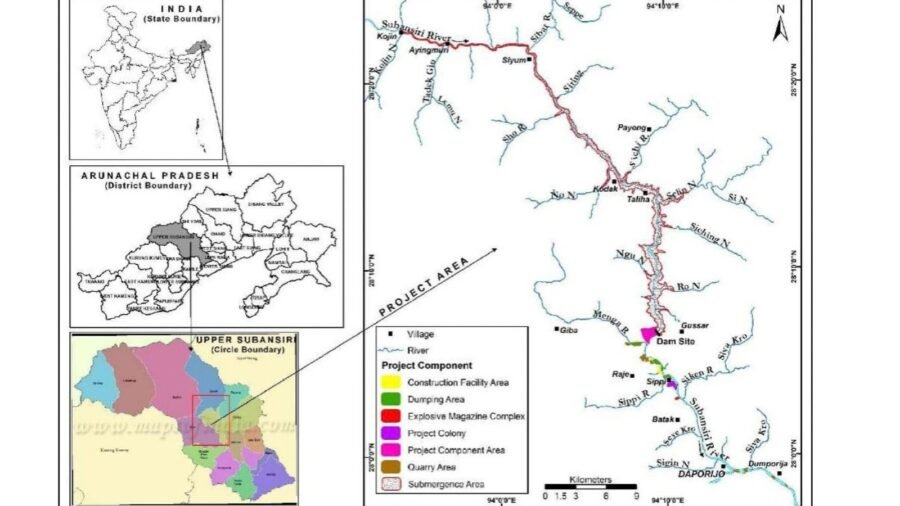
The project envisages construction of a 237-metre-high storage dam from the deepest foundation level on the Subansiri River. The reservoir surface area is 22.2 sq km at full reservoir level (FRL), whereas the reservoir length is around 50 km at FRL, as per the project documents.
Upper Subansiri project
Upper Subansiri is one among the cascade of projects proposed on the Subansiri river basin, which is a key tributary of the Brahmaputra River. The Dengser hydel project is proposed immediately upstream of the Upper Subansiri, while above it, the Oju, Niare, Naba, and Nalo are also proposed. Downstream, the Subansiri Lower has been approved and is under implementation, and the Kamala hydel project, formerly known as Middle Subansiri, is under implementation on the Kamala River, a tributary of the Subansiri.
The project was initially conceived in the 1980s as a single, large project for flood moderation. However, subsequently, it was decided to split it into Subansiri Upper, Middle (which is now the Kamala project), and Subansiri Lower, which is built at Gerukamukh village on the Assam-Arunachal Pradesh border. As per the minutes of the EAC’s meetings, 1,139 households are likely to be affected due to land acquisition for the hydel project.
Story continues below this ad
Other than the Upper Subansiri, the 2,220 MW Oju hydel project approved upstream, the 2,000 MW Subansiri Lower project, and the Dibang Multipurpose project are some of the large hydroelectric projects approved or under implementation.

Son of a Jharkhand cop went for Maggi. Then he got killed
By Sohail Khan · 25 Sep
Jhansi-Agra Cantt Express train extended up to Mathura, check new stops and timings
By Sohail Khan · 25 Sep
Bhuj-Barauni Amrit Bharat train approved: Check route, stops, timings and frequency
By Sohail Khan · 25 Sep
Leave a Reply