Arts of combat: Keralites try their hand at new martial arts
There is a moment in the 2023 Marko Zaror-starrer Chilean martial arts flick The Fist of the Condor (El puño del condor) where the antagonist, played by Eyal Meyer, leaps high in the thick of a fight, twists his outstretched body mid-flight and drops into a neat Ashwa Vadivu. Kalaripayattu practitioners will quickly identify the ‘horse stance’ as something singular to their art. But Chile in Andean South America is scarcely a place one instantly associates with the move.
“I had received a phone call from Marko, saying they were making a new movie and wanted to introduce different martial arts and techniques to the project. He had heard about me as an actor and my relationship with Kalaripayattu. He told me that we should first rehearse to see if this martial art would work for the movie.I immediately said, 'Sure, let’s go for it,'”Meyer, who first came into contact with the martial art in 2006 while studying acting and theatre at the University of Chile, told in a recent e-mail interview. Today, the actor runs Mauna Kalari in Santiago, the Chilean capital.
Back at home
While Kalaripayattu has been making ripples across the globe, back home in Keralam, its birthplace, a different kind of revolution is taking place on the local martial arts scene.
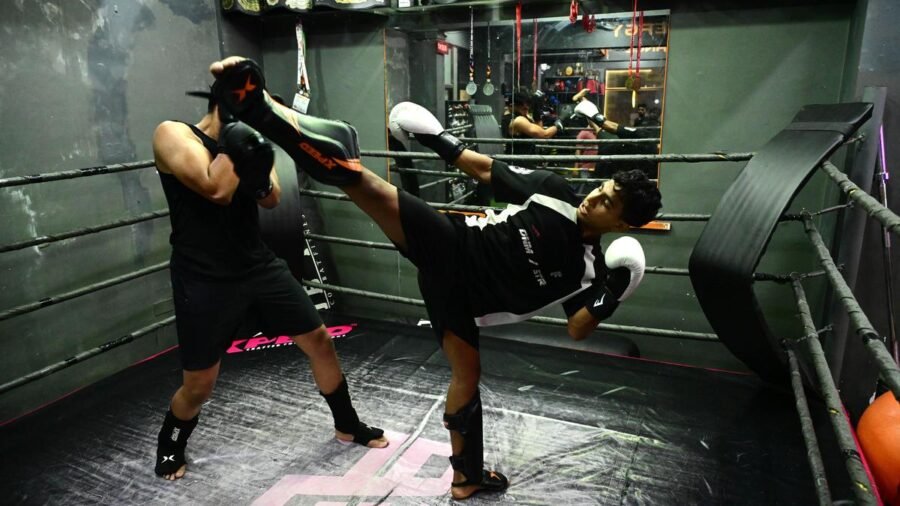
A sparring session in progress at the JB Fit Club in Thiruvananthapuram.
Jayamohan A.
In State capital Thiruvananthapuram, 19-year-old Muhammed Aiman S. plans to launch a rigorous three-month preparation soon for Sanda, a Chinese full-contact sport, for the University Games in December. Before the advent of the internet and social media, very few people would have heard of this sport. Now Sanda is a staple of the thriving combat sport environment in Keralam along with Mixed Martial Arts (MMA), Muay Thai and Brazilian Jiu-Jitsu (BJJ). “I will have two training sessions daily— one each in the morning and evening. Sanda is a speed game, with punches, kicks and take-downs,” explains Aiman, who fights out of the Johny Brothers Fight Club. A regular on the Muay Thai, Kickboxing and Sanda fight circuit, the psychology undergraduate began training in combat sports at a young age, amassing medals in the sub-junior and junior categories at the State and national levels. He recently won two of his three pro fights.
Win in Thailand
Ann Mary Philip from Edapally, Kochi, came to combat sports in her late thirties and went on to score a win in Thailand, the home of Muay Thai. Ann encountered kickboxing in 2018 while searching for a class for her son, Chris. Over the years, under the guidance of her coach Kiran V.S. of SpaRing combat sports gym, Ann evolved into Muay Thai, Boxing and the Russian combat sport of Sambo. At 42, she has now started training in BJJ. She first took part in a boxing tournament in 2024 when she was turning 40. “Forty is the age limit for amateur matches, but I had this great desire to experience boxing at least once. So my debut match was also my retirement match,” says Ann, who is a certified referee in Sambo and secretary general of the Sambo India Association.
People like Aiman and Ann represent the new breed of combat sports enthusiasts in the land of Kalaripayattu. Till a few years ago, the traditional martial arts (TMA) scene in Keralam was restricted to the big ‘Ks’— Karate, Kalaripayattu and Kung Fu— with Korean Taekwondo making a big entrance later on with its Olympic-sport tag. Today, MMA and Muay Thai clubs are all the rage in cities like Kochi, Thiruvananthapuram and Kozhikode and smaller towns, courtesy social media and YouTube. Unlike Karate classes of the 1980s or 1990s, which were usually conducted twice or thrice a week in school auditoriums after class hours or atop the roof of somebody’s house, today it is all about snazzy-looking gyms with floor mats, protective gear, weight racks, boxing rings and a bevy of heavy bags lining the wall for punching and kicking.
“MMA is by far the most popular because of the Ultimate Fighting Championship,” says Joys Varghese, founder of Spartans Martial Arts and Fitness. A recognised referee in combat sport events such as MMA and Muay Thai, he himself had begun his martial arts journey with Karate. Joys says he switched to MMA because he wanted something practical and would work in a real-life scenario. “Youngsters today are not interested in spending time on the forms (set routines) in Karate and Kung-Fu. They want faster, workable results,” says Joys.
Combat sport gyms
In these new combat sport gyms across Keralam, the emphasis is on what works inside the octagonal MMA cage, the boxing ring or on the mat. The romance of Shaolin Temple-inspired spiritual quests through martial arts takes a back seat here. Television and social media platforms dedicated to combat sports have played a big role in encouraging the younger generation to try out and even pursue careers in these money-spinning sports.
MMA is precisely what the name suggests: an eclectic mixture of punches, kicks, knees, elbows, wrestling takedowns, locks and chokes. Muay Thai, the art of eight limbs, first caught the imagination of Indian youth through movies of Thai star Tony Jaa. Real-life fighters such as Saenchai, Buakaw Banchamek, Tawanchai and Rodtang Jitmuangnon, who enjoy a global following, are as familiar to combat sport buffs in today’s Keralam as the legendary figures of Kalaripayattu lore, Thacholi Othenan or Aromal Chekavar.
“Social media is the biggest reason for Muay Thai (or Thai Boxing) becoming so popular today,” says Binu Joseph, president of the Kerala State Muay Thai Association.
Binu had started training in Muay Thai in 2009 in Bengaluru. “I was already doing Karate and Kickboxing at the time. In 2014, we conducted the first Muay Thai refereeing seminar at Kalikavu in Malappuram district. Coaches from nine districts participated in it. Today, Muay Thai is one of two combat sports that are in high demand among youth in Keralam, the other being MMA,” he says. The association was also formed the same year. “Before social media, people here did not have much awareness about martial arts beyond Karate, Kalari or Kung Fu. That is not the case nowadays. They know about other sports that are effective and engaging,” he observes.
To train at clubs abroad
With the world becoming smaller, Keralites are also increasingly travelling to places such as Thailand and Japan to train at clubs there. Binu himself has been to Thailand twice. Ann went to Thailand in 2024 to attend a camp. “They have fight nights every week. I registered, and I got a Muay Thai bout at the Bangla stadium which I won in the minus-50 category,” says Ann.
Keralites’ craze for martial arts is nothing new. The history of Kalaripayattu goes back centuries. The post-Independence years of the 20th century saw a revival of interest in it, thanks to the efforts of teachers such as C.V. Narayanan Nair and Chirakkal T. Sreedharan Nair. How the current influx of foreign combat arts would influence Kalaripayattu remains to be seen.
In the late 1970s, Karate came to Keralam with a big bang, riding on the excitement generated by Bruce Lee’s 1973 movie Enter the Dragon. Notably, the Japanese martial art made its entrance not directly from Japan but via Tamil Nadu and Sri Lanka. “Those days, youngsters studied Karate in secret, as parents tended to frown upon it. Today, they are more receptive,” says K. Nagulanathan, who teaches the Shotokan style of Karate in Thrissur. Nagulanathan had come to Keralam from Kilinochchi in Sri Lanka in 1981 and settled here to teach Karate. He does not believe that the entry of sports such as MMA has displaced Karate. The number of students has, in fact, increased, although their aspirations have changed, he says.
But this is where things get really interesting. In the midst of this martial arts ‘outbreak,’ there is also heightened interest in Kalaripayattu in its homeland.
“There is a revival. During a visit to Bengaluru, I was astonished to see the number of people taking up Kalaripayattu. People are also more aware about Kalaripayattu’s influence on other art forms,” says S.R.D. Prasad, an octogenarian Gurukkal (senior trainer), who runs the Sree Bharath Kalari at Valapattanam, Kannur. His father Chirakkal Sreedharan Nair had established the Kalari in 1948. The renewed interest, he says, is due to many factors, not least the Union government picking Kalaripayattu veterans for the coveted Padma Awards. Recipients include Meenakshi Amma, Sankara Narayana Menon Chundayil and Prasad himself. Prasad adds that Kalaripayattu teachers have also been forced to adapt to changing requirements.
Renewed interest in Kalaripayattu
In Thiruvananthapuram, the CVN Kalari continues to be a go-to place for Kalaripayattu enthusiasts. G. Sathyanarayanan,the grandson of C.V. Narayanan Nair, concurs that there is a renewed interest in Kalaripayattu. “A lot of the interest in Kalari is fuelled by the internet,” he notes. While changing times indeed call for changed strategies, it is still preferable to start the training between the ages of eight and 16, says Mr. Sathyanarayanan, who is now the Gurukkal at CVN Kalari. “Because the body is still supple and Kalaripayattu is not like other sports. It is an integrated system, and the body has to be prepared for structured training.”
Chilean actorEyal Meyer during a Kalaripayattu training session.
Special arrangement
Back in Chile, Meyer dreams of a sequel to The Fist of the Condor. “I hope so! I always tell Marko (Zaror) and Ernesto (Ernesto Diaz Espinoza, the film’s director) that we should do a second part that has more fighting sequences using Kalaripayattu’s weapons like the urumi. I have not seen that showcased in Western movies,” he says. Meyer has trained with the Kozhikode-based Hindustan Kalari Sangam, which he first contacted in 2008. “I finally arrived there in August 2011, where I was received openly and with warmth by everyone,” he recalls. He has since been to Keralam a number of times. He has his own take on Kalaripayattu’s prospects. “I don’t agree with the argument that it is a relic art. It is such a wise and profound technology for the body and mind that I feel it is more current than one thinks,” he notes.
The dedicated band of district correspondents
By Sohail Khan · 4 Sep
Leave a Reply