Apple’s AI groundwork, OpenAI chip flex, and the joys of aeroplane contrails

The biggest AI conversations, decoded. 02 September 2026
Published on: Sep 2, 2026, 08:00:37 IST
Prefer HTon Google
Share via
Copy link
Cognitive warmup. Remember when as kids, looking up at the sky and seeing those long white streaks being made by an aircraft told us two things. First, it was really high up in the sky and secondly, it was a ‘transcontinental flight’. We were young, we lived in simpler times, these little joys meant a lot, with a hope for the future. Watching these contrails form and then slowly dissipate as the aircraft disappeared from sight on the blue canvas. Apparently, these contrails are a bad thing, and AI wants to solve them.
Google and the UK government are collaborating on what is likely to be a 30-month project in the Shanwick airspace above the northeastern Atlantic Ocean, to test ways in which aeroplanes don’t create these contrails anymore. Contrails are created when water vapour condenses and freezes around aircraft exhaust, particularly if the air is cold and humid. Research believes they can trap heat radiating from the Earth, thus warming the atmosphere, which also serves to aviation’s overall impact on the environment. Google will provide AI forecasting models to identify flight paths and regions that reduce contrail creation, and measure results.
PREVIOUSLY, ON NEURAL DISPATCH
Apple AI foundations, strengthened
On Apple’s 50 year milestone, I had (among many other things) noted that the company had almost 2.5 billion (and counting) devices across the iPhone, iPad, Mac and other product lines which are essentially ‘AI ready’. No other tech company has that sort of compatibility width and longevity. Many would see the M6, the M5 Ultra, the M5 Pro and the M5 Max silicon, and and the Mac mini as well as Mac Studio announcements from last week as just new devices, but one needs to look closely to know its the first step in adding to that 2.5 billion base. Apple will be aggressively refreshing the Mac and iPad line-ups in the next few months, alongside the new iPhones, and perhaps even widen the Home portfolio.
The new M6 chip is Apple’s first 2-nanometer architecture silicon. A 12-core CPU, a 12-core GPU, a new dual 16-core Neural Engine and up to 32GB of unified memory. The dual 16-core Neural Engine will deliver what Apple says it has up to 4.8x faster AI performance compared with the M4 chip generation, and spreadsheet calculations in Microsoft Excel are 1.5x faster too.
The M5 Pro chip is meant for power intensive workflows such as complex video edits, animation and filmmaking, with more CPU and GPU cores, with up to 4x faster AI performance as well as 1.5x faster image processing compared with an M4 Pro. The M5 Pro has an 18-core CPU with an up to 20-core GPU with neural accelerators in each GPU core optimised for AI workflows that include large diffusion models or photo and video upscaling. It is very much on the agenda for running larger local large language models (LLMs) on a Mac mini.
The 3-nanometer M5 Max brings what is an up to 30% faster CPU with 18-cores alongside ‘Super Cores’ for performance, a 50% faster GPU with up to 40-cores, a 20% faster Neural Engine and a collective of this delivering a 4x improvement in AI performance. This can be configured with up to 128GB of unified memory, and remains the benchmark for performance-per-watt metrics.
The ‘Ultra’ silicon continues to use Apple’s two dual-die architecture, in this case the next generation UltraFusion Architecture bringing together two M5 Max chips to make the M5 Ultra. Generationally, this has a 30% faster CPU with up to 36 cores (that’s 12 Super Cores and 24 performance cores), an 80% faster GPU with up to 80 cores that brings neural accelerators to the Ultra chip for the first time, with up to 512GB of unified memory. All this comes together for what is an up to 4x faster AI compute performance than the M3 Ultra.
This is the most powerful SoC, or system on chip, that Apple has ever created. The new UltraFusion Architecture increases this connection density by over 6 times and also increases bandwidth to over 4 terabytes a second. In tandem, these ultra-low-latency, high-bandwidth interconnects allow the four dies to work as a unified processor. Apple is pitching this for the sort of workloads that involve immersive video editing using Final Cut Pro, or running frontier LLMs with more than 1 trillion parameters locally.
A numerical takeaway: Here’s something to get all those anti-Apple minds a bit riled up. If you’re serious about local AI (and ready for the expense that comes for such a setup), a fully configured Mac Studio with the M5 Ultra (36-core CPU / 80-core GPU / 1TB SSD) with 256GB unified memory, and 1.2TB/s memory bandwidth, will cost around $10,700. An Nvidia RTX Pro 6000 Blackwell GPU (only; GPU only) with 96GB GDDR7 memory, with 1.79TB/s memory bandwidth will cost you around $16,000. Value may not be the first word that comes to your mind. You can see what Apple has tried to do, and delivered.
THE LATEST, ON WIRED WISDOM
OpenAI’s Jalapeño silicon
Even though the Jalapeño was announced in June, all of a sudden on August 25, OpenAI suddenly decided to tell us that this chip made in partnership with Broadcom can help OpenAI’s models deliver faster responses than rival AI models. Great, but what does this mean? and more to the point, why now? I’ll answer the second question first. It’s a two part answer—talk about their chip development just days before Nvidia’s earnings call (though I’m not sure what purpose that serves), and most likely also to deflect from the executive exodus that I had noted in our conversation on Aug 19 (do read, you might not want to miss the humanoid robots bit).
OpenAI has used the InferenceX benchmark to show an AI system’s ability to handle inference and compares Jalapeño against Nvidia’s GB300 and GB200 chips across the GPT-OSS (120 billion parameters), DeepSeek R1 670B and Kimi K2.5 1T models. OpenAI says Jalapeño delivered 1.5 to 1.9 times more AI work per watt at peak throughput and 1.7 to 3.6 times lower end-to-end latency than the comparison systems. For highly interactive workloads, it delivered 2.1 to 4.1 times higher performance.
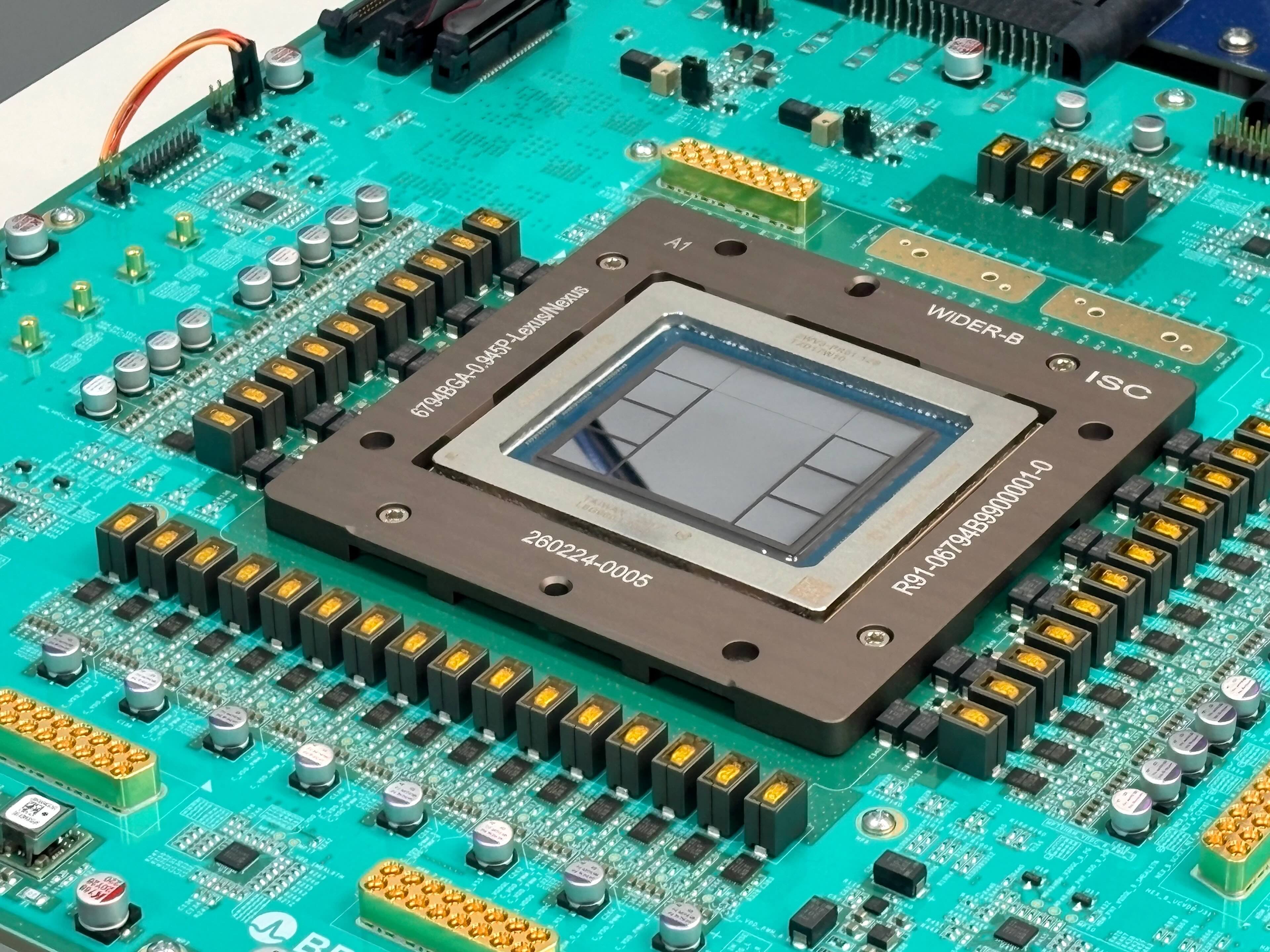
Important to distinguish that Jalapeño is an Application-Specific Integrated Circuit (ASIC), designed for AI inference. The AI company believes this chip can give them a broader full-stack advantage, meaning they can design models, products, serving software, chips, memory, networking, and systems together, using learnings from real workloads. “Jalapeño is working first-party silicon with measured results, and it is the beginning of a multigenerational platform,” OpenAI says in a statement, adding, “ In the months ahead, we will ramp Jalapeño to deliver faster, more capable, and more efficient products for our customers.”
What does this mean for an Nvidia proximity? They have a typically broad spectrum view, with a hint of humanitarian concern for good measure. “Meeting growing demand for AI will require more compute from every available source. We will continue to widely deploy accelerators from NVIDIA and other partners for both training and inference workloads. Our mission is to ensure that artificial general intelligence benefits all of humanity,” they say.
OpenAI confirms that Jalapeño Gen 2 is in deep development, while the Gen 3 plans are already taking shape.
It’ll be interesting to see when (and a big if) Google or AMD respond with regard to these performance claims, in the context of what OpenAI has claimed. Google has the Google TPU v5p & Trillium (TPU v6e) tensor processing unit, while AMD’s top-tier accelerators include the AMD Instinct MI300X and MI325X.
See Less


Grand Canyon’s flood paradox strands all
By Sohail Khan · 2 Sep
Leave a Reply