AI ‘thinking’ words it never says: What this tells us about consciousness
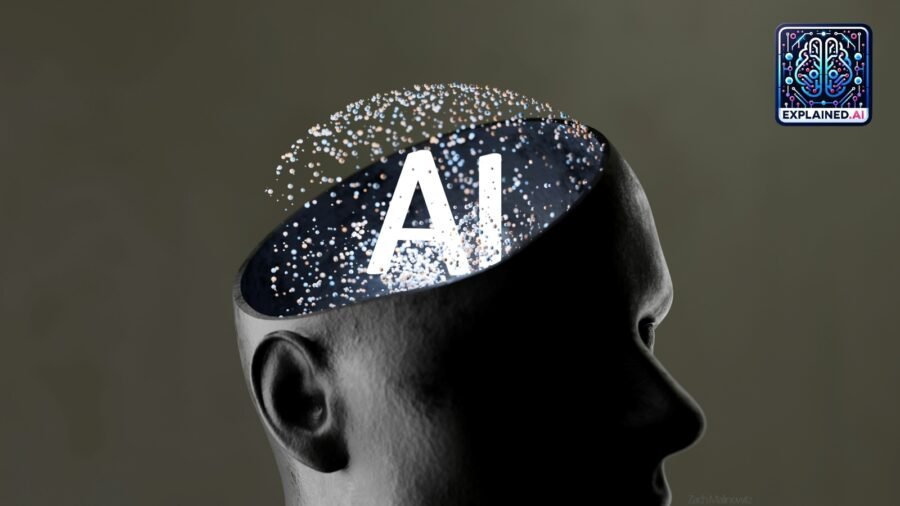
Whether artificial intelligence (AI) will be able to outperform human intelligence—and whether that will happen in the foreseeable future—is a recurrent question fuelled by the portrayal of AI in popular culture. Central to this comparison is a need to clearly define the term “intelligence”.
So, when Anthropic’s research, led by Jack Lindsey, found something resembling an internal thought process in the inner workings of its AI chatbot Claude Sonnet 4.5 — words that were related to its eventual outputs but invisible to the user — the debate was reignited. The AI company published a book-length research paper about the inner workings of large language models (LLMs) and put out a blog post announcing in July its findings, titled “A Global Workspace in Language Models”.
The research presents evidence that Claude has developed “a small collection of internal neural patterns that, compared to all its other internal processing, play a special role”.
J-space
Anthropic is calling the collection of these patterns the “J-space” — short for Jacobian space and named after the technique used to find the patterns. Essentially, these are patterns in a subset of Claude models’ inner computations that provide a mathematical approximation of an LLM’s working memory. Each J-space pattern is linked to a particular word, but when one of these patterns lights up, it doesn’t mean the model is saying that word — just that the word is represented in its internal processing.
The J-space operates silently within the model’s internal neural activations, allowing the model to represent a concept without writing it down. What is important is Anthropic’s clarification that the J-space wasn’t designed or programmed by the model maker, but instead emerged on its own during Claude’s training.
So does this answer the search for consciousness inside LLMs such as Claude, and can algorithms one day wake up and feel? There are divergent answers: Anil K. Seth, Professor of Cognitive and Computational Neuroscience at the University of Sussex and Director of the University’s Sussex Centre for Consciousness Science, says this does not come anywhere close. “I study consciousness, and I have my doubts,” Seth has maintained.
AI pioneer Geoffrey Hinton, meanwhile, has consistently said that chatbots have “subjective experience”, challenging the human belief in unique consciousness.
Story continues below this ad
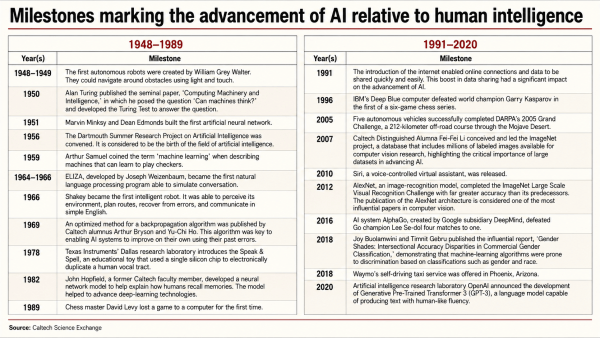 Milestones marking the advancement of AI.
Does the kind of “biological computer” that Australian startup Cortical Labs seems to be developing — a computer with human neurons mounted on silicon — potentially hold greater promise than Claude’s most recent experiment for achieving some sort of sentience?
“The kind of bio-hybrid computers that Cortical Labs and others are building may well move the needle on the potential for consciousness. The reason is that, all else equal, the more similar our technologies are to real brains, the more plausible consciousness becomes. The challenge is that we don’t yet know what difference makes the difference,” Seth told .
Inside Claude’s internal processing
So, what exactly does this step-by-step thinking inside the model look like? According to Dave Bergmann, when a reasoning LLM shows you its reasoning steps, that output is the equivalent of someone thinking out loud. (In technical terms, it’s reasoning in the token space.) “Imagine yourself cooking a simple meal and narrating every step out loud, like you’re hosting a cooking show: how you know when the pan is hot enough, why you’re adding salt after a quick taste test, how you’re cutting this vegetable and why. You’re still not saying every thought aloud. There’s a distinct inner monologue in your head that doesn’t get fully or faithfully broadcast in words,” according to Bergmann.
For instance, in the experiment on Claude Sonnet 4.5, Anthropic researchers asked the LLM to count to five and, at the same time, to “introspect deeply”. The AI model complied, dutifully coming up with 1, 2, 3, 4, 5. During this task, the researchers were observing what was going on inside the LLM’s many layers of artificial neural networks.
Story continues below this ad
For a long time, these layers have remained largely impenetrable. But what surprised the researchers when they parsed the model’s internal activations while it counted was that different words kept popping up in the underlying layers of the model. “Countdown” was one such word. Then midway through the output, the word “halfway” appeared. After the model belted out the number five, it said nothing else to the researchers, but the word “done” appeared in its neural layers.
Anthropic interprets this as evidence of an internal thought process, with representations related to Claude’s eventual outputs but not visible to the user.
Seth is clear in his view that biological traits may be necessary to produce consciousness. And we’re nowhere close to that. Anthropic said its J-space experiments do not show that Claude can have experiences or feel things in the way humans do, meaning there is still no evidence of consciousness. But the J-space appears to support some functions associated with conscious access. It holds the thoughts Claude can report on, deliberately bring to mind, and reason with, while the rest of its processing runs automatically beneath.
“This work is just a first step in what we expect to be an extensive line of research. The J-space looks like a good candidate for the divide between consciously accessible and unconscious processing in a language model, but we’d be surprised if it’s the whole story… And there remain many mysteries about how the J-space works. We don’t know what mechanism decides what enters the J-space in the first place. We’ve seen hints that it’s tied to Claude’s sense of self, something like emotional reactions, and traces of metacognition, without exactly having worked out how. But we now have methods for tackling questions like these. As that work progresses, our understanding of LLM minds — and their relationship to our own — will grow clearer,” Anthropic said in its blog post.

Good foundation: on India’s strong industrial growth performance
By Sohail Khan · 1 Oct
Bitter pills: on Court’s intervention, drug pricing
By Sohail Khan · 1 Oct
Household debt, financing today against tomorrow
By Sohail Khan · 1 Oct