A tennis glory shot – one-handed backhand – ends a 149-year tradition
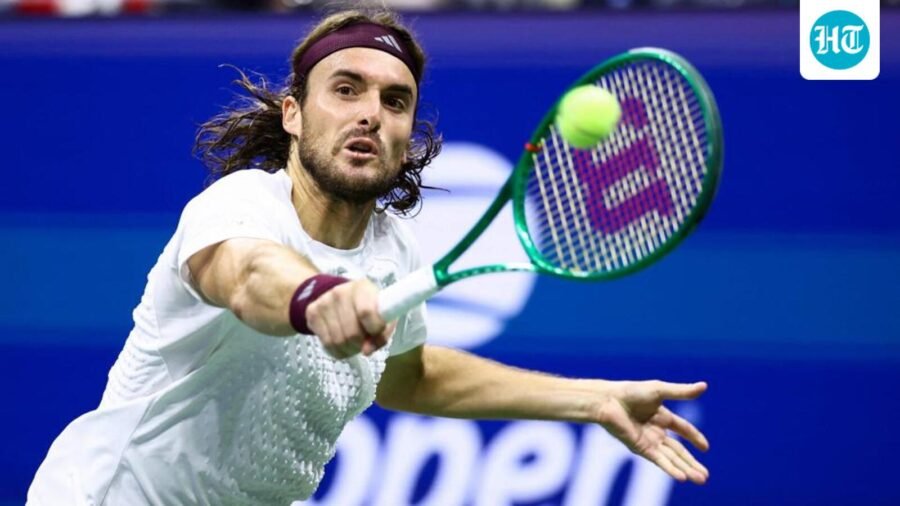
Stefanos Tsitsipas’ US Open exit means no practitioner of the beautiful shot will be in the men’s semis
Published on: Sep 7, 2026, 20:24:18 IST
Prefer HTon Google
Share via
Copy link
Mumbai: On social media, a new campaign started after an appeal was made from the Grandstand stadium in the Billie Jean King National Tennis Centre in New York.
“I’d like to start some sort of movement,” said Stefanos Tsitsipas on Saturday. “#Keeponehanderalive.”
Hours later, the Greek would post on his X account: “I’ve got a 150-year streak to save.”
The streak he referred to was of at least one men’s singles player with a one-handed backhand reaching the semi-final of a Grand Slam in each calendar year. The streak had lasted since the majors began with the 1877 Wimbledon Championships.
On Sunday night, in the stadium named after US tennis legend Arthur Ashe – he used a one-handed backhand – the sequence ended. Tsitsipas was beaten 6-2, 6-3, 6-4 by Ben Shelton in the fourth round of the US Open.
The end of the 149-year streak should not come entirely as a surprise, as more players funneling into the upper echelons of tennis possess the steady two-handed backhand, instead of the flamboyant one-hander.
“I think it is partly a consequence of the fact that, realistically, the two-handed backhand offers an advantage in modern tennis,” Lorenzo Musetti, the former world No.5 who kept the streak alive at the US Open in 2024 and French Open last year, was quoted as saying by the US Open website.
“In terms of efficiency, I think the two-handed backhand is more advantageous, especially in the modern game, with the speed at which tennis is played today.”
The sport has become slower because the overall speed of courts has been reduced and the tennis balls too have become heavier. This has caused rallies to become longer and reduced the tendency of players coming up to the net.
With the slower speeds, the two-hander provides scope for a slightly bigger margin of error.
“(The one-hander) requires excellent footwork and technique,” said Tsitsipas, a two-time Grand Slam finalist, after his second round at the US Open. “That is the only downside (compared to) a double-handed backhand.
“I feel like with a double-handed backhand you can always save the situation, if you’re a bit late or out of position you can always use your left hand to sort of ‘scoop’ it in. There is no such thing with a one-handed backhand. If you’re late, you’re late. You missed the train.”
Once a staple and now an aberration, the one-handed backhand’s decline has been steady across decades.
In the 1969 calendar year, the first full season played in the Open Era, all four semi-finalists in each of the four majors used one-handers. In 2000, 14-time Grand Slam champion Pete Sampras was the only one-hander in the Australian Open semi-finals, Franco Squillari and Gustavo Kuerten reached the last four at the French Open, Sampras and Pat Rafter were semi-finalists at Wimbledon, and Sampras alone reached the last four in New York.
This season, based on the current rankings, no top 10 ATP player uses a one-handed backhand. Going back to the US Open in 2006, four in the top 10 – Roger Federer, Ivan Ljubicic, Tommy Robredo and James Blake used the one-hander.
Federer, a 20-time Grand Slam winner whose backhand has been revered for its balletic beauty and accuracy, had kept the streak alive for many years.
“My coaches when I was growing up were, I would say, 90 percent one-handers,” he said in a press conference during the US Open Fan Week. “So, I think when your coach is a one-handed tennis player, you will most likely be a one-handed tennis player too.
“Nowadays, probably the coaches are mostly double-handed players, and it’s just easier to teach a kid to have two hands on the backhand side.”
To tackle the changing speed of the courts, Federer in 2014 changed his racquet from a 90-square-inch frame to 97 inches, allowing him a bigger striking zone and the option to attack earlier.
There are still a few who choose the one-hander. Rising star Lilli Tagger, an 18-year-old from Austria who won the junior French Open last year, was allowed to play with the one-handed backhand after she won a bet against her coach in the junior days.
The world No.49 is now one of only four women’s singles players in the top 100 using the one-hander – Diane Parry, Viktroija Golubic and Tatjana Maria are the others. Tagger now trains in an academy run by Francesca Schiavone, the last women’s singles player to win a Grand Slam (French Open 2010) using the one-handed backhand.
Among the men, the last player to win a Slam with the one-hander was Dominic Thiem in the 2020 US Open. There are six men in the top 100 using that stroke – Musetti, Tsitsipas, Denis Shapovalov, Daniel Altmaier, Giovanni Mpetshi Perricard and Aleksandar Kovacevic.
When Swiss three-time Grand Slam winner Stan Wawrinka retires in a few months, there will no longer be an active major winner with a one-handed backhand.
“You see, every single decade, we are degrading. We are like dinosaurs going extinct,” Tsitsipas said.
For those few hours on social media, #Keeponehanderalive was active. That movement though, seems to have come to a shuddering halt. Like the 149-year-old streak.
See Less

Mitchell Santner warns ‘new-look’ India side on New Zealand pitches in two-Test series
By Sohail Khan · 7 Sep
Ajmal tells PCB chief Naqvi: ‘No one’s demotivated players more than Pakistan board’
By Sohail Khan · 7 SepKylian Mbappe embraces Ballon d’Or talk after historic World Cup exploits
By Sohail Khan · 7 Sep
Leave a Reply