A face from a skull: How a cop’s AI app is helping identify the unidentified

The system uses AI assisted facial reconstruction to generate possible facial appearances from damaged photographs, witness sketches, partial images and skeletal references. From a single reconstruction, it can generate up to 108 scientifically guided variations, increasing the chances that investigators, relatives or members of the public will recognise the person.
Story continues below.
Subscribe to see fewer ads.
The application has two specialised modules. Dev Drishti generates controlled variations of a known face using forensic prompts and identity lock constraints, while Dev Roop Rekha reconstructs faces from witness sketches, degraded photographs, partial images and skeletal references.
An idea born from unidentified bodies
The idea took shape from Bagate’s experience in Sindhudurg and Ratnagiri, two coastal districts where police frequently encounter bodies washed ashore. Prolonged exposure to seawater can destroy facial features, while bodies recovered from forest areas are often decomposed or reduced to skeletal remains.
Bagate, who was Additional SP in Sindhudurg from 2021 to 2023, said the difficulty of identifying such bodies often affected the investigation itself.
“Unless the identity of a body is established, the chances of solving the crime are significantly reduced. Several such cases remained unsolved. When I took charge as Superintendent of Police in Ratnagiri, I decided to develop an AI based application that could assist police in identifying unidentified bodies, particularly in cases where the remains were decomposed or skeletal,” he said.
Story continues below this ad
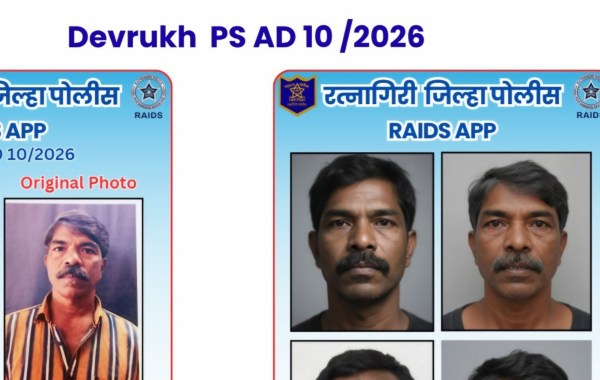 An unidentified body was found in a forest area under Devrukh police station limits, with only skeletal remains left due to advanced decomposition; investigators used the RAIDS App to generate an AI-based facial reconstruction from the skull and circulated the image among nearby village police patils, leading one patil to identify a resemblance to Santosh Rajaram Anerao, who was seen wearing an orange T-shirt with black and white stripes in a photo. Police then contacted his family in Mumbai and called them to Devrukh police station for verification, where they identified the recovered clothing and cap as belonging to Anerao, confirming his identity.
He began exploring the technology after taking charge as Ratnagiri SP in May 2025. The application was developed over two months, in September and October 2025, followed by another two to three months of testing and fine tuning. Bagate said the first results in previously unsolved cases began emerging in January 2026. The Maharashtra government subsequently recognised the initiative, which received an e-Governance Award in March.
The application was developed with the help of Bagate’s childhood friends Jitesh Jaiswal and Ritesh Jaiswal, both engineers from Aurangabad. Police constable Abhijit Dalvi, who has a degree in Electronics and Telecommunication Engineering, also played a key role in developing and improving the system.
From a damaged face to an identity
The system has already been tested in cases where conventional identification proved difficult.
In Kalyan, police used RAIDS after an unidentified man was found with his face allegedly deliberately damaged. A reconstructed image was circulated and information from the public helped establish his identity, providing investigators with a lead that subsequently assisted in detecting the case and arresting the accused.
Story continues below this ad
In Nagpur, an unidentified body with a mutilated face was found in a forest. Police processed photographs through RAIDS and circulated the reconstructed image at markets, bus stands and other public places. A shopkeeper recognised the face and told police that the deceased was a businessman known in the area. Police established his identity within two hours.
In Guhagar in Ratnagiri, villagers found a human skull along with clothing and personal belongings. Police uploaded the skull image to RAIDS, which generated a facial reconstruction that closely matched the photograph of missing person Pramod Dhodu Kamble. His relatives compared the reconstructed image with his photograph and the recovered belongings before confirming the identity.
The system has also been used in a Panvel case involving an unidentified woman whose body had been severely damaged. Police approached Ratnagiri Police through RAIDS and generated a reconstructed facial image and analytical report, which investigators are using to try to establish her identity.
Not just for unidentified bodies
The application is also being used to generate leads in missing person and accused tracing cases. RAIDS currently contains details of 384 missing persons, while AI based facial reconstruction has been carried out in nine missing person cases.
Story continues below this ad
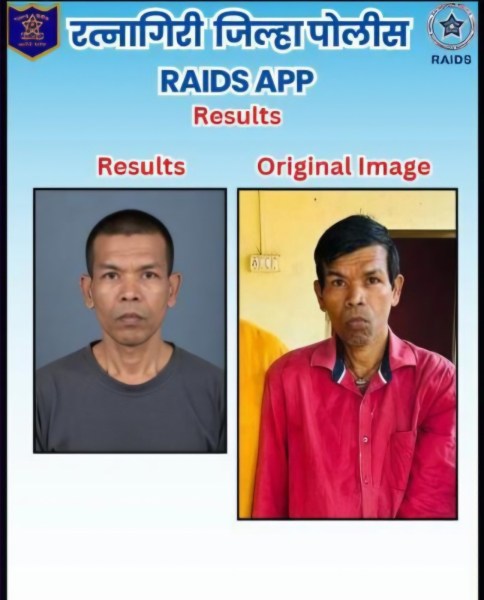 Villagers working in a forest under Guhagar police station limits found human skeletal remains, including a skull, clothes and personal belongings, and reported the discovery to police. Using the RAIDS (Rapid AI-Driven Investigation and Detection System) app’s AI Face Reconstruction module, police generated a facial image from the skull that closely matched missing person Pramod Dhodu Kamble, last seen wearing a red shirt. Kamble’s relatives were called in, and after viewing the reconstructed image, his original photograph, and the recovered clothes and belongings, they confirmed the remains were his.
In one 2006 murder case in Khed, police used old photographs of two brothers who had remained absconding for nearly two decades. RAIDS generated facial variations showing possible changes in their appearance, including hairstyles and facial hair. Investigators circulated the images and received information about people resembling them. The two were eventually traced in Panvel on March 17 this year. Police alleged that they had changed their identities to avoid detection.
The Dev Roop Rekha module has also been used in an acid attack case in Ahilyanagar. After a 12 year old girl was attacked, an eyewitness helped police prepare a sketch of the suspect. The sketch was uploaded to RAIDS, which generated more realistic facial images. The eyewitness said the reconstructed face closely matched the person she had seen, providing police with an investigative lead.
From Ratnagiri to other police units
The system is no longer confined to the district where it was developed. Police units from Nashik and Nagpur have shared information with the platform, while its capabilities have also been used in cases in Nanded and Navi Mumbai. Its use has also been reported in cases in Ahilyanagar, Satara, Palghar and Raigad.
Within Maharashtra, the system is also being used by the State CID and several district police units. Its database brings together information on unidentified bodies, missing persons, wanted and absconding accused and repeat offenders, potentially allowing investigators to look for links across police station and district boundaries.
Story continues below this ad
The system has also received national attention. Bagate was among five police officers selected for the Prime Minister’s Silver Cup presentation at the Sardar Vallabhbhai Patel National Police Academy in Hyderabad, where he presented RAIDS and its use in police investigations. The initiative subsequently received third prize in the competition.
An investigative lead, not proof
Police officials stress that RAIDS does not independently establish identity or guilt. The AI generated face is treated as an investigative lead. DNA testing, fingerprints, medical examination and other established forensic procedures remain necessary before an identity can be conclusively established.
Bagate said the purpose of the technology is ultimately humanitarian.
“The technology has a humanitarian objective ensuring that unidentified deceased persons do not remain anonymous and that families are not left without answers,” he said. “Police are using the platform to bridge the gap between an unidentified body and a possible identity.”
Story continues below this ad
For police, that gap can be the difference between an investigation going cold and a family finally knowing what happened to a missing relative. After proper verification, Bagate said, the identification can also allow families to perform the last rites of their loved ones with dignity.



Leave a Reply