8th CPC: How basic pay may double after DA merger
Synopsis
8th Pay Commission news: Employee and pensioner groups are urging the 8th Pay Commission to merge dearness allowance with basic pay. This merger aims to accelerate salary increases for central government employees. Organisations like NC-JCM and AINPSEF have submitted their recommendations for this significant change. The proposed merger could potentially double basic pay for some employees within seven years. These discussions are ongoing as the commission gathers feedback from various stakeholders.
The 8th Pay Commission’s discussions with employee and pensioner bodies and other stakeholders in Puducherry began today (Wednesday, September 9, 2026). The pay commission has just concluded similar meetings in Chennai and will have its next round of discussions in Chandigarh from September 16-18, 2026. In various discussions that have taken place and in the memorandum that employee and pensioner bodies have submitted to the 8th Pay Commission, a key demand that has been raised by many key bodies is the merger of dearness allowance (DA) with basic pay.
Why do employee and pensioner bodies want the merger of DA with basic pay?
Leading central government employee organisations such as the National Council – Joint Consultative Machinery (NC-JCM), the All India Defence Employees’ Federation (AIDEF) and the All India New Pension Scheme Employees’ Federation (AINPSEF) among others have recommended the merger of DA with basic pay when DA crosses the 25% stage.
Under the current system, the Finance Ministry increases the DA of all central government employees twice a year- in January and June. However, it doesn’t merge DA with employees’ basic pay at any stage.
The AINPSEF says that the merger of DA with basic pay will help increase the salary at a quicker pace, and employees don’t have to wait for 10 years for a good salary raise.
The AINPSEF says that the merger will mainly help employees working at low levels, who get low salaries and reside in big cities where expenses are high.
DA merger recommendations for 8th Pay Commission
| Organisation | Proposed Annual Increment | Proposed DA |
| National Council of the Joint Consultative Machinery (NC-JCM) | 6% | All allowances to be increased by three times and to be linked with DA increase |
| National Federation of Postal Employees (NFPE) | 6% | At 25%, DA should be merged with basic pay |
| All India New Pension Scheme Employees Federation (AINPSEF) | 7% | At 25%, DA should be merged with basic pay |
| Indian Railways' Supervisors' Association (IRTSA) | 5% | At 50%, DA should be merged with basic pay |
| Pragatisheel Shikshak Nyaya Manch (PSNM) | 7% | At 50%, DA should be merged with basic pay |
| All India Defence Employees' Federation (AIDEF) | 6% | All allowances to be increased by three times and to be linked with DA increase |
How DA merger with basic pay can work in practice
The NC-JCM, in its memorandum submitted to the 8th Pay Commission, says that when DA crosses the 25% limit, it should be merged with basic pay. Now let’s see how it may work in practice.
Take the example of a Level 1 employee earning a basic pay of Rs 18,000. Assuming that the 8th Pay Commission’s fitment factor will be 2.1, their revised salary may be Rs 37,800 as of January 1, 2026. If the employee gets a 4% average DA hike every year and the annual increment rate increases from 3% to 7%, their estimated gross salary (basic pay+DA) as of January 1, 2033, will be approximately Rs 77,694, a 106% increase from the revised basic pay of Rs 37,800. The DA rate at that time would be approximately 28%. If the DA is merged at that stage, the employee’s basic salary will be approximately. This means that in seven years, the basic salary will double.
| Basic pay | ₹ 18,000 |
| Revised basic pay at 2.1 fitment factor | ₹ 37,800 |
| Annual increment rate | 7% |
| Annual DA hike | 4% |
| Date | Basic Pay (₹) | DA Rate | DA Amount (₹) | Gross Salary (₹) | Gross Salary increase |
| 01-Jan-26 | 37800 | 0% | 0 | 37800 | |
| 01-Jan-27 | 40446 | 4% | 1618 | 42064 | 11% |
| 01-Jan-28 | 43277 | 8% | 3462 | 46739 | 24% |
| 01-Jan-29 | 46307 | 12% | 5557 | 51863 | 37% |
| 01-Jan-30 | 49548 | 16% | 7928 | 57476 | 52% |
| 01-Jan-31 | 53016 | 20% | 10603 | 63620 | 68% |
| 01-Jan-32 | 56728 | 24% | 13615 | 70342 | 86% |
| 01-Jan-33 | 60699 | 28% | 16996 | 77694 | 106% |
Source: AINPSEF
How basic pay of Level 6 employee may double in 7 years after DA merger
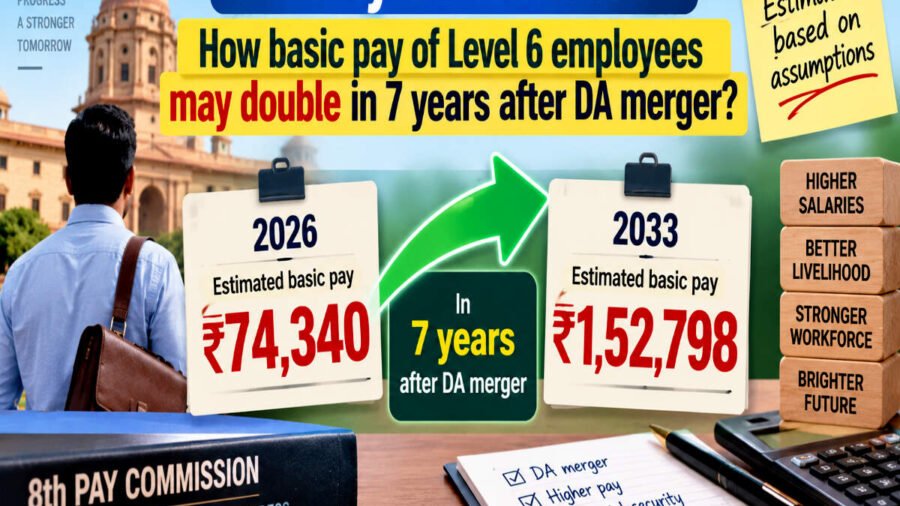
Now take the example of a Level 6 central government employee who gets the basic pay of Rs 37,800 under the 7th Pay Commission and see the estimated salary progression in 7 years into the 8th Pay Commission.
| Basic pay | ₹ 35,400 |
| Revised basic pay at 2.1 fitment factor | ₹ 74,340 |
| Annual increment rate | 7% |
| Annual DA hike | 4% |
| Date | Basic Pay (₹) | DA Rate | DA Amount (₹) | Gross Salary (₹) | Gross Salary increase |
| 01-Jan-26 | 74340 | 0% | 0 | 74340 | |
| 01-Jan-27 | 79544 | 4% | 3182 | 82726 | 11% |
| 01-Jan-28 | 85112 | 8% | 6809 | 91921 | 24% |
| 01-Jan-29 | 91070 | 12% | 10928 | 101998 | 37% |
| 01-Jan-30 | 97445 | 16% | 15591 | 113036 | 52% |
| 01-Jan-31 | 104266 | 20% | 20853 | 125119 | 68% |
| 01-Jan-32 | 111564 | 24% | 26775 | 138340 | 86% |
| 01-Jan-33 | 119374 | 28% | 33425 | 152798 | 106% |
Here also, you can see that at an average 4% annual DA increase, an annual increment rate of 7% and a fitment factor of 2.1, a Level 6 employee’s estimated basic pay after the DA merger on January 1, 2033, will be Rs 1,52,798, which is more than two times of Rs 74,340.
However, these are estimates, and the real basic and gross salary increases will be known only after the government approves the 8th Pay Commission report.
(Join our ETWealth WhatsApp channel for all the latest updates)
Add 

(Catch all the Personal Finance News, Breaking News, Budget 2025 Events and Latest News Updates on The .)
…more

Brent oil price crosses $100: Why Middle East conflict is driving crude prices higher
By Sohail Khan · 9 Sep
Cabinet clears rail projects worth Rs 10,021 cr
By Sohail Khan · 9 Sep
33K deaths in India in building collapses, fires
By Sohail Khan · 9 Sep
Leave a Reply