10 UPI transactions that will attract MDR charges
Synopsis
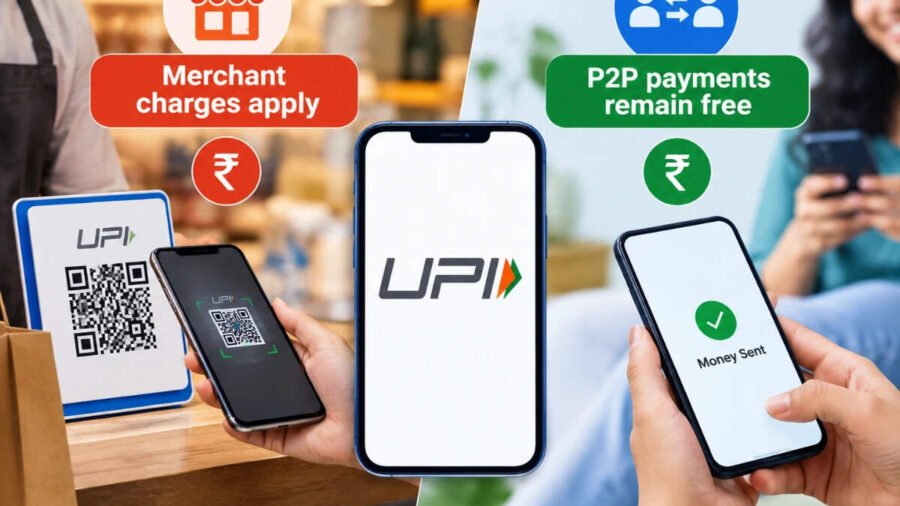
A new UPI framework will implement fees on certain merchant transactions while keeping person-to-person payments and transactions under two thousand rupees free of charge.

The new Unified Payments Interface (UPI) framework does not mean customers will pay a charge, or the Merchant Discount Rate (MDR), every time they use the UPI. The new MDR charge, which will come into effect from October 15, 2026, will apply only to specified merchant transactions above the threshold, with separate rates applied for sectors such as essential services and capital market transactions.
Person-to-person payments will continue to remain free, irrespective of the amount transferred, while merchant transactions up to Rs 2,000 will also remain outside the MDR framework, as per a statement from the Ministry of Finance.
The Ministry of Finance, in a social media post on X, said, “Consequently, approximately 96% of all P2M transactions will remain unaffected. MDR will apply only to specified merchant transactions above Rs 2,000.”
But then which transactions will attract charges? Check 10 such transactions that will attract MDR charges as a Ministry of Finance release.
Merchant payments above Rs 2,000
Railway payments above Rs 2,000
Telecom payments above Rs 2,000
Insurance payments above Rs 2,000
Fuel payments above Rs 2,000
Agricultural input payments above Rs 2,000
Mutual fund payments
Securities-related payments
Stockbroker payments
Dealer-related capital market payments
0.4% MDR on merchant transactions above Rs 2,000
A nominal MDR of 0.4% will apply only to P2M (person to merchant) transactions above Rs 2,000. The MDR will be shared among payment ecosystem participants, including banks, payment service providers and UPI application providers.
Rs 300 capping for merchant transactions above Rs 75,000
For transactions of Rs 75,000 and above, the MDR will be capped at Rs 300 per transaction.
Essential sector payments above Rs 2,000
Transactions above Rs 2,000 in certain essential and thin-margin sectors will attract a flat MDR of Rs 5 per transaction.
The sectors covered include railways, telecommunications, insurance, fuel, agricultural inputs
Note for these transactions, the applicable MDR will be Rs 5 rather than the standard 0.4% rate.
Capital market transactions
A separate, lower MDR rate will apply to transactions linked to the capital markets.
Payments relating to mutual funds, securities, stockbrokers and dealers will attract an MDR of 0.02%, subject to a cap of Rs 300 per transaction.
According to the SBI FAQs on MDR, “This specific MDR tier explicitly covers all regulated entities operating within capital markets, including Asset Management Companies (Mutual Funds), SEBI-registered stockbrokers, securities dealers, and investment platforms. It applies to fund transfers executed via UPI for equity buying, debt market investments, mutual fund purchases, and broker wallet top-ups. By defining this category separately, it is ensured that capital market transfers are distinct from routine retail shopping or general service payments.”
Will customers pay MDR?
The Finance Ministry says that MDR is a charge within the merchant payment ecosystem and it is not a charge on customers making UPI payments.
"Banks have been advised to ensure that merchants do not pass MDR charges on to customers. UPI application providers are expressly prohibited from imposing platform fees or hidden charges," says the Finance Ministry.
Individuals will continue to have unlimited free usage, with no monthly quotas, volume restrictions or tiered caps on free UPI transactions, says the Ministry.
Will daily transaction UPI limit attract MDR charges?
The Finance Ministry reveals that daily transaction limits prescribed by banks and the NPCI, generally ranging from Rs 1 lakh to Rs 5 lakh depending on the transaction category, are security and risk-management safeguards. They are not charging thresholds.
How is MDR calculated on exact transactions (e.g., Rs 5,000 vs Rs 1,00,000)?
According to frequently asked questions (FAQs) issued by the the National Payments Corporation of India,
NPCI FAQs on MDR, “MDR calculations follow a clear, predictable formula based on transaction value thresholds. For a Rs 3,000 purchase, applying the 0.4% rate results in an MDR fee of Rs 12 paid by the merchant to its acquiring bank. For a Rs 50,000 purchase, a 0.4% fee equals Rs 200. However, for a high-value purchase of Rs 1,00,000, the 0.4% calculation is superseded by the fixed maximum cap of Rs 300 (Rs 300 is the fixed maximum cap per transaction for payments of Rs 75,000 and above. Any transaction under Rs 2,000 incurs no MDR.”
Reeju Datta, co-founder, Cashfree, explains, “With zero MDR, the adoption of UPI increased significantly across smaller merchants, changing the way India pays. However, running UPI involved significant costs. A calibrated MDR finally gives the ecosystem a way to fund that directly, and to invest in areas like fraud prevention, acceptance infrastructure in smaller towns etc. It will also provide incentive for newer players to enter the market and innovate for different use cases which in turn would increase adoption for UPI further.”
(Join our ETWealth WhatsApp channel for all the latest updates)
Add 

(Catch all the Personal Finance News, Breaking News, Budget 2025 Events and Latest News Updates on The .)
…more

Varun Chakravarthy ruled out of Asian Games
By Sohail Khan · 16 Sep
How to build wealth on irregular income
By Sohail Khan · 16 Sep
Sethupathi’s Maharaja to be remade in Hollywood
By Sohail Khan · 16 Sep
Leave a Reply