Zhu Rongji’s economic legacy is now Xi Jinping’s crisis to solve
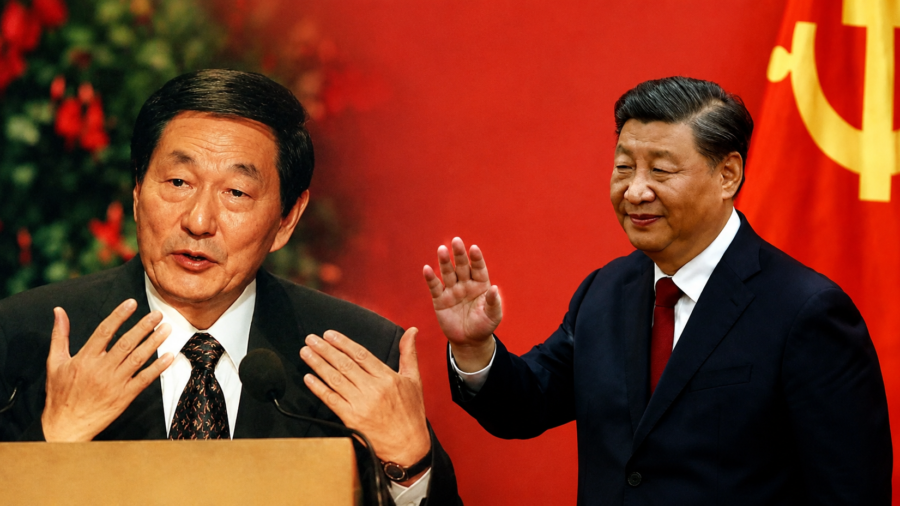
When Zhu Rongji became China’s fifth premier in March 1998, he famously declared at his inaugural press conference, “Whether it is a minefield or an abyss that lies ahead, I will go forth without hesitation and serve with all my energy until my dying breath.” With his passing on August 12, one cannot help but notice the similarities in his practice of demolition economics, and what China is both creating and experiencing today.
Firstly, what is interesting to note is that the obituary Xinhua released that evening – issued jointly by the Party Centre, the NPC Standing Committee, the State Council and the CPPCC – singled out three of his economic achievements. These are the 1994 tax-sharing fiscal system, the overhaul of the central bank and commercial banking, and the reorganisation of State-Owned Enterprises (SOEs). It then closed, as these documents have always done for the past decade, by urging party cadres to rally closely around the Party Centre with Xi at its core.
Advertisement
But beyond the unwavering politics of such events, each reform the obituary lists has now translated into an economic crisis for Beijing to handle. The 1994 fiscal reform is a classic example. It famously gave the centre greater control over finances, even as it left expenditure obligations with local governments across its four levels – starting with provinces, down to townships. How local governments subsequently generated money has now translated into Beijing’s most controversial bubble – through the property sector. But since its unravelling after the introduction of the “three red lines” policy in 2020 and Evergrande’s loan default in 2021, the fissures have become all the more apparent. Real estate investment fell 17.2 per cent in 2025, while fixed-asset investment fell by 3.8 per cent – its first annual decline in decades – and Beijing has allocated a whopping 4.4 trillion yuan (over US$ 610 billion) in local special-purpose bonds just this year to relieve local government debt stress, and, to some extent, stabilise the property market.
Then there is the 1990s reform co-authored by Zhu and Jiang Zemin — “grasp the large, release the small”. It revolved around maintaining party control over large SOEs, while privatising or shutting down smaller ones. It made Zhu the architect of mass layoffs of roughly 30 million state workers, articulated at the time as ‘Xiagang’ (or ‘stepping down from the post’). At the same time, it normalised massive CPC subsidy programmes for big SOEs, as well as mergers into major conglomerates.
But the rationale behind the policy reflects similar concerns in contemporary China. Partly, the policy aimed to grapple with excess capacity, and partly with deflation and bureaucratic inefficiency. Beijing is fighting the same enemies today, although the same toolkits and instincts as Zhu are no longer effective. Not only are the big players in these sectors private, “shutting them down” means destroying the investments of industrial policy, and creating deeper income troubles at a time when youth unemployment is ~17 per cent.
Advertisement
So, Xi’s campaign works on persuasion and ceilings. Since 2025, the “anti-involution” (fan neijuan) campaign has imposed output quotas, revised the Price Law, and pushed industry associations to end market-distorting pricing in major sectors such as solar, batteries, and electric vehicles. Some of its evidently affirmative consequences include the GDP deflator turning positive in the second quarter of 2026 after twelve negative quarters, and producer prices rising for the first time since late 2022. Though anti-involution is not the silver bullet that will kickstart domestic consumption — in fact, the deflator rising 1.6 per cent y-o-y may have more to do with external factors like import commodity prices than internal successes.
Speaking of external challenges, the most consequential unravelling has happened in China’s global economic image. Zhu’s wrangling with the World Trade Organisation (WTO) granted China a global market big enough to absorb whatever the domestic market could not. And to this day, China remains an export-oriented economy. In 2025, China recorded the highest proportional contribution of net exports to GDP growth since 1997 (~33 per cent). Even as Zhu’s legacy has left indelible footprints on China’s economic model, from Beijing’s perspective, global market sentiment has worsened. And so, the economy Xi is managing today, with a target of 4.5-5 per cent in 2026, is starkly different from the one that clawed back to 9 per cent soon after the Asian Financial Crisis.
The writer is Associate Fellow, Geostrategy Programme at the Takshashila Institution, Bengaluru. Views expressed are the author’s, and do not represent those of the institution

The Koran and politics of purdah
By Sohail Khan · 22 Sep
Persistent antagonism towards Urdu
By Sohail Khan · 22 Sep
How ‘kaata wash’ helps preserve the delicate Dhakai jamdani sari
By Sohail Khan · 21 Sep