Why Trump wants to cut US military drills with South Korea over Iran
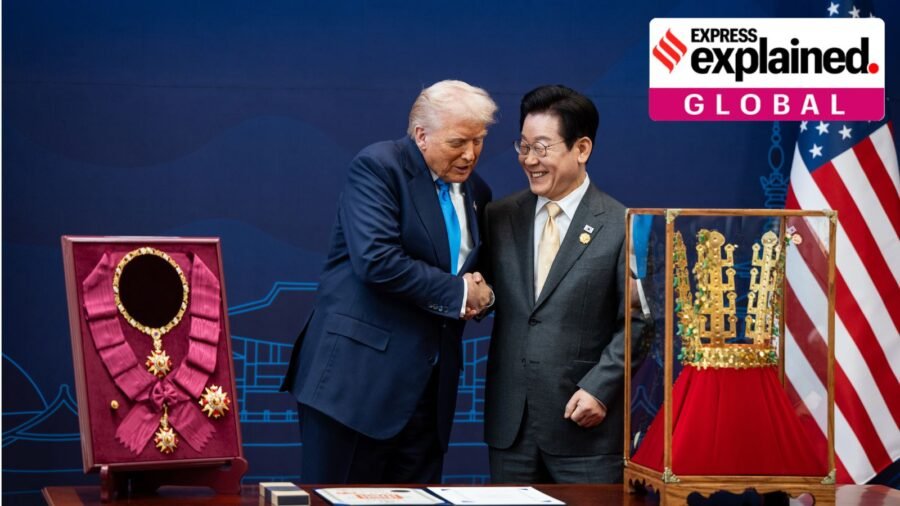
Donald Trump on Sunday announced that the US would reduce its joint military exercises with South Korea, a long-term American ally, for not participating in the “Denuclearization of the Islamic Republic of Iran.”
In a social media post, the US President also said that North Korea, by contrast, had been “unthreatening and respectful” to him. North Korea had expressed its condemnation to the exercise last week, calling it a provocation that heightens tensions on the Korean Peninsula.
However, South Korean joint chiefs of staff told Reuters that the drills started on Monday as scheduled.
The latest development comes mere days after South Korean President Lee Jae Myung proposed talks with North Korea to officially end the war between the two.
Why has Trump paused the exercise?
It was long expected that Trump would either suspend or scale down the joint military exercise, or even reduce the US military presence in South Korea.
The US President has repeatedly expressed his disappointment with several of the US’ long-time allies not contributing military or logistical support to aid the US in its ongoing war with Iran.
Trump has previously expressed objections over perceived heavy military spending in South Korea, saying the US is not getting enough for helping it secure its defence against North Korea. He has also repeatedly objected to the size of the troops on the peninsula and the money spent.
Story continues below this ad
To this end, South Korea has attempted to appease the US President, committing $350 billion in investments in the US.
What are the Ulchi Freedom drills?
The Ulchi Freedom drills are a combined military exercise between South Korea and the US. Named after the Korean general Ulchi Mondik, the exercise is reportedly the world’s largest computerised command and control implementation focused on defending South Korea from a North Korean attack. Since 1976, the drills have been conducted annually between August and September, except for 2018, when the South Korean government temporarily cancelled them.
The drills have had various names over the years: the Taeguk Exercise through the 1960s until 1969, when it was renamed the Ulchi Exercise. The drills were renamed the Ulchi-Focus Lens in 1976, a name it held until 2008, when the scope of the drills was updated to reflect the shift in operational control.
This year, about 18,000 South Korean troops are expected to participate alongside US forces, amounting to about 28,500. Personnel from 11 of the 18 member states of the United Nations Command (UNC) — the multinational body that oversees the 1953 armistice that halted hostilities of the Korean War — are also expected to participate. The exercise got its latest rebrand in 2022 when it was rechristened the Ulchi Freedom Shield to reflect the multifaceted nature of threats.
Story continues below this ad
Relations between the Koreas
North Korea and South Korea have been in a state of war since 1953.
After Japan announced its intent to surrender in 1945, the Korean Peninsula, previously under its control, was divided into two: The Soviet and the Chinese communists propped up the Democratic People’s Republic of Korea in the North, while the Americans supported the creation of the Republic of Korea in the South.
In 1950, North Korean forces under founder Kim Il Sung invaded the South, triggering the three-year-long Korean War. Despite making major initial gains, US troops helped the South fight back. Eventually, neither side secured a decisive victory, and an armistice was signed in 1953, effectively leaving both sides at war.
Since then, both Korean nations have dreamt of “reunification”, by force if necessary. But the likely human and material cost of an all-out war has meant that the status quo has, by and large, prevailed. Since the 1970s, both sides have held negotiations towards achieving a “peaceful reunification”, with agreements in 2000, 2007, and 2018 significant in this regard. However, very little tangible progress has been made.
Story continues below this ad
Meanwhile, North Korea has also pursued the development of nuclear weapons, inviting heavy sanctions from the UN Security Council, the US, and its allies. Last week, it launched a ballistic missile towards the Sea of Japan.
Things came to a head in 2019 when Trump, then the US president, met with North Korean leader Kim Jong Un in Hanoi, Vietnam. While the outcome of this meeting— their second—was hoped to make progress on denuclearisation and sanctions, the summit ended abruptly. As a result, North Korea completely ended all attempts to normalise relations with the US (and consequently South Korea). The country restarted its nuclear programme with gusto.
Tensions between North and South Korea have only escalated since then. In January 2024, Kim notably announced a shift in DPRK’s outlook towards South Korea. Renouncing further attempts at reunification, Kim said that the South was now to be viewed as the “primary foe and invariable principal enemy”.
In recent years, both countries have resorted to escalating tactics, ranging from defence posturing to balloon diplomacy: North Korea sends trash-laden helium balloons in response to South Korean activists sending “propaganda-laden” balloons to the North. Similarly, both countries blast music via loudspeakers at each other.
Story continues below this ad
North Korea maintains a close strategic partnership with China, which has repeatedly demonstrated a commitment to supporting communist regimes and a willingness to confront US-led forces in the region. Russia has also emerged as a North Korean ally, trading weapons with the largely isolated ‘hermit’ kingdom. North Korean troops have participated in Russia’s war against Ukraine and have reportedly gained “crucial experience”, according to an official with U.S. and South Korean Combined Forces Command quoted by The New York Times on Monday.

A foot-and-mouth disease strain is back after 60 years: Why SAT-1 is raising alarms
By Sohail Khan · 8 Sep
The BAPS sect, a vow of celibacy, and the Paris row
By Sohail Khan · 8 Sep
Delhi building collapse: How NDRF conducts search-and-rescue operations
By Sohail Khan · 8 Sep