Delhi building collapse: How NDRF conducts search-and-rescue operations
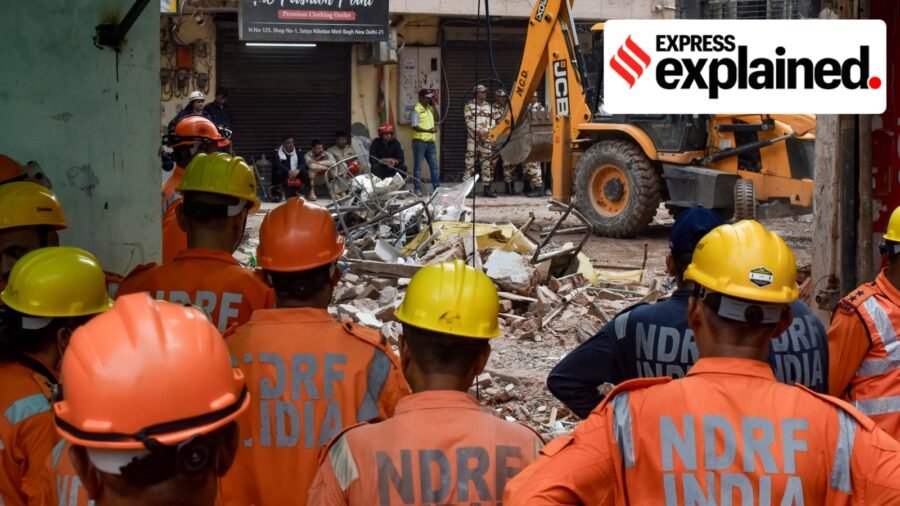
After the collapse of a five-storey building in south-west Delhi’s Satya Niketan on Sunday (September 6), search-and-rescue (SAR) operations ended after 27 hours the next day. At least seven people have been reported dead so far with some others injured.
The building, built in the 1990s and located close to Delhi University’s South campus, housed a private hostel that was home to several students. The National Disaster Response Force (NDRF), along with other agencies, conducted the rescue operation at the scene of the collapse.
The NDRF was established in 2006 as a specialised response unit to natural and man-made disasters following a series of severe natural calamities in India in the 1990s and early 2000s. It falls under the administrative control of the Union Ministry of Home Affairs and is headed by the Director General (DG), NDRF. It currently has 16 battalions, and each battalion also has smaller, strategically located regional response centres (RRCs) set up across different vulnerable zones to ensure faster deployment and immediate response during emergencies.
Here’s how the NDRF carries out SAR operations for incidents of building collapse, the technology deployed in these situations, and the need for more state-level disaster response units.
Rescue ops for building collapse
The NDRF classifies its operations at building collapses such as the one at Satya Niketan as “collapse structure search and rescue” (CSSR). The term applies to rescue and recovery operations at the scene of a large and complex structural collapse or multiple structural collapse, but can also be applied to a less complex “structural collapse”. A collapse refers to a failure of a structure or component to maintain its structural integrity.
A CSSR operation attempts to conduct a safe and effective SAR operation using advanced techniques to locate, extricate, and stabilise the victim trapped inside the confined space or void of a collapsed structure in the shortest span of time.
Requisition: According to NDRF’s document on the standard operating procedure for CSSR, an SAR team is to be deployed on either receiving specific orders from NDRF headquarters; on the request of the affected state or Union Territory government, local administration, or the affected authorities; or on the orders of the Battalion Commandant.
Story continues below this ad
Former DG of NDRF, Atul Karwal, told that each battalion is “constantly tuned into the area of responsibility”. “Each battalion is looking at the news and seeing what is happening in their area. If there’s a building collapse, we don’t even wait for formal requisition. We immediately set out or contact the authorities in a proactive manner, because we realise that the earlier we reach, the more lives we’ll save.”
When asked whether there is a minimum threshold — be it in terms of operational complexity or the number of lives at stake — for which the NDRF is called upon, Karwal said that was not a determining factor.
Upon requisition, two SAR teams at battalion HQ and one team at each RRC should be “On Wheel” with all the required equipment, tools, and stores. The On Wheel team(s) will move within 30 minutes from the Unit/RRC location for the incident site, and arrangements will be made to ensure fastest movement so as to commence the rescue operation at the earliest at the incident site.
Assessment: On arrival at the incident site, the SAR team will establish its base of operation close by keeping in view the situation on ground. The team commander will do an immediate hazard assessment and mitigation, ensuring that the scene’s perimeter must be secured using physical barriers for controlling spontaneous rescuers or civilians.
Story continues below this ad
At the Satya Niketan site, the NDRF carried out relief operations with other organisations such as the Delhi Police, the Delhi Fire Service, and the Delhi Disaster Management Authority. On the question of coordination, Karwal said that there’s a formal or informal incident command system in place wherein the NDRF first goes and reports to the senior person from the local authorities, who is already coordinating multiple agencies on the site.
“NDRF is respected for its expertise and the special equipment which we carry, which most other agencies may not have. Then the coordination can be done on the advice or requirements of the NDRF, taking into account the special competencies of various agencies. So it depends on the situation, but the NDRF doesn’t go and take over the command suo motu,” he said.
Structural engineers, who are specially trained in structural assessment and building marking system, will be involved in structural triage: assessing structural stability of the remaining debris, identifying potential hazards (like gas leaks or live wires), and planning safe access routes. If the triage team determines that the building is structurally unstable, SAR team will not enter until appropriate shoring and stabilisation has been done. Shoring needs to be done on structures with severely damaged panels, loose pieces of concrete, cracked or broken pre-fabricated panels, and cracked masonry walls, etc.
Access and extrication: In case of multi-storey or major building collapse, multiple entries to the building will prove fruitful. The team commander and the designated safety officer need to ensure that action of one sub team does not compromise the security of other sub teams. During the operation, the local government or authorities can be asked for all necessary services or facilities such as heavy machinery in the form of excavators, tractors, bulldozers, and cranes.
Story continues below this ad
If the SAR team has to breach walls, floors, or roofs to gain access to victims, they should attempt to gain access by not compromising the stability of load bearing walls. Victim assessment must be made and the proper extrication method must be chosen to avoid any further injuries.
Responders will triage and provide pre-hospital treatment (PHT) to the injured victims before handing them over to emergency medical services. If any live victim is located, the medical component of the SAR team must accompany the sub team during rescue. After evacuation, victims will be immediately dispatched for advanced medical care after giving PHT.
Debris removal may be conducted if it is part of SAR operations, that is, until all the victims have been extricated or accounted for. Rescuers must be very careful when removing debris so as not to cause secondary collapse or further injury to the victim. It should also be first removed from the areas where there is the highest probability of trapped victims.
Once all the victims have been extricated, that is, there is no possibility of trapped victims; SAR operations may be called off in that collapsed structure after due consultation with the state or district administration concerned.
Technology deployed
Story continues below this ad
NDRF Inspector General Narendra Singh Bundela told a government-owned news agency on Monday that the rescue teams at Satya Niketan were using specialised equipment, including breaching and cutting systems, lifting equipment, inflatable bags, and hydraulic and wooden shoring systems to remove concrete slabs and stabilise the collapsed structure.
Bundela said that canines and life-detection equipment were also deployed to locate victims trapped under the debris. These “life detectors”, Karwal said, were acoustic sensors that are put in a building collapse situation at various places. “We’ll sense heartbeats, we’ll sense somebody scratching at or under the rubble, signifying there is something that we need to detect here. Again, the agencies there have to help us by quietening down what they are doing,” he said.
SDRF for Delhi: Need of the hour?
One of the major criticisms towards the relief operations at Satya Niketan was the delay in emergency response time. Other incidents in the recent past point to the need for Delhi to have its own functional state disaster response force (SDRF) for a quicker and better disaster response. In December 2023, Union Minister of State for Home Affairs Nityanand Rai had told Parliament that as per the National Policy on Disaster Management, raising of an SDRF and equipping them is with the state or Union Territory governments concerned.
In July, PTI reported that the Delhi government was planning to strengthen its disaster management apparatus by raising four battalions of an SDRF to tackle natural and man-made calamities. Officials said that the need for an SDRF has been felt for quite some time in view of Delhi’s large population and frequent accidents, besides the city’s vulnerability to earthquakes owing to its location in Seismic Zone-IV.
Story continues below this ad
A senior Delhi government officer told PTI that the plan is to raise SDRF in Delhi with four battalions comprising personnel from police, paramilitary, and direct recruitment of eligible candidates, including ex-Agniveers.

At Nagoya, promises kept, a winning arc
By Sohail Khan · 1 Oct
With Central Vista, a library without a home and a larger absence
By Sohail Khan · 1 Oct
40 years ago, October 1, 1986: First-ever Asiad gold for Usha
By Sohail Khan · 1 Oct