Why the Supreme Court upheld hanging as a constitutional mode of execution
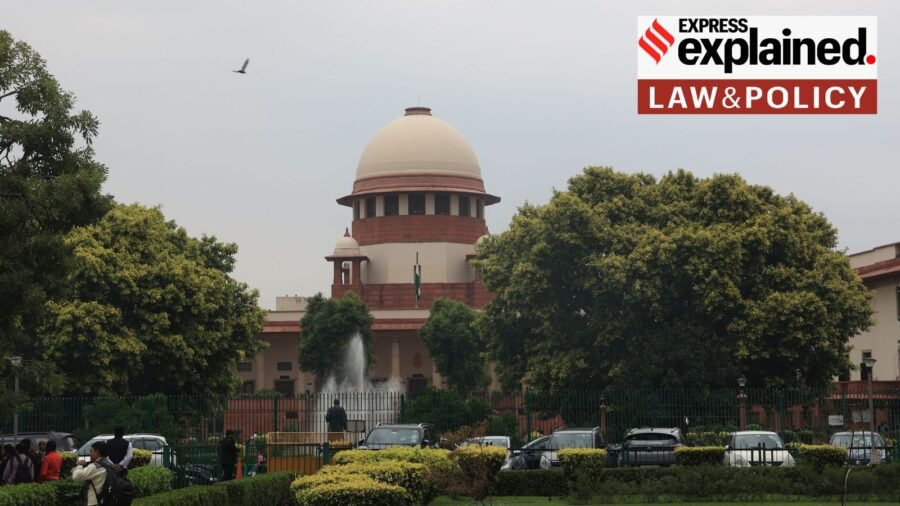
Can a method of execution devised in colonial India still satisfy the Constitution’s promise of dignity? The Supreme Court on Tuesday (Aug 18) said it can, at least on the material currently before it.
A bench comprising Justices Vikram Nath and Sandeep Mehta upheld the constitutional validity of hanging as a mode of executing a death sentence, dismissing a PIL that argued the method is scientifically unreliable and violates the right to a dignified death under Article 21.
The court held that the challenge ran into two hurdles – the 1983 precedent of Deena vs UOI in which a three-judge bench upheld hanging as a constitutional mode of execution, and the Parliament’s decision to retain hanging while enacting the BNSS.
It said, “this constitutional protection does not cease to exist at the gallows, it must apply with equal emphasis to prisoners who are on death row.”
Why is hanging being challenged?
Hanging is designed to work through a calculated “drop” based on the person’s height and weight, meant to cause a fracture-dislocation at the C2-C3 vertebrae and bring about near-instant unconsciousness.
The Supreme Court in Deena vs UOI upheld the constitutional validity of hanging after examining medical evidence, expert opinion, and comparative execution methods. The court held that hanging, when properly administered, is a quick and certain method of execution and does not violate Article 21. It said that the process causes no greater pain than any other known method and avoids “barbarity, torture and degradation.”
But the petitioners argued that both the scientific understanding and constitutional doctrine have evolved since. The petition sought a declaration that the provision prescribing hanging was unconstitutional and argued that Article 21 includes a right to die through a dignified procedure. They said the method is “accompanied by intense physical torture and pain,” and inherently unpredictable; too short a drop causes death by strangulation, too long a drop can decapitate.
Story continues below this ad
Reliance was placed on a 1992 study of the skeletal remains of 34 people hanged in England between 1882 and 1945. Fractures at C2-C3 were common, but the “hangman’s fracture” — assumed to cause near-instant death—showed up in only three of the 34 cases; six died of asphyxiation instead. They argued that this made hanging neither quick nor controllable and thus violated Article 21, as it isn’t reliably instantaneous, the run-up to execution causes severe psychological suffering, and its outcomes can’t be managed.
The Union argued that since 2003, only eight executions have taken place in India and pointed out that no botched execution has ever been recorded in India, while lethal injection in the US carries a well-documented history of failures.
What does the law say about hanging?
The right to die with dignity flows from the right to life guaranteed under Article 21 of the Constitution. The Supreme Court in Gian Kaur v State of Punjab (1996) held that the right to life includes the right to live and consequently to die with dignity.
Section 393(5) BNSS provides that where a person is sentenced to death, “the sentence shall direct that he be hanged by the neck till he is dead.”
Story continues below this ad
The clause has barely changed since it was first introduced in the CrPC in 1861, has survived multiple amendments, and now appears in the BNSS.
What has the Law Commission said?
A key plank of the challenge was the Law Commission of India’s 187th report submitted in 2003 under the chairmanship of Justice M. Jagannadha Rao.
After examining the execution practices in India and abroad, the commission recommended that the law “be amended by providing an alternative mode of execution of the death sentence by lethal injection until the accused is dead.”
The report also examined military laws under which death sentences awarded through court-martial may be carried out by shooting. The petitioners also relied on these provisions to argue that hanging need not remain the sole legally recognised mode of execution.
Story continues below this ad
The SC noted that the Law Commission reports are recommendatory and that Parliament retained hanging while enacting the BNSS, a factor the Court treated as a legislative reaffirmation of the existing framework.
Why did the SC uphold hanging?
The bench found no reason to revisit Deena. It noted that the petitioners had placed scientific material before the Court but held that the material did not displace the basis on which Deena had been decided. Nor did it establish that lethal injection, electrocution, lethal gas or shooting offered an advantage over hanging.
It referred to the reasoning in Deena, where hanging through the long-drop method was described as a process intended to bring about immediate unconsciousness through cervical fracture. The Court said the existing method continues to satisfy the State’s obligation to carry out a death sentence with “decency and decorum” and without “degradation or brutality.”
While dismissing the petition, the bench stopped short of treating the issue as closed forever. It observed that constitutional law evolves and that future challenges could arise if new scientific, medical or empirical material fundamentally alters the assumptions on which Deena was decided. It also left it open to the Union government to examine alternative methods of execution, should it choose to do so.

How ‘kaata wash’ helps preserve the delicate Dhakai jamdani sari
By Sohail Khan · 21 Sep
Letters to The Editor — September 22, 2026
By Sohail Khan · 21 Sep
A Malacca-Singapore model for resolving Hormuz
By Sohail Khan · 21 Sep