Why petition against Bodh Gaya Temple Act cites Hindu rituals, Buddhist rights
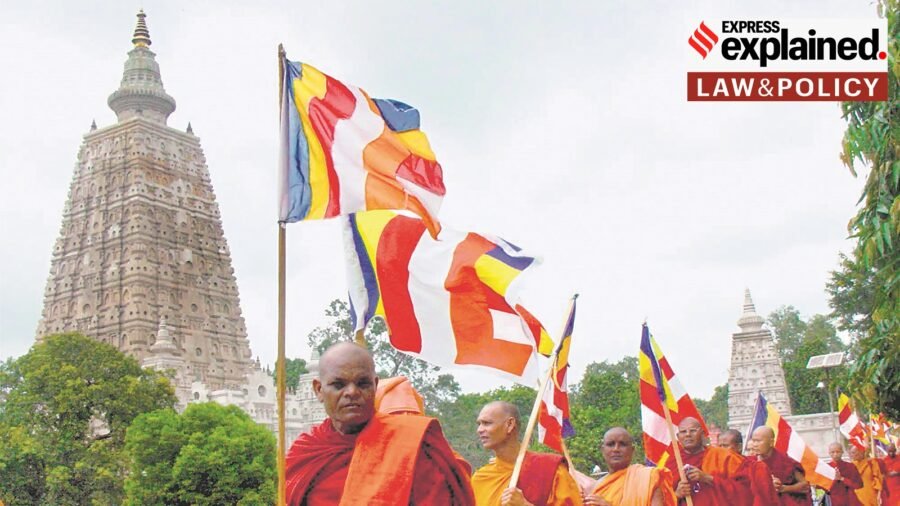
A Supreme Court bench led by Chief Justice of India (CJI) Surya Kant on Tuesday (August 11) deferred hearing a challenge to the constitutional validity of the Bodh Gaya Temple Act, which governs one of the most important sites in Buddhism.
The plea seeks repeal of the 1949 Act and asks for a new Central law, under which the “total management, control and administration” of the Mahabodhi Temple in Bihar would be vested in Buddhists. Currently, Hindus are also involved in its management.
At its core, the petition argues that the existing statutory framework dilutes Buddhists’ right to manage the shrine. It additionally seeks declaration as a site of “national importance,” the removal of alleged encroachments, and separate land for Hindu worship. The petition was filed by the Buddhist Society of India and tagged with seven similar petitions.
The SC bench has deferred hearing to October, until after it delivers judgment in the nine-judge Sabarimala Temple reference. The connection between the two cases is largely constitutional. The Bodh Gaya case also relies on Articles 25 and 26 (on religious freedoms) to argue that Buddhists should exclusively manage the Mahabodhi Temple. In listing the matter for October, the SC has indicated that the Sabarimala verdict will be out by then, which is expected to clarify the scope of denominational rights and religious autonomy.
History, governance of Bodh Gaya
Prince Siddhartha is said to have attained enlightenment or nirvana and become the Buddha (literally, “the Enlightened One”) in 589 BCE while meditating under the Bo tree in Bodh Gaya.
Emperor Ashoka constructed a shrine to mark the site in the 3rd century BCE, of which only the Vajrasana (Diamond Throne), a stone slab under the Bodhi tree next to the temple, remains. The broader Mahabodhi Temple Complex is also a UNESCO World Heritage Site.
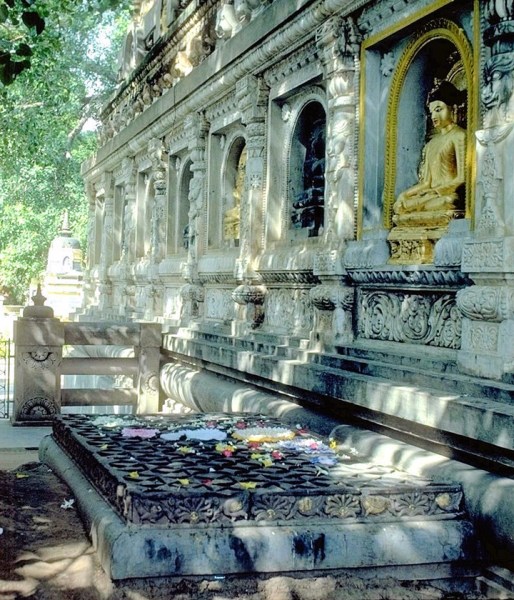 Vajrasana Diamond Throne of Ashoka at Bodh Gaya. (Wikimedia Commons)
In 1949, the Bodh Gaya Temple Act was enacted in the Bihar legislature to regulate the management and control of the temple and its properties. It creates an eight-member committee with four Hindu and four Buddhist members. The government can nominate one secretary among them, while the Gaya district magistrate serves as the ex-officio chairperson.
Story continues below this ad
While the Act provides for parity, the petition argues that actual control has remained skewed because the district magistrates have historically been Hindu. It contends that a “change in management structure” is needed to remove what it sees as a Hindu dominance in the temple’s administration. To illustrate this, the plea states that between 1953 and 2007, only one of seven secretaries appointed under the Act was a Buddhist.
It also takes issue with the State’s powers under the Act. It points out that if the government is “satisfied that the committee is guilty of gross mismanagement”, it can dissolve the committee, reconstitute it, or assume direct control of the temple and its properties. According to the petitioner, this shows that the State remains the “ultimate owner and controller”.
Another argument pertains to provisions governing worship. The petition notes that the committee is tasked with ensuring the proper conduct of worship at the temple and “pindadan (offering of pindas) on the temple land”, which is a Hindu ancestral ritual.
It further points to Section 11, which states that “Hindus and Buddhists of every sect shall have access to the Temple and the Temple land for the purpose of worship and pindadan”. According to the petitioner, this creates a statutory carve-out for Hindu religious practices within a Buddhist place of worship.
The Mahanth’s role and Hindu rituals
Story continues below this ad
The Act defines a “Mahanth” as the presiding priest of the Shaivite monastery at Bodh Gaya. Under Section 3(2), the Mahant is one of the four Hindu members of the management committee. Section 13 further provides that the committee has no jurisdiction over the movable or immovable property of the “Shaivite monastery of Bodh Gaya.”
The petitioner argues that these provisions entrench the monastery’s role in the temple’s governance structure and enforce the impression that the site is linked to Hinduism. It also says that Buddhists are left with only “symbolic representation”.
Another part of the petition concerns the distinction between Buddhism and Hinduism and argues that Hindu rituals should not be performed within the Mahabodhi Temple Complex.
It states that Buddhism “does not involve a belief in any God” and rejects the proposition that Buddha is an incarnation of Vishnu as a “misconception and myth.” It places objections to the practice of Hindu rituals, arguing that “the practice of pind dana to their ancestors can not be permitted in the Bodhgaya temple.”
Story continues below this ad
The petition further contends that references in the Act to puja, temple worship and pindadan blur the distinction between the two faiths and are inconsistent with the Buddhist character of the site. It also alleges that the Buddha statue is draped and identified in a manner associated with Hindu worship.
Basis in fundamental rights
The constitutional challenge is anchored in Article 13, which provides that laws “in force in the territory of India immediately before the commencement of the Constitution… shall be void” if they are inconsistent with fundamental rights.
Since the Bodh Gaya Temple Act predates the Constitution, the petitioner argues that it must be tested against Constitutional guarantees. Relying on Articles 25 and 26, the plea argues that the administration of the Mahabodhi Temple should rest exclusively with Buddhists, stating that Buddhists are a minority community.
The petition also invokes Article 14 on equality before the law, alleging discrimination against Buddhists, and Article 29 on the cultural rights of minorities, arguing that Bodh Gaya occupies a unique place in Buddhist history.
Story continues below this ad
It further relies on Article 49, which requires the State to “protect every monument or place or object of artistic or historic interests, declared by or under law made by Parliament to be of national importance”.

Campaign to reduce the intake of salt
By Sohail Khan · 21 Sep
Missing measure in India’s magnet mission
By Sohail Khan · 21 Sep
India’s real rate moment, the cost of delay
By Sohail Khan · 21 Sep