Why Karnataka’s two new laws sparked controversy over Bengaluru tunnel road project
The passage of two Bills in the Karnataka state legislature on governing parks and urban mobility — two existential subjects in the state capital Bengaluru — by the ruling Congress government during a short-lived monsoon session has fuelled a controversy.
On Monday (August 24), the two Bills — The Karnataka Government Parks (Preservation) (Amendment) Bill, 2026, and The Bengaluru Metropolitan Land Transport Authority (Amendment) Bill, 2026 — were passed by both Houses of the legislature without a debate, amid protests by the opposition BJP demanding the resignation of a Congress minister accused in a corruption case.
While the Bills seem innocuous in nature in terms of its stated purpose — allowing usage of 5% of protected park lands in Bengaluru for public utilities and providing retrospective clearance for big ticket urban mobility projects — they are also being seen as disguised efforts to facilitate construction of a controversial and unpopular 16.75-km city tunnel road, which happens to be a pet project of Karnataka Chief Minister D K Shivakumar.
Story continues below this ad
Here’s what to know about the two Bills, why they are attracting criticism, and the controversy surrounding the Rs 40,000 crore Bengaluru tunnel road project.
The Karnataka Government Parks (Preservation) (Amendment) Bill, 2026
The proposed law amends the Karnataka Government Parks (Preservation) Act, 1975, and diminishes the protection accorded to parks in cities like Bengaluru, which has been known as a “Garden City” in the past before traffic woes took over. It allows the state government “to alienate park land by way of sale, lease, gift, exchange, mortgage, or otherwise, up to an absolute limit of 5% of the total area”.
While the government has argued that the new law “applies strictly in favor of Government Departments, Statutory Authorities, Government Companies, or Local Authorities for public utility projects”, the Opposition and environmentalists see the Bill as unlocking the door to commercialisation and use of parks for state infrastructure projects.
The amendment withdraws restrictions imposed in Section 5 of the 1975 Act (on diversion of park land for alternative purposes by the state) by allowing the diversion of 5% of any park land for public infrastructure purposes. According to the new law, the diversion of park land can be authorised on the basis of the recommendations of a High Level Committee created by the state if the committee “considers it to be expedient in public interest to permit the utilization of any land or building or parts thereof comprised in a Park or Garden…” as being in public interest.
Story continues below this ad
Bengaluru has around 1,353 parks, with the 240-acre Lalbagh Botanical Garden — which is over 200 years old — and the 197-acre Cubbon Park being the most iconic ones.
The BJP has criticised the new law as “full scale real estate commercialisation” of parks, and have alleged that it is intended to facilitate the construction of the controversial tunnel road through Bengaluru’s iconic Lalbagh Botanical Garden. This will be undertaken by the Adani Group, which is the lowest bidder for the project.
“Bengaluru is already choking, stripped of its canopy, and desperate for green spaces. Instead of expanding and fiercely guarding our parks, this government views public open space as nothing more than a private land bank waiting to be monetised,” R Ashoka, BJP MLA and the Leader of Opposition in the Karnataka Assembly, said on social media.
Bengaluru South MP and BJP leader Tejasvi Surya, who has filed a writ petition in the Karnataka High Court against the proposed tunnel road project running through five acres of the Lalbagh garden, urged in a letter to the Governor to deny assent for the amended park preservation law and “refer it back to the State Legislature for reconsideration”. He also pointed to the proposed Hebbal Short Tunnel project needing approximately 3.45 acres of Hebbal Lake, which he called a “crucial aquifer” and an “ecologically important green space” in the city.
Story continues below this ad
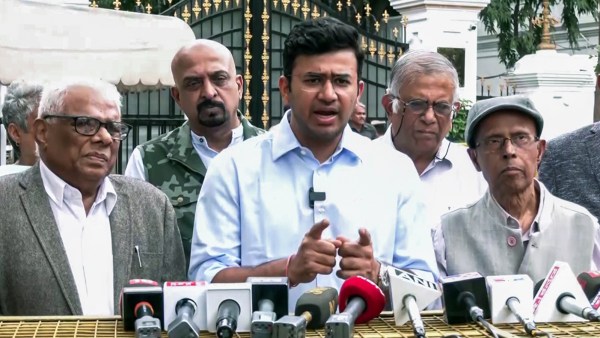 BJP MP Tejasvi Surya in Bengaluru on August 26, 2026. Photo: ANI
Karnataka CM Shivakumar denied claims that the new law will allow commercialisation of parks and facilitate usage of Lalbagh for the tunnel road project. He said that the tunnel road “will pass under Lalbagh but Lalbagh itself will not be affected”.
“In a corner… there may be a requirement for land usage during construction. It will be a small portion that is not used. There may be temporary usage for six months for storage of machinery, that is all,” he said.
Shivakumar, who has interests in the real estate sector in Bengaluru, added his government would create six new parks on the lines of Lalbagh in and around Bengaluru, spread over 5,000 acres of land.
The Bengaluru Metropolitan Land Transport Authority (Amendment) Bill, 2026
This amendment to the Bengaluru Metropolitan Land Transport Authority (BMLTA) Act, 2022, provides deemed clearances to major city projects proposed since 2023. It is widely seen as an effort to circumvent BMLTA evaluation and clearances of major Bengaluru mobility projects like the tunnel road project and other constructions.
Story continues below this ad
The law amends Section 19 of the Act by introducing a new subsection [Section 19(6)], which says: “…all projects initiated during the period commencing from the date of commencement of the Bengaluru Metropolitan Land Transport Authority Act, 2022 (Karnataka Act 06 of 2023) and ending immediately before the date of notification of the Bengaluru Metropolitan Land Transport Authority Rules, 2026,….., shall be deemed to have been taken, prepared, undertaken or instituted, as the case may be, under this Act.”
Before this amendment, Section 19 said the BMLTA had the power “to approve all major Urban Transport projects proposed” for Bengaluru “from the perspective of consistency with the Comprehensive Mobility Plan” in a time-bound manner.
In its statement of reasons, the new law says that the amendment is necessary “to ensure continuity in administrative decision making in view of the imminent and pressing need to decongest traffic and address the mounting mobility challenges in Bengaluru”.
The law has come amid a challenge by citizens in the Karnataka High Court to controversial rules framed on January 3, 2026, by the BMLTA to facilitate the retrospective clearances for big-ticket Bengaluru mobility projects that did not undergo the due process of scrutiny and analysis by urban mobility experts and agencies.
Story continues below this ad
The BMLTA itself has been critical of the tunnel road project: in a review of the project’s feasibility last year, it said the project does not align with Bengaluru’s Metro-centric Comprehensive Mobility Plan (CMP), the city’s Climate Action Plan, or the National Urban Transport Policy. Highlighting the CMP’s target of a 70% share for public transport by 2035, the review said that tunnel roads would encourage car-based commuting instead.
BJP leaders and urban mobility experts in Bengaluru are also in favour of expanding the Bengaluru Metro network rather than embarking on the cost-intensive tunnel road project.
The Bengaluru Tunnel Road project
The 16.75-km north-south tunnel road project in Bengaluru proposes to connect the Hebbal and Silk Board junctions through twin tunnel tubes. This is to be executed in two packages: the first package comprises the Esteem Mall, Hebbal-Seshadri Road stretch and the second is the Seshadri Road-St John’s Hospital, Madiwala stretch.
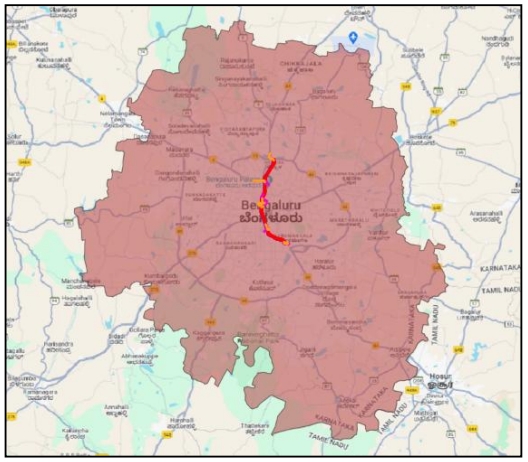 The tunnel road project’s location in Bengaluru’s administrative boundary.
As per the bids opened by the Bengaluru Smart Infrastructure Ltd — a special purpose vehicle established by the Karnataka government in June last year — the Adani Group emerged as the lowest bidder, quoting a total of Rs 22,267 crore against the government estimate of Rs 17,698 crore.
Story continues below this ad
For the first package, the Adani Group reportedly placed a bid of Rs 10,867 crore against the government’s estimated cost of Rs 8,770 crore. In the second package, the Adani Group’s bid was Rs 11,400 crore against the government estimate of Rs 8,928 crore. The group’s bid is approximately 24% higher for the first package and 28% higher for the second package.
The bids were invited when Shivakumar was the Deputy CM, in charge of the development of Bengaluru (May 2023-May 2026). According to Shivakumar, the project would help ease the traffic burden in the heart of Bengaluru.
The tunnel road project, structured under a build-operate-transfer model, envisions 40% government funding with the remaining investment coming from private concessionaires. On the lowest bid amount being much higher than the original estimates, Shivakumar had said last year: “The government is not paying any money to the bidder. The bidder has to invest in the project and we will give them only 40% of our estimates.”
That the two Bills were passed by the Karnataka legislature a day after Gautam Adani, the chairman of the Adani Group, had a meeting with Shivakumar has also added to the controversy. While the CM’s office described the meeting with Gautam Adani as a “courtesy visit”, Karnataka Home Minister Priyank Kharge said that the meeting was in context of the Adani Group being a “government contractor” and there was nothing inappropriate about it.
Story continues below this ad
“The Adani Group has several projects in Karnataka. The ACC cement factory in Chittapur (Kharge’s constituency) was taken over by the Adani Group, the Mangalore Airport is operated by the group. So, the company is already operating projects in the state,” Kharge said.

Everyone loves the baby. Who cares for the mother?
By Sohail Khan · 31 Aug
Typhoid control needs more vaccine, less antibiotic
By Sohail Khan · 31 Aug
Don’t make Vande Mataram a religious quarrel
By Sohail Khan · 31 Aug
Leave a Reply