Why is Kaziranga’s Eco-Sensitive Zone in focus? | Explained
The story so far:
The Assam government recently announced plans to approach the Centre to shrink the Eco-Sensitive Zone (ESZ), a buffer zone around protected areas, to a minimum of 1 km instead of the default 10 km. Chief Minister Himanta Biswa Sarma’s argument that an ESZ of more than 1 km around Kaziranga National Park and Tiger Reserve would affect civic and urban growth in surrounding towns has stoked controversy and raised questions about the government’s seriousness about conserving natural assets.
What is an ESZ?
Also known as an Ecologically Fragile Area, an ESZ is a buffer zone or a wide demarcated strip around national parks and wildlife sanctuaries protected by law to stop heavy human damage, lower human-animal conflicts, and improve conservation of natural assets.
The National Board for Wildlife (NBWL) adopted a resolution in 2002 to declare such buffer zones around protected areas under the Environment (Protection) Act of 1986. As part of the National Wildlife Action Plan (2002-2016), the Ministry of Environment, Forest and Climate Change (MoEFCC) instructed the State governments in 2011 to submit site-specific proposals for ESZs, with a general guideline that a buffer zone should be up to 10 km from the periphery of a protected area. The guidelines allowed an ESZ to exceed the 10-km limit to include larger ecologically important sensitive corridors, connectivity patches, and vital landscape linkages.
Why are ESZs important?
According to the NBWL, an ESZ is envisaged as a shock absorber to minimise the impact of certain human activities on the fragile ecosystem of the protected areas. In other words, it is considered a transition zone between high-protection areas and low-protection areas, without affecting the daily activities of people living in the vicinity. Such activities have three categories—prohibited, regulated and permitted.
The prohibited activities include commercial mining, sawmills, industries causing air, water, soil and noise pollution, hydroelectric projects, discharge of effluents or solid waste and certain tourism events. Among the regulated activities are felling of trees, establishment of hotels and resorts, commercial use of natural water, erection of electric cables, widening of roads and drastic change of agricultural system with the use of heavy technology, pesticides, etc. The permitted activities include ongoing eco-friendly agricultural or horticultural practices, rainwater harvesting, the use of renewable energy sources and adoption of green technology. All these are intended to minimise the impact of urbanisation and other developmental activities on the flora and fauna in the protected areas.
Can the extent of an ESZ be reduced?
According to the rules, the default 10 km ESZ extent remains in force for protected areas unless a State government submits or receives a final, site-specific notification approved by the MoEFCC.
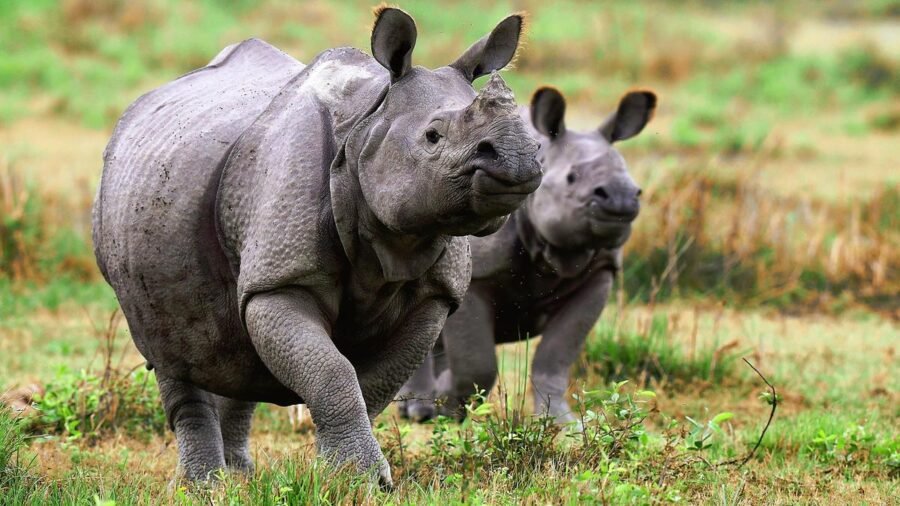
Assam has eight national parks, more than 20 existing and proposed wildlife sanctuaries, and other protected areas with ESZ varying by site. While a few have site-specific draft or final notifications, the rhino-centric Kaziranga operates under the default rule pending final tailored notifications.
The Chief Minister cited the case of Deepor Beel, a Ramsar Site on the south-western edge of Guwahati, to argue that Bokakhat, Kaliabor and other surrounding towns warrant a 1-km ESZ for Kaziranga.
The MoEFCC’s July 2025 draft notification for Deepor Beel notes the “immense biotic pressure” on the wetland due to expanding human settlements, industrial units, discharge of city waste and industrial effluents, and a railway track along its southern boundary. It prescribes an extent of 25.294 metres to 5 km around the Deepor Beel Bird Sanctuary (covering 4.1 sq. km within a wetland that extends up to 40 sq. km in the summer and reduces to about 10 sq. km in winter), encompassing an ESZ of 38.84 sq. km.
The Chief Minister also referred to a Supreme Court order to announce plans to approach the Centre for a baseline ESZ buffer of 1 to 3 km around Kaziranga. Based on objections from some States, specifically Kerala, which wanted the ESZ around Wayanad Wildlife Sanctuary reduced from 118.59 sq. km down to 88.21 sq. km, the Supreme Court modified its June 2022 order that mandated a uniform 1-km ESZ around all protected forests.
In April 2023, the Supreme Court ruled that a one-size-fits-all ESZ is not feasible, exempting areas with existing draft or final notifications and allowing basic local infrastructure, while maintaining a strict ban on commercial mining near sanctuaries.
How will a reduced ESZ impact Kaziranga?
The Chief Minister’s announcement has elicited strong reactions.
Jadab Payeng, a grassroots environmental activist based east of Kaziranga, urged the government to stick to 10 km as the ESZ for the UNESCO World Heritage Site given the frequent human-animal conflicts. He said Kaziranga’s reputation as one of the best protected national parks in the world would suffer otherwise.
Assam Congress president Gaurav Gogoi and environmental groups questioned the proposal against wider ecological protection, warning that a shrinking buffer zone for the 1,302 sq. km Kaziranga Tiger Reserve could harm animal migration routes during annual floods.
The worry is more about the southern boundary of the rhino domain blending into the hills of Karbi Anglong district across National Highway-715 (formerly NH-27), where animals take refuge when the core area of the national park is flooded. Stone quarrying and riverbed mining in these hills—a Karbi Anglong-based activist recently flagged large-scale sand extraction and use of heavy machinery in the Deihori River—close to the park have been threatening vital wildlife corridors and local hydrology.
There are also allegations against influential political leaders, their family members and business houses having established or pursuing hotels and resorts within the proposed ESZ. Local farmers have been opposing one such luxury hotel project for which Pranab Doley, a land rights activist, has been detained under the National Security Act.

TDP activist clings on to ZP Chairman’s car bonnet for 3km in Chittoor
By Sohail Khan · 8 Sep
One held for attempting to murder prison officer in Keralam
By Sohail Khan · 8 Sep
Former Delhi chief secretary Rakesh Mehta dies by suicide: Officials
By Sohail Khan · 8 Sep