When the British built a 4,000-km wall of thorns across India to tax a kitchen ingredient
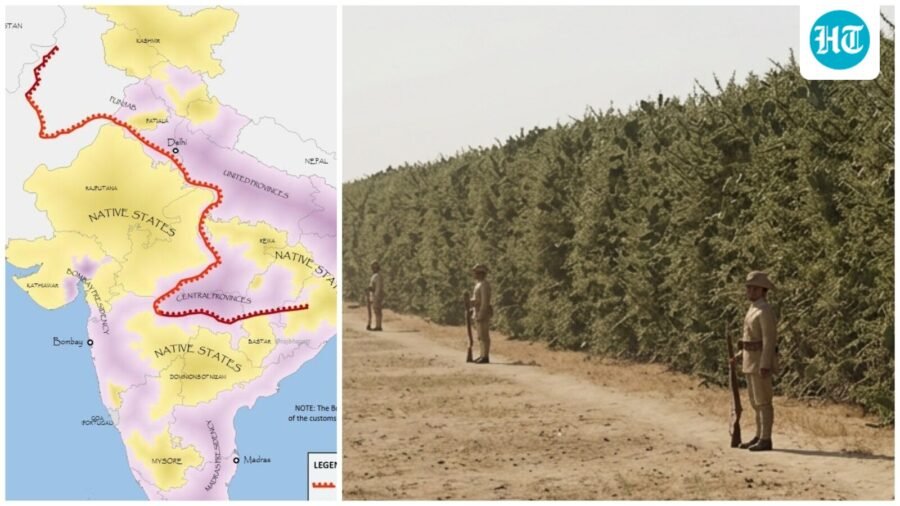
'The Great Hedge of India' was a vast network of thorny bushes, trees, brushwood, customs posts and patrol routes.
Updated on: Aug 26, 2026, 12:33:21 IST
Prefer HTon Google
Share via
Copy link
Everyday life in 19th-century India involved a barrier larger than most European borders. It was built for a single purpose of keeping salt out of dinner pots.
Salt, under the British Raj, became one of the state's most heavily taxed commodities. To protect this revenue, colonial administrators created a 4,000-kilometre wall of thorns across the country.
'The Great Hedge of India' was a vast network of thorny bushes, trees, brushwood, customs posts and patrol routes designed to stop untaxed salt from entering areas where the British charged higher duties.
Everyone needed salt and the British colonisers knew to capitalise on it. Thus began the story of the hedge.
Why the British needed a giant wall
The problem was caused by different salt prices and taxes across British-controlled areas. Traders bought cheaper salt in one region and sold it for a profit in areas where taxes were higher. It cut into British revenue.
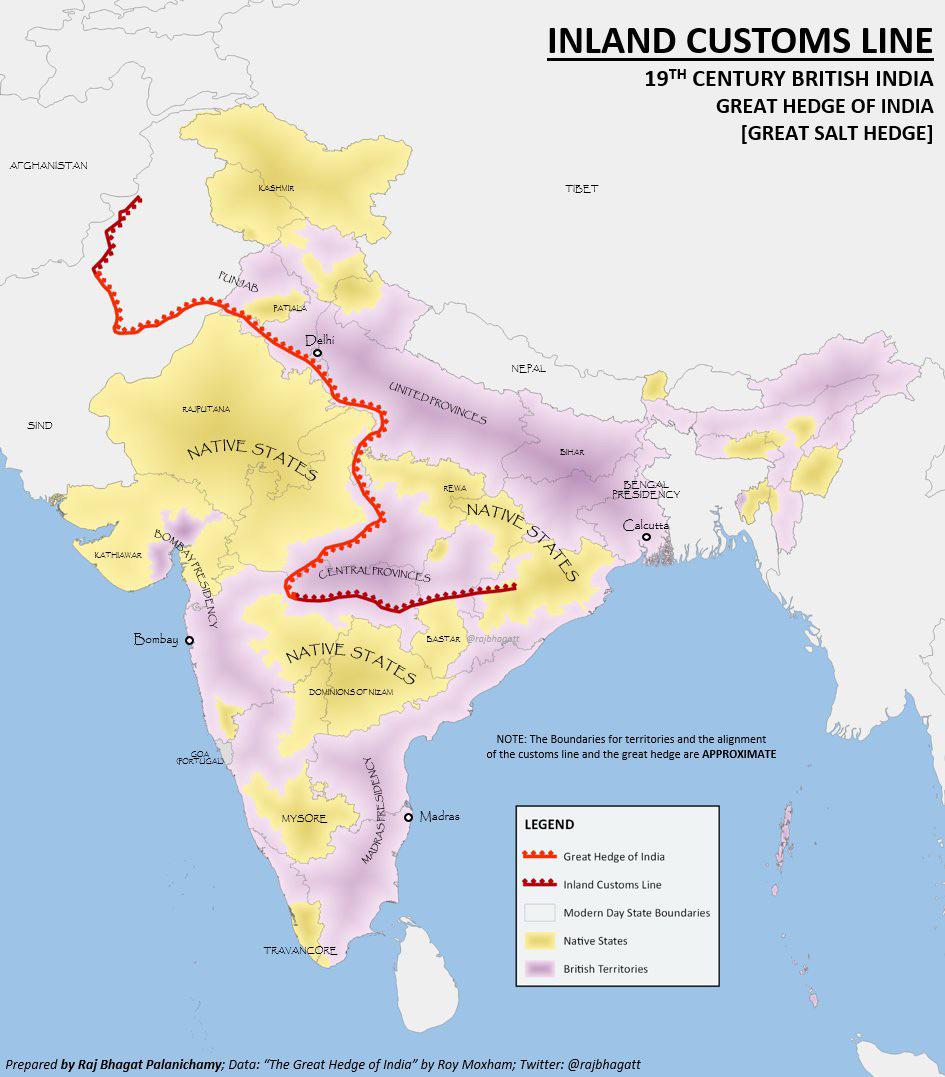
To stop this, the East India Company set up customs posts and checkpoints in the early 19th century. In 1843, the system came under the Inland Customs Department, which stopped untaxed salt from entering high-tax areas, especially the Bengal Presidency. As British territory expanded, so did the customs line.
From checkpoints to a wall of thorns
The Inland Customs Line began with customs posts, checkpoints and patrol routes. Officials later added stakes, deadwood and thorny bushes to stop people from crossing over.
By the 1860s, the British began planting vegetation densely, creating what became known as the Great Hedge of India. It used babool, karonda, Indian plum, prickly pear, bamboo and other thorny plants, as per archieval records and books. Dry branches were used where the plants failed to grow.
By 1869, the line stretched more than 4,000 kilometres, from Multan (in present-day Pakistan) to Orissa (now Odisha). Rivers such as the Indus, Sutlej and Yamuna formed natural barriers in some areas, while trenches and embankments were used elsewhere.
In places, the hedge was 10-12 feet high and up to 14 feet thick. One British officer compared it to the Great Wall of China.
An enormous workforce
Keeping the hedge alive and maintaining the customs line required a large administrative operation. In the financial year 1869-70, the Inland Customs Line employed around 12,000 people and operated about 1,727 customs posts.
Guards, inspectors, gardeners and labourers were spread along the route.
The hedge needed constant attention. Termites, rats, storms, fires and natural decay damaged it. Sections that failed to grow had to be replanted with brushwood brought from elsewhere.
As much as 250 tonnes of dry branches and brushwood per mile, according to accounts cited in research on the hedge.
Among the officials involved in strengthening the system was Allan Octavian Hume, then Commissioner of Inland Customs. Hume would later become one of the founders of the Indian National Congress.
How much money did the salt tax bring?
In 1869-70, the Inland Customs Line collected around ₹1.25 crore in salt tax. The maintenance of the system cost about ₹16.2 lakh, as per historical records in History Under Your Feet website.
By 1877, salt tax revenue across British India had reached roughly £6.3 million, which made salt one of the colonial government's most lucrative sources of income.
Was the hedge foolproof?
The barrier was designed to make crossings difficult, but smugglers continued to find ways around it. They could throw sacks of salt over the hedge to accomplices waiting on the other side. Sections could be cut or burned. Others could simply look for weaker points or find ways around the barrier.
How a 4,000-km hedge vanished
By the late 19th century, the British began making changes to the salt system. Tax rates became more uniform across India. As the differences in salt prices narrowed, the massive inland customs barrier became less necessary.
In 1879, the Inland Customs Line was formally abolished. The customs organisation was disbanded and the hedge was abandoned.
Once officials stopped maintaining it, vegetation died, useful wood was removed, embankments eroded and the surrounding landscape slowly reclaimed the route.
Within a few decades, the enormous barrier almost vanished.
In 1995, British book conservator and historian Roy Moxham came across an elderly priest in Uttar Pradesh's Airak. He remembered where remnants of the old barrier could be found. The priest had been a dacoit in his younger years.
Moxham eventually identified what may have been surviving traces of the hedge near Etawah in Uttar Pradesh.
His research became the basis for his 2001 book, The Great Hedge of India: The Search for the Living Barrier that Divided a People, which brought the forgotten story to an audience.
Salt: A weapon against the Raj
The hedge disappeared in the 19th century, but the salt tax remained. More than 50 years later, salt would become the focus of one of the most important campaigns of India's freedom movement.
In 1930, Mahatma Gandhi chose the salt tax as the mantle of his civil disobedience campaign.
See Less


A new right of way: What AP’s Pedestrian Policy means for the public
By Sohail Khan · 26 Aug
Murder accused shot in leg by police during arrest bid in Neyveli
By Sohail Khan · 26 Aug
Leave a Reply