What led to the re-test of three UGC-NET papers? | Explained
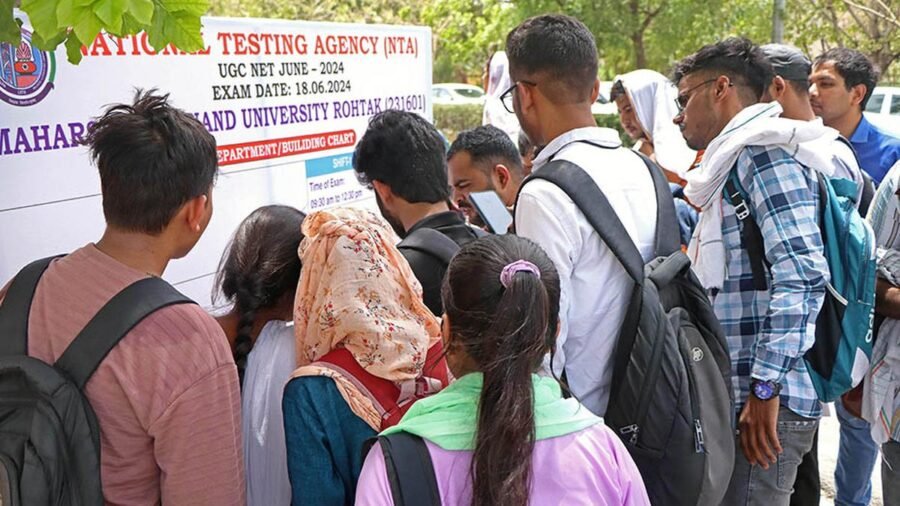
The story so far: The National Testing Agency (NTA) will re-conduct the UGC-NET examination for English, Sociology and Commerce after receiving complaints of “multiple errors” in the question papers, according to an official notification released on August 16.
The UGC-NET was held from June 22 to 30 across 87 subjects. Under the new notification, the English and Commerce papers will be re-conducted on September 9, while Sociology will be held on September 10. The same day, the NTA also released the provisional answer key for the remaining 84 papers, clarifying that the re-test will not affect the results of candidates who appeared for those subjects.
The NTA said results for the 84 unaffected subjects will be declared as scheduled, and that allocation of Junior Research Fellowship (JRF) seats and e-certificates for Assistant Professor eligibility and PhD admission will not be delayed by the re-conduct of the three papers.
On the errors, the NTA said it had formed a committee to investigate the complaints.
“The Committee recommended that, in the interest of holding a fair and error-free examination, these three papers should be re-conducted. It has therefore been concluded by NTA that papers carrying such defects do not meet the standards of fairness and error-free examination, and defects of this extent cannot be cured merely by dropping questions after the challenge process,” the notification said.
What were the errors?
The committee found that the three papers contained “factual, typographical, translation errors, including misspelt names of prominent scholars, garbled book titles, errors in the stem wording of questions, grammatical errors, gender and number agreement errors, punctuation mistakes, and non-standard coined terms for established concepts, as well as repetition of a significant number of questions previously administered.”
Candidates who sat the Sociology paper recalled specific errors. Surya, from Chennai and currently in Delhi preparing for his PhD, was attempting the exam for the fifth time to clear JRF. He recalled sociologist T. Parsons being misspelt as “T Parsows” in one option, and George Ritzer rendered as “Putzer” in another — both prominent figures in the field. He also recalled J.K. Rowling, the Harry Potter author, appearing as an option in one multiple-choice question. “Which is funny,” he said.
Juliya, from Kozhikode in Kerala and currently pursuing a Master’s at Jamia Millia Islamia, Delhi, also sat the Sociology paper — her second attempt, having first appeared in December 2025. She recalled Indian sociologist A.R. Desai being misnamed “AK Desai”.
Simran, from Bihar, sat the English paper for the third time this year to clear JRF; the fellowship available to non-NET scholars at Delhi University is a stipend of ₹8,000 a month. She alleged that 60 to 65 questions, including the comprehension-based ones, were repeated from the December 2024 re-test paper — itself conducted after an earlier examination was cancelled. The similarity was so striking, she said, that she felt as though she had already taken the paper, particularly since the comprehension passage was identical.
Why are candidates concerned?
The NTA notification states there is no additional fee for the re-test, but for candidates it still means repeating months of preparation and bearing fresh travel costs to their exam centres. Beyond the expense, many are also dealing with the mental strain of preparing for an examination they have already taken.
Uncertainty over the revised results has added to concerns about their academic future, including the timeline for JRF certification and PhD admissions. Some candidates are unsure whether admissions will still be open by the time revised results are declared.
Surya will have to travel back to Chennai for the re-test in September. He said the delay had already caused anxiety: “I have no idea what I should do after coming back to Delhi… I have very little time, I also have to apply to universities and work on my PhD proposal.”
Simran said she had studied roughly 12 hours a day for three months and must now repeat that preparation alongside her PhD work. “Either you give me a fellowship or give me a fair exam,” she said. She also pointed to the delayed release of the provisional answer key, which extended candidates’ uncertainty, and to the financial burden of preparing and appearing for the exam a second time while managing accommodation, food and other costs in Delhi.
What happens to the other candidates?
Candidates who sat the remaining 84 subjects will not have to retake the exam; the NTA has said their results will be declared as scheduled, with JRF allocation and e-certificate issuance for those subjects unaffected by the re-conduct.
“Results for the 84 subjects for which Answer Key Challenge was issued earlier today will be declared as per schedule. Allocation of JRF seats and issuance of e-certificates for eligibility for Assistant Professor and for admission to PhD for these 84 subjects will not be delayed due to re-conduct of the examination for the three subjects. The number of candidates to be qualified for eligibility for Assistant Professor shall be equal to 6% of the candidates who appeared in the test conducted in June 2026, or the retest, whichever is higher,” the notification said.
For candidates in the three affected subjects, however, the September exam will determine their revised scores and eligibility, leaving the timeline for results — and its knock-on effect on admissions — uncertain. The notification adds: “Similarly, the subject-wise allocation for the remaining three subjects for (i) JRF (ii) eligibility for Assistant Professor and (iii) eligibility for admission to PhD, will be done as mentioned in the Information Bulletin. After the retest, the numbers already allocated for each subject shall not be reduced under any circumstances.”
What does the NTA not clarify?
The notification closes by saying the “NTA remains committed to conducting examinations that are fair, accurate and transparent,” but it does not specify the nature or extent of the errors, or how many questions were affected in each paper. It makes no provision for reimbursing candidates’ travel or accommodation costs for the re-test, and gives no specific timeline for the declaration of results.
Candidates said answer keys are usually released within 20 to 25 days of an exam; this year’s provisional key came 45 days after the UGC-NET, alongside the announcement of the re-test. Candidates have questioned whether an earlier decision could have reduced the time lost and given those affected more time to prepare.
also spoke to candidates who sat other subjects, including geography, political science and physical education. Some reported alleged repetition of questions in their papers and raised similar concerns — but these complaints have not led to any re-test announcement for those subjects.

Centre denies permission for Telangana CM Revanth Reddy’s U.S. visit
By Sohail Khan · 21 Aug

Leave a Reply