What is ‘political clearance’ and why do chief ministers need it for foreign trips?
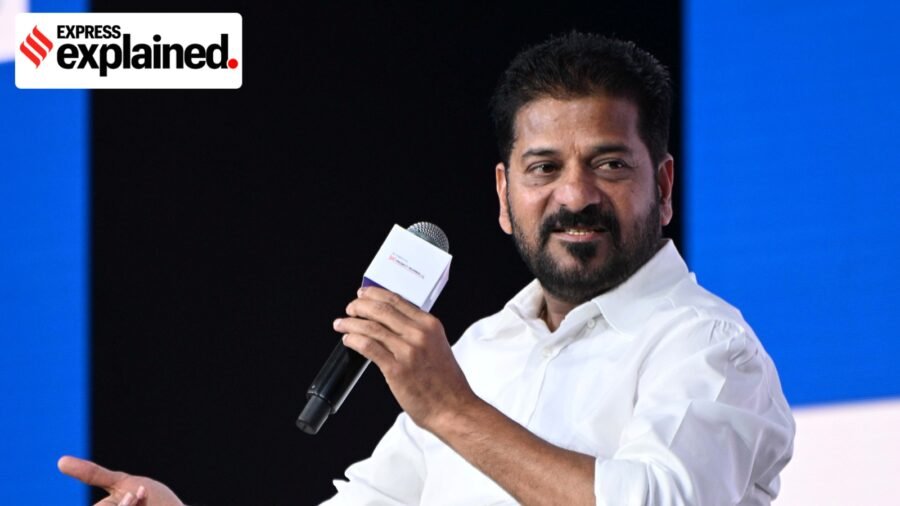
Telangana Chief Minister A Revanth Reddy’s visit to the US has been cancelled after the Ministry of External Affairs (MEA) denied “clearance from political angle”, his office said on Friday.
For a foreign trip, public servants need something called “political clearance” from the External Affairs Ministry.
Reddy, who had embarked on a 10-day tour of the UK and the US on August 20 to sign MoUs with educational institutions, will now return from London to Hyderabad on August 23 instead of leaving for Boston.
Story continues below this ad
What is political clearance, why is it required for public servants such as chief ministers and how is it granted? We explain:
What is political clearance?
Political clearance is granted by the Ministry of External Affairs (MEA). This is required not only for public servants but any government servant for a foreign trip. The MEA gets hundreds of requests for political clearance every month from ministries, secretaries, bureaucrats and other officials.
The decision to grant or deny clearance is based on multiple factors, such as the nature of the event, the level of participation from other countries, the kind of invitation that has been extended, and also India’s relations with the host country.
The system is meant to ensure that official foreign visits do not have diplomatic or foreign-policy implications that have not been assessed by the government.
Story continues below this ad
Since 2016, political clearance applications can be made on the MEA website epolclearance.gov.in. These are processed and clearance is issued after coordination among various ministry divisions, which is done through a dedicated ‘Coordination Division’.
What clearances do Chief Ministers require to travel abroad?
Chief Ministers, as well as state and Union Territory ministers, are required to inform the Cabinet Secretariat as well as the MEA about any foreign visit, be it official or private.
According to a Cabinet Secretariat circular on May 6, 2015, “… prior political clearance and FCRA (Foreign Contribution Regulation Act) clearance are mandatory.”
Chief Ministers, ministers of state governments and other state officials also need clearance from the Department of Economic Affairs, and must send a copy of the application to the DEA Secretary.
Story continues below this ad
The DEA and the ministry concerned will entertain an application only if political clearance from the MEA is attached with the request. Without this clearance, no public servant can go abroad.
How often have CMs’ requests for political clearance been denied?
Political clearance being denied is nothing new.
In 2022, Arvind Kejriwal, who was then the Delhi chief minister, had to cancel his Singapore visit after not receiving clearance.
In October 2019, the Centre had not given him approval to attend another conference abroad, which he eventually addressed through videoconferencing.
Story continues below this ad
During the previous UPA regime, the MEA had denied political clearance to trips by then Chief Ministers Tarun Gogoi (Assam, Congress) to the US and Israel, and Arjun Munda (Jharkhand, BJP) to Thailand. Gogoi had wanted to visit New York for a “high level meeting” on April 2, 2012; a note from the Ministry said: “… direct correspondence by a diplomatic Mission with a State Government being inappropriate”. About his proposed trip to Israel for an event on water and environment technology, the Ministry had said: “Concerned agencies would be hard put to provide special consideration for CM, Assam, both from the substantive and protocol angles.”
In Reddy’s case, his office is seeking clarity from MEA officials on why permission was denied. Officials said that the state government had sought permission from the Centre on August 16, but only the UK trip was approved. The Centre informed the state government of its refusal of permission after the official delegation reached the UK.
When Narendra Modi took oath as Prime Minister, he held meetings with the secretaries of several Union departments and sought their suggestions. On June 14, 2014, then Civil Aviation Secretary Ashok Lavasa (who later resigned as Election Commissioner) wrote to then Cabinet Secretary Ajit Seth that the “dilatory system” of the MEA clearing all proposals for travel abroad by officials should be changed.
Seth forwarded the letter to the MEA; then Foreign Secretary Sujatha Singh wrote back to him on August 13, 2014, stressing that it was the MEA’s prerogative to decide on the suitability, desirability and level of participation of Indian officials in engagements abroad. This practice continues.
Are any other clearances required?
Different officers need different additional clearances.
Story continues below this ad
- Chief Ministers, ministers of state governments and other state officials, as mentioned earlier, also need clearance from the Department of Economic Affairs.
- For Union ministers, after getting political clearance from the MEA, additional clearance is needed from the Prime Minister, whether the trip is official or personal
- Lok Sabha MPs need clearance from the Speaker, and Rajya Sabha members from the Chairperson (Vice President of India).
- For officers of various ministries up to Joint Secretary level, clearance is given by the minister concerned, after political clearance. For those above that rank, the proposal needs approval of a screening committee of secretaries.
The rules vary according to the duration of the visit, the country to be visited, and the number of members in a delegation. If the foreign trip involves the hospitality of organisations other than those of the UN, FCRA clearance is needed from the Home Ministry. Ministries often issue circulars that foreign travel requests must be submitted much early and ministries do not entertain such requests if political clearance is not attached to that.
For MPs, it is not obligatory to inform Lok Sabha or Rajya Sabha secretariat if the trip is private. However, several MPs do inform the office of the Speaker (Lok Sabha) or Chairman (Rajya Sabha). For government employees, all foreign trips, official or personal, need approval.
On May 9, 2019 the Union Department of Expenditure issued a circular directing Ministries/Departments to: “ensure that the timeline stipulated for submitting the proposal for foreign visits requiring ScoS (Screening Committee of Secretaries) and Prime Minister’s approval are received 15 days prior to departure date of the delegation but not later than before 5 days before date of departure”.
Do judges need clearance for foreign trips?
For official foreign travel, the proposal by a Supreme Court or High Court judge is sent to the Department of Justice (DoJ) after taking clearance from the Chief Justice of India. The DoJ, after taking political clearance from the MEA and in some cases from the Home Ministry (when FCRA is involved), issues approval. Political clearance from the MEA was needed even for personal trips until February 11, 2010, when the DoJ decided to dispense with this necessity in case of private visits.
Story continues below this ad
On February 15, 2011, the DoJ issued new guidelines, with restrictions particularly on the personal travel of judges of the higher judiciary. These guidelines were challenged in the Delhi High Court, which struck them down on May 25, 2012. So, now judges do not need clearance for personal foreign trips.
On July 13 last year, the Centre issued an Office Memorandum stating that “in such cases, where Visa Support Notes Verbale are sought from the CPV Division, MEA by the Hon’ble Judges of Supreme Court and the Hon’ble Judges of High Courts of India, prior Political Clearance of the MEA is to be submitted for the intended private or official visits abroad”. But on April 1 this year, the Delhi High Court, struck down the memorandum saying “it is uncalled for, given the high offices they (judges) are holding”.

Woman wears same T-shirt after 7 years, shows 65-kg weight-loss transformation: ‘Baby Nonu…’
By Sohail Khan · 28 Sep
In great powers’ AI race, New Delhi’s place will depend on capabilities built at home
By Sohail Khan · 28 Sep