What India stands to gain by joining NASA’s Moon Base programme
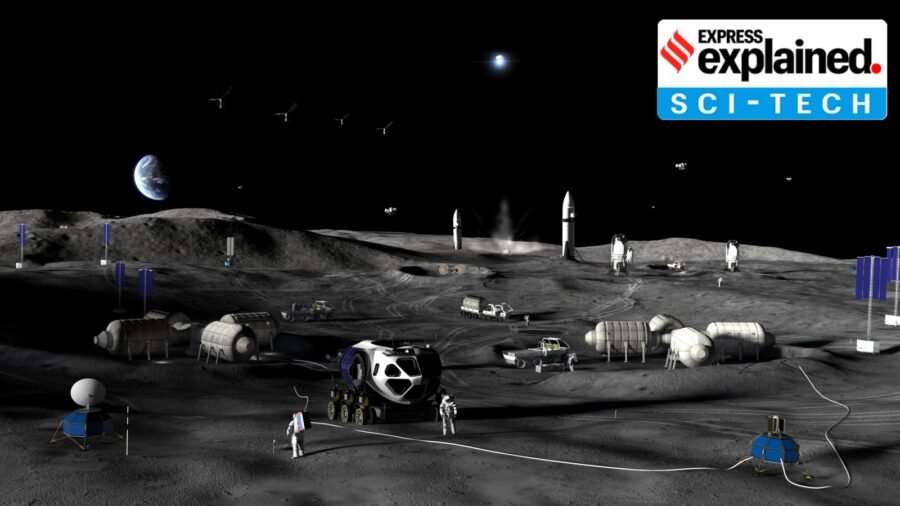
The invitation to join NASA’s Moon Base programme can be an important turning point in the history of the Indian Space Research Organisation (ISRO), one that can potentially put it on an entirely different trajectory. The invitation itself was not surprising, considering that India has already signed the Artemis Accords, and entered into a strategic partnership with the United States on human spaceflight missions. Yet, given the extremely volatile relationship between the two countries in the last couple of years, this initiative to forge a closer partnership on space is a refreshing move.
In scale and ambition, the Moon Base programme can be compared only to the Apollo missions. In terms of its impact on humanity and the future of the planet, it could turn out to be far more consequential.
Settling on the Moon
The Moon Base programme is about creating a permanent research station on the Moon, one that can be inhabited by astronauts, and robots, for prolonged periods of time. The base, to be built in stages over several years, is meant to facilitate lunar research, and allow exploration and exploitation of lunar resources. It will possibly be the most challenging engineering exercise ever undertaken, requiring several trips to the Moon by crewed and robotic missions. It could also be the costliest scientific project ever.
NASA is in no position, and does not want, to execute this entirely on its own. Its budget has been slashed significantly under the Donald Trump administration, while most of its hardware production is now happening in the private sector. So, it is seeking partners, both in the international community as well as in the private industry, to collaborate with.
The countries that have signed on to the Artemis Accords have, in a way, already shown a willingness to join such a collaboration. There are 70 nations in that club now, including some major space-faring countries like Japan, India, South Korea, and Israel. Several European countries are also in the group.
In a short period of six years, the Artemis Accords has come up as a unique grouping of countries interested in exploration of outer space. The Accords are just a set of principles and good practices that countries agree to follow while carrying out their space activities. But they are increasingly being seen as a US-led camp seeking to write its own rules for space exploration and use of extraterrestrial resources, subtly bypassing international multilateral arrangements. The fact that two major space powers, Russia and China, are not part of the group, gives credence to this argument.
India has traditionally been extremely reluctant to join any such group. But with Artemis Accords, it has made its choice very clear. It was one of the early signatories to the Accords, joining as the 27th nation in 2023. There is no official confirmation as of now, but it is very likely that ISRO would accept the offer of collaborating on the Moon Base programme.
Not adversarial
Story continues below this ad
It makes eminent sense for it to do so. ISRO has its own plans for human spaceflight missions, setting up a space station, and even landing humans on the Moon. Joining the Moon Base programme offers the opportunity for it to gain valuable experience in planning and executing complex missions like these, and leapfrog in technology development. ISRO has demonstrated its capabilities in executing such missions on its own as well, but that would require time and huge amounts of money.
Space exploration is reaching a stage where a 10-year gap in technology development can leave a nation fairly well behind. Besides, it would not make economic sense to reinvent the wheel. As it is, ISRO’s current plans to have an independent human spaceflight programme, a Moon landing programme, and also a full-fledged space station, are extremely ambitious. It is, no doubt, extremely important to have these capabilities. But it is difficult to imagine that India would have the scientific and economic rationale for running these sustainably on its own.
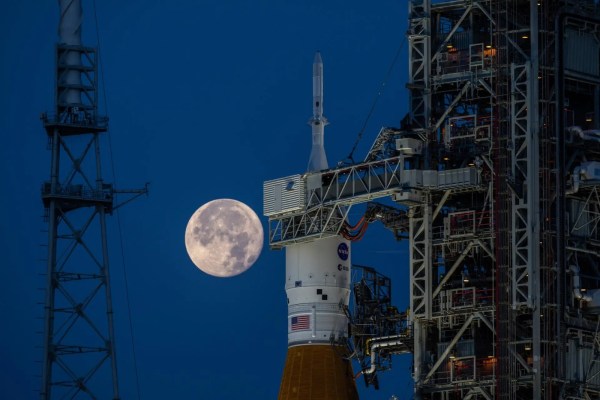 A full Moon is in view from Launch Complex 39B at NASA’s Kennedy Space Center in Florida on June 14, 2022. Photo: NASA/Ben Smegelsky
The plan for setting up the Bharat Antariksh Station is a case in point. While ISRO must have the technology and capability to build such space infrastructure, it is extremely unlikely that India would have, in about a decade’s time, a scientific ecosystem hungry enough to need an entire space station for its own use all year round. It will have to be a shared infrastructure, just like the International Space Station is right now.
Similarly, while it would be absolutely crucial to have independent capabilities to send humans into space, and land them on the Moon, maintaining a separate full-fledged programme for lunar exploration might not be economically feasible. The costs are prohibitively high even for the leading economy and richest country of the world. For a nation like India, which is chasing multiple parallel goals on the path to prosperity, it might be difficult to allocate resources on the scale required.
Artemis Accords
Story continues below this ad
The concerns about India joining what appears like a US-led bloc might be overstated. The Artemis Accords are not like a geopolitical or military camp. Space, as of now at least, is not adversarial. If the US lands on the Moon ahead of others, it does not get to control the area or the resources. It does not harm the interests of China or Russia, which are attempting to do the same thing through their own partnership.
The Moon is large enough, and its resources abundant enough, to support the efforts of all the parties, at least in the foreseeable future. That is why the current trend of de-globalisation, or go-it-alone approach, in matters of critical technologies like semi-conductors, clean energy and artificial intelligence does not apply in the case of space. There is no domination of supply chains or control over resources.
For India, signing the Artemis Accords, or joining the Moon Base effort, does not prevent it from continuing its long-standing space cooperation with Russia, for example.
ISRO does, however, have to ensure that it does not lose sight of its own targets and objectives while collaborating with the US. Also, that it does not get locked into the US technology ecosystem such that it creates an overdependence. The Artemis Accords does emphasise on development of interoperable systems, but it is not a major restriction for ISRO which is just beginning to develop these systems.
Story continues below this ad
The space cooperation with the US is, therefore, a major opportunity for ISRO to fast-track its project timelines, and get to the frontiers of technology development. It could result in a lot of spin-off benefits that can bring cascading dividends across sectors.
Rishi Sunak, Ro Khanna, Dinesh D’Souza: united by colour; divided among white nationalists
By Sohail Khan · 28 Sep
From Nepal to India, how AI is improving disaster management
By Sohail Khan · 28 Sep
40 years ago September 28, 1986: Relief for Haryana farmers
By Sohail Khan · 28 Sep