What India must do before going all out on AI
Benchmarks
Nifty24,179.30-39.75
FEATURED FUNDS★★★★★
Motilal Oswal Midcap Fund Direct-Growth
5Y Return
23.95 %
Invest Now
Enter search text:
Business News›AI›AI Insights›Before the first server hums: India needs an impact test for the AI age
Read Today's Paper
Before the first server hums: India needs an impact test for the AI age
Synopsis
Before advancing with AI infrastructure in India, it is crucial to conduct thorough impact assessments. Large data centres have high demands for electricity and water, necessitating a careful analysis of their environmental and social ramifications. Balancing potential economic advantages with public subsidies and infrastructure expenses is essential for promoting sustainable and well-located AI development.
 IANS
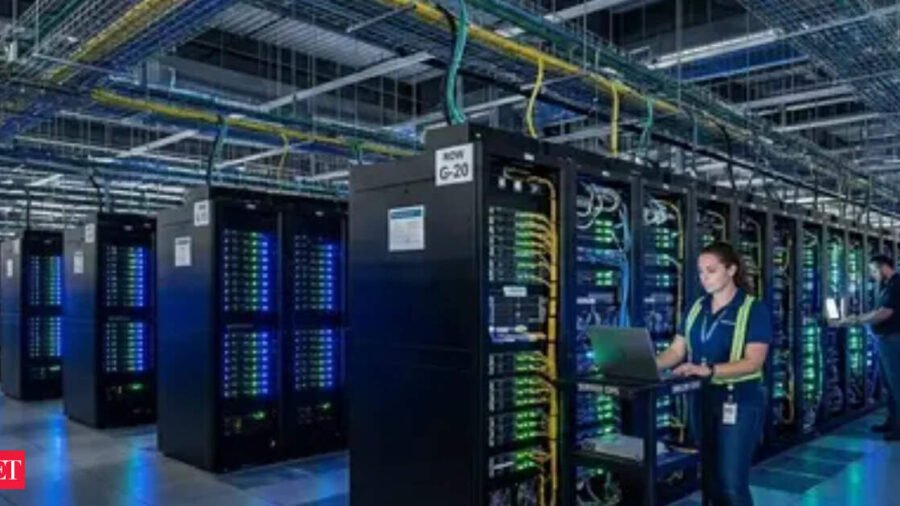
IANSIn Visakhapatnam, India’s digital future is beginning to acquire a distinctly physical form. A proposed artificial intelligence (AI) and data-centre hub promises billions of dollars in investment, enormous computing capacity, new infrastructure and a stronger position for India in the global AI economy. Yet beneath the vocabulary of clouds, models and compute lies a more terrestrial set of questions. How much electricity will such infrastructure require? How much water will it consume? What will it mean for land, local communities and public resources? And, crucially, were these consequences adequately assessed before the project gathered momentum?
That last question deserves far greater policy attention.
India routinely evaluates the implications of highways, ports, mines and power plants before they are built. Large AI infrastructure is increasingly acquiring comparable characteristics. High capital intensity, concentrated electricity demand, substantial cooling requirements and long-lived consequences for local resources. Yet data centres continue to be treated primarily as digital assets.
That distinction is becoming difficult to sustain.
In an earlier article, “When the Cloud Gets Thirsty: Should India Make AI Pay Back Its Water Debt?”, we examined the growing water footprint of India’s AI and data-centre ecosystem and argued for greater efficiency, replenishment and carefully designed water-credit mechanisms. The present argument moves one stage upstream. Rather than merely compensating for externalities after they arise, India must begin assessing their environmental, social and economic consequences before large AI infrastructure is approved, incentivised or built.
India therefore needs a robust ex-ante Environmental, Social and Economic Impact Assessment (ESEIA) framework for major AI and data-centre projects. This is not an argument for technological caution. It is an argument for greater economic and institutional discipline in deciding where, how and at what resource cost infrastructure should be developed.
The economic case for AI investment is formidable. Google’s proposed Visakhapatnam AI hub represents an announced investment of roughly $15 billion between 2026 and 2030. India’s data-centre capacity has expanded from approximately 375 MW in 2020 to 1,500 MW in 2025, while more than 38,000 GPUs have been onboarded under the national AI compute initiative. Government estimates suggest that AI could contribute as much as $1.7 trillion to India’s economy by 2035.
But scale changes the nature of responsibility.
A data centre may resemble an office complex from the outside while behaving more like an industrial installation in its demand for electricity, cooling and supporting infrastructure. The International Energy Agency estimates that data centres consumed about 415 terawatt-hours of electricity in 2024, roughly 1.5 per cent of global electricity demand, and projects consumption to rise to around 945 TWh by 2030. At such a trajectory, assessing impacts after construction is rather like inspecting a building’s foundations after the upper floors have already been completed.
That is why the emphasis must be ex ante.
Also read | India’s AI data-centre push could drive 5% of global chip demand by 2030
Conventional sustainability reporting tells us what happened. Impact assessment should help determine what ought to happen before capital, land and infrastructure become irreversibly committed.
The environmental component should examine projected electricity requirements, peak-load implications, energy sources, freshwater withdrawal, basin-level water stress, cooling technologies, recycled-water availability, land-use change, biodiversity, waste generation and climate resilience. Carbon alone is an inadequate proxy for environmental sustainability.
But environmental arithmetic tells only part of the story.
The social assessment must identify who bears the costs and who receives the benefits. A facility may consume only a small fraction of a state’s aggregate water availability yet place disproportionate pressure on a particular watershed shared by households, farmers and urban users. Aggregate statistics can therefore obscure highly localised consequences.
Employment quality, livelihood effects, land acquisition, community access to water and electricity, public-health implications, infrastructure pressures and stakeholder consultation should all form part of the assessment. The relevant question is not merely, “How much resource will the project consume?” It is, “Whose resource, in which location, during which season, and at whose opportunity cost?”
The economic pillar is equally important. Impact assessment must not become a euphemism for environmental restriction. A credible framework should quantify investment, direct and indirect employment, local procurement, tax revenues, digital connectivity, productivity gains, innovation spillovers and strategic access to domestic compute.
Yet every balance sheet has two sides.
States may provide subsidised land, fiscal incentives, transmission infrastructure, water connections and other forms of public support to attract large technology investments. These may be legitimate development choices, but they should be evaluated against the value ultimately created. The question is not simply how large the investment is, but what its net development value becomes once subsidies, infrastructure costs, environmental externalities and social consequences are entered on the same ledger.
ESEIA should therefore function not as a compliance ritual, but as a decision-making instrument.
The framework should be proportionate and risk-based. Small facilities should undergo simplified screening. Larger projects should face progressively stronger requirements based on electricity load, freshwater consumption, land footprint, location in water-stressed regions and cumulative data-centre concentration. Low-risk projects could receive expedited approval; medium-risk projects could proceed with clear mitigation obligations; high-impact projects should require independent assessment and alternatives analysis before substantial public incentives or final clearance are granted.
Alternatives matter. A cheaper site in a water-stressed basin with a constrained grid may appear attractive in a financial model. A slightly more expensive location offering treated wastewater, renewable-energy access and stronger transmission infrastructure may prove substantially cheaper to society over the project’s lifetime.
Impact assessment, in this sense, is not the brake pedal. It is the navigation system.
India must also assess cumulative impacts. Five individually manageable data centres can collectively overwhelm the same watershed or electricity network. Assessment should therefore extend beyond individual buildings to data-centre clusters, power systems and water basins.
India does not need less AI infrastructure. It needs better-sited, better-designed and better-assessed infrastructure.
Sustainable development is not achieved by placing growth and ecology on opposite sides of a scale. It is achieved by making trade-offs visible before they become irreversible.
Before the first server hums, before the first litre is drawn and before billions are committed, India should insist on seeing the complete balance sheet. Environmental, social and economic.
Because the most expensive impact is often the one discovered too late.
Pradeep S. Mehta is the secretary-general of CUTS International. Sohom Banerjee is associated with Jaipuria Institute of Management, Noida.
Add 

(Disclaimer: The opinions expressed in this column are that of the writer. The facts and opinions expressed here do not reflect the views of www.economictimes.com.)


Enter search text:
Continue reading with one of these options:
Limited Access
Free
Login to get access to some exclusive stories
& personalised newsletters
Login Now
Unlimited Access
Starting @ Rs120/month
Get access to exclusive stories, expert opinions &
in-depth stock reports
Subscribe Now
ET
Unlock Access to All Exclusives with ETPrime FREE TRIAL
15 Days Free: Unlock All ETPrime Exclusives, Market Tools & ePapers
Trial offer expiring in00 : 05 : 00
I'd rather pay ₹2599 now


Uh-oh! This is an exclusive story available for selected readers only.
Worry not. You’re just a step away.

Prime Account Detected!
It seems like you're already an ETPrime member with
Login using your ET Prime credentials to enjoy all member benefits
Log out of your current logged-in account and log in again using your ET Prime credentials to enjoy all member benefits.
Unlock ETPrime's Exclusive Stories Today!
Subscribe to gain powerful insights on business, stock market and industry trends.
Big Price Drop! Flat 40% Off
Student Only Offer
Already a Member? Sign In now
Already a Member? Sign In now
Already a Member? Sign In now
Offer Exclusively For You
Save up to Rs. 700/-
ON ET PRIME MEMBERSHIP
Avail Offer
Offer Exclusively For You
Get 1 Year Free
With 1 and 2-Year ET prime membership
Avail Offer
Offer Exclusively For You
Get 1 Year Free
With 1 and 2-Year ET prime membership
Avail Offer
Offer Exclusively For You
Get Flat 40% Off
Then ₹ 1749 for 1 year
Avail Offer
Offer Exclusively For You
ET Prime at ₹ 49 for 1 month
Then ₹ 1749 for 1 year
Avail Offer
Special Offer
Get flat 40% off on ETPrime
Avail Offer
Avail Offer
Claim NowAlready a Member? Sign In now
Need Assistance?
Connect with an ETPrime expert for personalized support and guidance
+91 9484700004
' + h3 + '
' + h4 + '
- ' + listing + '
What’s Included with

1Exclusive Insights That Matter
Uncover the truth with our investigative stories
Make strategic moves using the real-world case studies
Read industry-specific stories to identify emerging trends
Spot opportunities with in-depth insights that matter

Trump temper on H-1B visas is forcing Indians to do these things to stay put in US

What Adani’s US indictment means for India Inc’s overseas fundraising

Why veterans like Reliance, L&T are on acquisition spree? Aswath Damodaran has an answer.

Will China’s dollar bond sale in Saudi Arabia trump the US in financial world?

Huawei launches its own OS to compete with Google and Apple. But can it win beyond China?

The problem with lab grown diamonds

Why a falling rupee is a better option for the economy

A list of top 20 momentum stocks that have delivered massive returns in one year
2Invest Wisely With Smart Market Tools & Investment Ideas
Alpha Trade

Get daily trade ideas from SEBI-registered research analysts.
Investment Ideas

Grow your wealth with stock ideas & sectoral trends.
Stock Reports Plus

All-in-one stock research with Stock Score, peer comparison & key signals.
BigBull Portfolio
Get to know where the market bulls are investing to identify the right stocks.
Stock Analyzer
Check the score based on the company's fundamentals, solvency, growth, risk & ownership to decide the right stocks.
Market Mood

Analyze the market sentiments & identify the trend reversal for strategic decisions.
Stock Talk Live at 9 AM Daily

Ask your stock queries & get assured replies by ET appointed, SEBI registered experts.
3Stay informed anytime, anywhere with ET ePaper
ePaper – Print View

Read the PDF version of ET newspaper. Download & access it offline anytime.
ePaper – Digital View
Read your daily newspaper in Digital View & get it delivered to your inbox everyday.
Wealth Edition

Manage your money efficiently with this weekly money management guide.
4Times Of India Subscription (1 Year)
ePaper

Read the PDF version of newspaper. Download & access it offline anytime.
Deep Explainers

Explore the In-depth explanation of complex topics for everyday life decisions.
Health+ Stories

Get fitter with daily health insights committed to your well-being.
Personal Finance+ Stories

Manage your wealth better with in-depth insights & updates on finance.
New York Times Exclusives

Stay globally informed with exclusive story from New York Times.
5Enjoy Complimentary Subscriptions From Top Brands
Docubay Subscription

Stream new documentaries from all across the world every day.
Stories you might be interested in

Kobe Bryant’s $6M BodyArmor bet became $400M
By Sohail Khan · 25 Sep
Harsh Goenka questions VIP darshan at temples
By Sohail Khan · 25 Sep
Mandeep K Bhandari appointed CBSE chairperson
By Sohail Khan · 25 Sep