What Independence Day means between the tricolour and the traffic lights
Every August 15, India argues with itself.
One side asks: Are we truly free? The other celebrates Independence Day as a moment of national glory and pride.
Advertisement
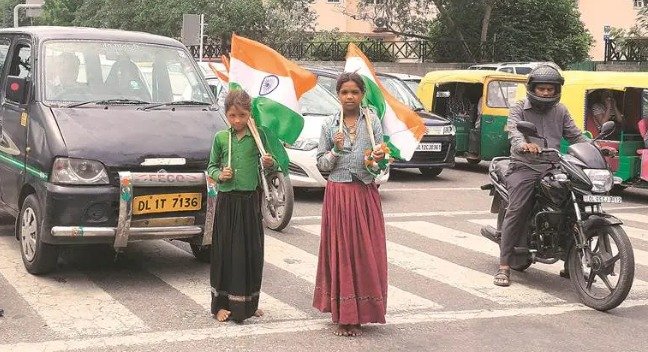
Few images capture this contradiction better than a poor child in tattered clothes selling tricolour flags at a traffic signal, alongside the Prime Minister’s speech from the Red Fort and the flood of flags, patriotic songs, Army pride, cultural events and television broadcasts across the country. To use the words of social psychologist Michael Billig, the latter is a production of banal nationalism where nationalist feelings are cultivated over the years through everyday unconscious habits, films, symbols and rituals.
Then come the statistics. One side cites poverty, inequality and exclusion; the other points to rising incomes, welfare schemes, education and social mobility. This binary can be captured quite well in the tussle between social mobility discourse that has been in vogue in academia and what anthropologist Sherry Ortner calls “dark anthropology”, focused on domination, exclusion and violence. It is an important lens, but it leaves little room for understanding how marginalised social groups have also created concrete freedoms for themselves, through both state institutions and their own struggles.
My fieldwork in remote southern Odisha last year brought this contradiction home. South Odisha is one of the poorest regions in India. Many of my interlocutors were Dalits and Adivasis. When I asked what life was like in the 1970s and 1980s, some described hunger that is difficult to imagine today. Their families survived on small quantities of millets and, occasionally, meat and roots from the forest. They lived in mud huts that could collapse during the monsoon. Rice was scarce. During desperate weeks, some would grind tamarind seeds, mix the powder with water, and drink it.
Advertisement
Today, they told me, they no longer worry about starvation in the same way because they receive rations regularly. For someone who has known hunger, that is not merely a welfare statistic. It is a concrete freedom. A Dalit primary school teacher told me how Ramachandra Ulaka, an Adivasi MLA and minister, helped provide hostel facilities for Dalit and Adivasi students. The teacher himself had benefited from such a hostel.
Yet these same communities were far from passive beneficiaries of the state. They opposed moneylenders, forest officials, state-supported displacement projects and feudal practices associated with hereditary Brahmin officials who exercised considerable power over social life in parts of the region. The state, in other words, could be both a source of opportunity and an instrument of dispossession. This contradiction appears across India, and it will be useful to trace it through Dalit realities.
Sandhya Fuchs, in her study of atrocity cases in Rajasthan, shows how Dalit victims can be denied justice through legal mistranslation. Yet Geert De Neve has documented how Dalits in western Tamil Nadu have used the SC/ST Prevention of Atrocities Act to challenge dominant-caste power. The law can therefore be an instrument of exclusion in one situation and a weapon to challenge caste power in another.
Migration tells a similar story. Many Dalit labourers from Bihar working at construction sites in Tamil Nadu live with bare-minimum savings and insecure employment. Yet some working in Kerala earn better wages and aspire to build concrete houses and basic amenities for their families back home.
Migration can mean exploitation and opportunity at once. Dalits leaving villages have often entered insecure, low-paying urban jobs. But their departure has also challenged dominant-caste power in the villages. And those seeking mobility have pursued it through things that may appear ordinary: Better clothes, different food, better houses, basic assets and access to public spaces. These are not simply markers of consumption. They can be assertions of self-respect and dignity.
Politics reveals the same complexity. During the 2024 general election, Hindutva politics sought to mobilise voters in Uttar Pradesh around the Ram Mandir inauguration and religious identity. Yet a significant section of Dalit voters moved away from the BJP because they feared that it could undermine the Constitution and reservations, which they regarded as democratic rights. This is a reminder that marginalised citizens are not merely passive victims of political manipulation. They interpret politics through their own experiences and aspirations.
Ambedkar had warned that universal suffrage and regular elections alone could not guarantee democracy in a society marked by deep historical inequalities. A governing class, he argued, could use power to bypass democratic means and rule over others. Dalit communities have repeatedly challenged this bypassing. They have demanded that state institutions act as neutral administrators rather than centres of caste or religious power. Through protests and collective action, they have also pushed Indian social life towards greater equality and dignity. At the same time, some sections have also been drawn into dominant ideologies like Hindutva amid insecurity, despair and precarious livelihoods that promise them momentary belonging and euphoria at the cost of their progress.
These contradictions should not be brushed aside. They are the story, and modern India is a constant struggle between these multiple forces. Economist Barbara Harriss-White has argued that Indian academia often struggles to hold contradictory outcomes together, and, I would argue, so does Indian public discourse. Perhaps that is exactly what we need to do when thinking about nearly eight decades of independent India. India is neither a story of uninterrupted progress nor one of unbroken oppression.
For a Dalit family, freedom may mean regular food, a hostel for a child, access to education, the ability to migrate, a concrete house, entry into a public space, protection under the law or the confidence to vote for the Constitution. It may also coexist with exploitation, discrimination, insecurity and state neglect. August 15 need not force us to choose between these stories.
Freedom was not simply delivered to Indians in 1947. For millions, it has been — and continues to be — made, negotiated and fought for in the ordinary spaces of everyday life.
That is perhaps the more complicated story of independent India. But it may also be the more truthful one.
The writer is an anti-caste scholar and a rapper
Rishi Sunak, Ro Khanna, Dinesh D’Souza: united by colour; divided among white nationalists
By Sohail Khan · 28 Sep
From Nepal to India, how AI is improving disaster management
By Sohail Khan · 28 Sep
40 years ago September 28, 1986: Relief for Haryana farmers
By Sohail Khan · 28 Sep