Vandita Mishra writes: The day after I-Day, snapshots of freedom and unfreedom
Dear Express Readers,
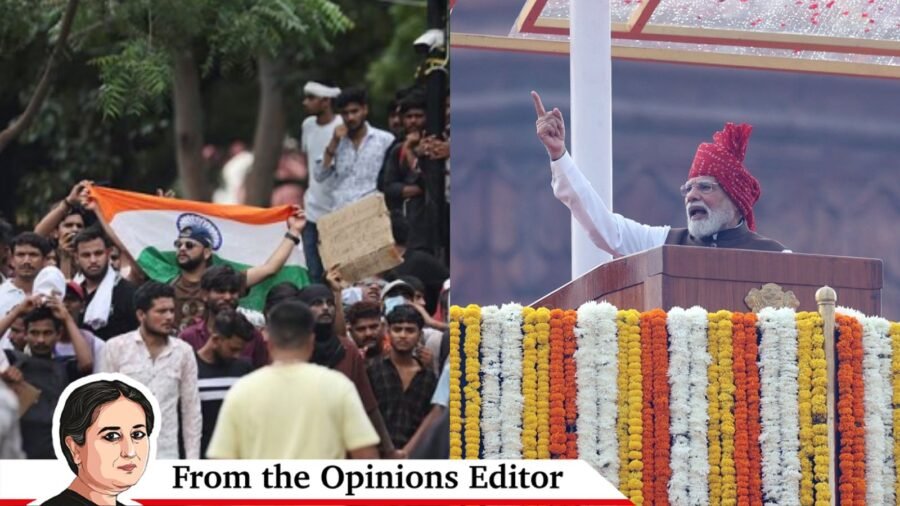
This Independence Day came close on the heels of a students’ movement that forced a powerful government to bend and became a liberating moment. The day after, it is an occasion to look back at what moved, and what has not changed.
Advertisement
To begin with, freedom’s heady freeze-frame. Till the Jantar Mantar moment, a narrative was quietly gathering force and becoming a stranglehold. It went like this — Congress and regional parties are in unchecked decline and the BJP, armed with a will-to-power that is undiminished by power, enormous resources and control over central agencies, is seizing and filling the spaces being vacated by Opposition parties. After the resignation of Union minister Dharmendra Pradhan in response to the demand of the protesting students at Jantar Mantar, that story is now unfrozen. A third force has flashed on the public mind and put both the main players on notice. Suddenly, the government looks vulnerable too, not just the Opposition. Democracy’s wet dog shake has opened up and loosened democratic spaces.
Though he did not mention the students’ movement by name, Prime Minister Narendra Modi’s I-Day speech at Red Fort both acknowledged it and sought to domesticate it. He invoked “yuva shakti” profusely, but asked that it be yoked to the national project. He described the young, the protagonists at Jantar Mantar, as the “labharthi” or passive beneficiaries. His choice of words was not incidental — a challenge before the nation, he said, was posed by the “dimagi Naxal (one with a Naxal mindset)”, well after the defeat of the “hathiyari Naxal (armed insurgent)”. In the PM’s repertoire of slurs and labels for critics and dissenters — like “eco system”, “aandolan jeevi”, and “urban Naxal” — “dimagi Naxal” is perhaps the most unvarnished. It takes no detours, looks for no pretexts, as it reaches inside the mind to criminalise thought and ideas directly.
A few days before the PM made his speech at Red Fort, a sessions court in Mumbai delivered a similar-sounding lesson in unfreedom. It refused anticipatory bail to two TISS students accused of raising slogans during an event in October 2025, in which they paid homage to the late Delhi University professor GN Saibaba by reading out his poems (Bombay High Court has given one of the two students interim protection from arrest subsequently). Additional Sessions Judge V B Bohra said: “…the act of accused persons appeared to be not limited to paying him (Saibaba) homage. They even allegedly raised slogans …”. The alleged slogans sought the release of Umar Khalid and Sharjeel Imam, former student activists facing trial under UAPA — they have been jailed now for about six years, their trial is still not in sight, but raising slogans, not the prolonged pre-trial incarceration, is what the Mumbai court sees as the crime and injustice.
Advertisement
And in JNU, authorities withdrew permission to discuss Umar Khalid’s book, a PhD dissertation certified by the university, citing “non disclosure of full facts” — opaque bureaucracy-speak that should embarrass the distinguished university.
The last snapshot frames the Bar Council of India chairman, who issued a diktat punishing the entire 2026 batch of the NALSAR University of Law, for the criticism by some of them of the Chief Justice of India, and their opposition to him attending their convocation as chief guest. He retracted his repressive directive and apologised to students subsequently. But the lingering image is that of an institution cracking down on the freedoms of tomorrow’s Bar and Bench, in order to cosy up to the current political/judicial establishment — another image of unfreedom, certainly.
The PM’s new label for critics, the additional sessions judge’s constricted view, the clampdown by the premier university and the Bar’s arrested slide — all these came only days after the students’ protests at Jantar Mantar scored a huge strike for freedom. They underline something that must be kept sight of in the post Jantar Mantar moment.
For all its spectacular arc, the students’ success story is up against the mixed realities of a complex and layered polity. In this context, Gen Z’s success lies more in what it can help illuminate, rather than what it has achieved. Going ahead, it will be measured by whether or not it becomes a continuing catalyst.
Though it came together at Jantar Mantar as one, and even as coherence is being artificially imposed upon it, Gen Z is a shifting construct. Even in electoral terms, it is not clear that Gen Z is a bounded category. Do the young vote in critical numbers, are they a vote bank with a defined set of issues and separate concerns, do they vote more for change — there are no clear answers.
What is clearer is something much more amorphous but also more valuable — the students’ movement, and its outcome, has dented power and opened up possibilities. It has pointed to the suffocation of the electorate because of the limited menu of political choices. It has put both government and opposition on notice, and changed the subject to the ruling behemoth’s vulnerability.
Gen Z is not an actor or formula, it must not become a cliche that can be co-opted or relegated. The day after the 80th Independence Day, it must be seen for what it is — a moment of freedom that needs to be joined, and widened patiently.
Till next time,
Vandita
Recommended Readings:
Sonia Gandhi writes: History will indeed remember Dr Manmohan Singh kindly
S Y Quraishi writes| EC’s real test: Winning the confidence of the Opposition
Nikhil Dey and Aruna Ropy write: What was promised by NREGA’s new version, where it falls short
Yogendra Yadav writes: Caste census is dead. Don’t expect a formal announcement or funeral
Pratap Bhanu Mehta writes: The nationalism that evokes pride, the nation we are
Rishi Sunak, Ro Khanna, Dinesh D’Souza: united by colour; divided among white nationalists
By Sohail Khan · 28 Sep
From Nepal to India, how AI is improving disaster management
By Sohail Khan · 28 Sep
40 years ago September 28, 1986: Relief for Haryana farmers
By Sohail Khan · 28 Sep