To stop crime, Gujarat wants to integrate 80,000 CCTV cameras into a single system. Here’s the plan
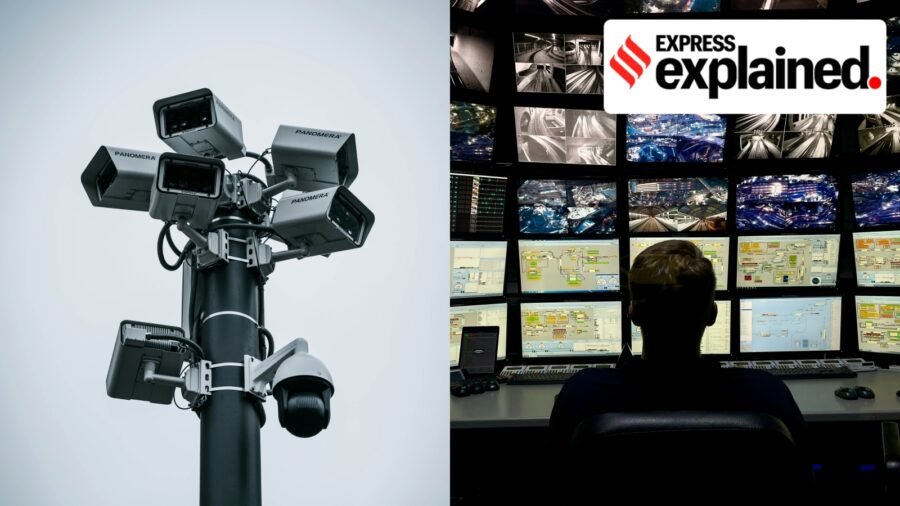
How do you integrate the operations of more than 80,000 CCTV cameras that were installed by 26 separate departments under multiple government schemes across 34 districts into one seamless and effective system?
Especially when these cameras are of many kinds, were built by different companies using a range of technologies, and were installed at various times over many years?
The Gujarat government is seeking a tech solution to straighten out the jumble, and it wants the public to help. The prize: Rs 37 lakh.
Why is there a need to integrate CCTV feeds?
The purpose is to improve the efficiency of police investigations that involve the tracking of vehicles and their movement across the state. The police want to graduate from having to manually identify security cameras that could be expected to contain leads or evidence in an investigation, to being able to automatically detect the movement of vehicles and persons across the field of vision of CCTV cameras operated by various government departments, official sources told .
Having an integrated field of vision would liberate the police from the painstaking task of mapping specific camera units, obtaining their footage and scanning through it, thereby saving person hours and speeding up the investigation, the sources said.
How will the process of finding this solution proceed?
On Monday (August 18), the Gujarat government announced a hackathon, and invited more than 700 entities to propose a tech solution for this intended integration. Applications can be filed until August 29, after which a shortlist of applicants will be drawn up.
Story continues below this ad
The shortlisted entities will be invited to the first ‘sandbox’ round of the hackathon at the iHub campus of Gujarat University in Ahmedabad. A sandbox round allows teams access to a safe, isolated, flexible space to experiment with code, APIs (Application Programming Interface, a set of rules and protocols that lets different software programs talk to each other), or data models to build and test early prototypes without risk of damage to live systems.
Those who are able to demonstrate a viable proof of concept will be moved to the second round of the hackathon, where they will be given access to live CCTV footage to present their solutions in real time.
Participants will get 12-hour feeds from CCTV cameras across five departments with varied problems including night-and-day footage, grainy footage, blurred footage, and footage in a variety of environments and weather conditions.
What exactly is the challenge for the participants here?
Story continues below this ad
The ‘problem statement’ of the hackathon describes the challenge as follows: “At present, 26 different Government Departments are operating independent CCTV systems across the State. These systems include both analog and IP-based cameras deployed at geographically dispersed locations. Each department currently operates a standalone camera ecosystem. Some departments are using cloud-based storage solutions, while others rely on local storage infrastructure. The video retention period also varies significantly, with some systems storing footage for 7 days and others for 15 days or more. The usage and deployment pattern of cameras differ across departments based on their operational requirements and functional objectives.”
Therefore, “The Government intends to integrate these government cameras primarily deployed in the public domain into a unified video management and analytics ecosystem. …The proposed solution should support viewing capabilities for public-facing CCTV cameras installed by societies, malls, commercial establishments and other private entities, wherever feasible and permitted.”
Also, “various Government departments already maintain critical databases such as VAHAN, SARTHI, eGujCop (Gujarat Police’s CCTNS platform), AFIS and NAFIS containing records of arrested persons, stolen vehicles, wanted criminals, missing persons, unidentified dead bodies and fingerprint data. The proposed CCTV Integration System should be integrated with these databases to enable automated real-time alerts and proactive monitoring capabilities for law enforcement agencies.”
What specific problems will the tech integration solve?
Story continues below this ad
Suman Nala, superintendent of police for Technical Services and State Crime Records Bureau (SCRB), told , “We first want to integrate the cameras in the public spaces and then further down the line, we want to be able to get feeds of private cameras in public spaces such as malls and other areas.”
Capabilities such as automatic number plate recognition, vehicle tracking, watchlist matching, and cross-camera search will undergo real-world testing at the hackathon. The challenge is to integrate all the different CCTV systems to the 20,000 installed by police under Vishwas with other systems, including those of the Smart City and other programs, she said.
“In the simplest terms, if a vehicle number or description is put in the system, it should be able to give out an alert when the vehicle is identified, be able to track the particular vehicle across the different CCTVs operated by different departments on the route, and be able to give its destination — all of which will be based on the integration of the feeds of cameras installed by any government department on this particular route,” Nala said.
The work of mapping private cameras in public spaces is underway separately. While these cameras – single units installed in private premises – may not be integrated into the larger system, mapping them will help police seek cooperation if there are no government cameras in the vicinity.
Story continues below this ad
What about concerns such as privacy of citizens and fears of surveillance?
Could the project attract criticism for allegedly building the framework of a “surveillance state”? No, Nala said.
“We already have cameras in public spaces, and we are already getting their feed. The point here is only the integration of the available footage. This system will be used not only for faster location-tracing of stolen vehicles, but also for speedy detection and apprehension of those accused in heinous crimes. We are not storing everyone’s private data or faces. We are just enhancing our available capabilities,” she said.
Details of the hackathon are available on the official portal https://sentinel.gujarat.gov.in. The initiative is being organised with technology partnership support from i-Hub (Gujarat) and knowledge partnership support from Dhirubhai Ambani Institute of Information and Communication Technology, Ahmedabad (DA-IICT) and the National Forensic Sciences University (NFSU).

Sussanne Khan says she felt ‘more love’ for Hrithik Roshan’s mother after losing her own
By Sohail Khan · 28 Sep
COP31 hosts Australia and Türkiye face the fossil-fuel question
By Sohail Khan · 28 Sep