There’s one tobacco product India forgot to tax. And that hurts the poorest
By Amit Summan and Rijo M John
On February 1, the Indian government did something rare with its tobacco taxation policy: A complete overhaul. The reworked GST framework pushed cigarettes, pan masala, gutka and chewing tobacco into a 40 per cent slab, up from 28 per cent, and shifted the tax base to the printed retail price. Tax is now charged on what a pack actually sells for, rather than the lower price manufacturers had long declared to reduce their liability. And then, in the same stroke, the government cut the rate on the one product that harms Indians the most — bidis — to 18 per cent from 28 per cent.
Advertisement
Bidis are the country’s most widely smoked tobacco product, and their users are overwhelmingly poor and rural. For decades, they have been taxed at rates far below those of cigarettes, and small producers have sat entirely outside the tax net. The February reform did not narrow that gap. It widened it, to 22 percentage points in the GST alone, at the precise moment the government had the political will and administrative machinery to close it. Central excise taxes compound the gap: cigarettes carry excise duties ranging from Rs 2,050 to Rs 8,500 per 1,000 sticks, depending on length, which bidis largely escape. The reform raised the total tax burden on cigarettes from 55 per cent to 66 per cent, and kept bidis at 22 per cent, well below the 75 per cent the WHO recommends.
The case for treating bidis like the health hazard they are is not a matter of opinion. In a study published this year in the journal BMJ Tobacco Control, we and our colleagues modelled the 50-year effects of a 30 per cent tax-driven increase in bidi prices combined with ending small-producer exemptions. Indians would collectively live an estimated 48 million years more over those 50 years. The total economic benefit — from lower health spending, avoided illness and the output of people who would otherwise have died early — comes to 2.45 per cent of India’s total health expenditure. And far from draining the exchequer, the reform would raise bidi tax revenue by roughly Rs 68 billion in its first year alone.
The standard objection is that higher bidi taxes would squeeze the poor, who do most of the smoking. The opposite is true, and the reason is that the harm itself is regressive. Because bidi use is concentrated in low-income and rural households, the disease it causes — tuberculosis, chronic lung disease, oral cancer — and the catastrophic medical bills that follow fall hardest on the families least able to afford them. The burden does not stop at the smoker. Every rupee spent on bidis is a rupee not spent on food, schooling or a child’s nutrition, and every premature death takes a breadwinner with it. Long illness exacts its own toll before that, pulling family members — usually women — out of paid work and into unpaid caregiving. Keeping the product artificially cheap does not ease that burden; it deepens it. A tax that reduces consumption is the more genuinely pro-poor policy.
Advertisement
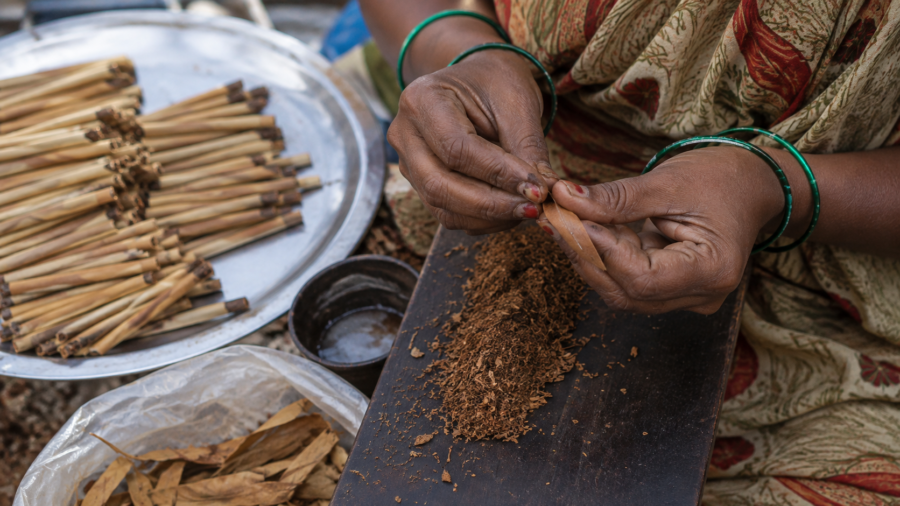
The second objection is about livelihoods, and it deserves a more honest answer than it usually gets. The bidi industry employs several million people, most of them women rolling the product at home. But the industry’s appeal to worker welfare does not survive contact with how it treats those workers. India’s bidi rollers are among the most poorly paid workers in the country, earning a fraction of the wages in comparable manufacturing, almost always below statutory minimum wages, and overwhelmingly outside the labour protections that formal employment carries. They work without masks or gloves, handling raw tobacco for hours, and bear their own documented burden of respiratory and musculoskeletal disease. The status quo has not delivered these women decent work. It has delivered them poverty wages and occupational harm, defended in their name.
That matters for how reform should proceed. The aim is not to strand five million workers to make a fiscal point. It is to use the revenue a proper bidi tax generates — tens of billions of rupees a year, and well over a trillion across the decades our study models — to fund the transition these workers have never been offered: enforcement of minimum wages, skilling programmes and welfare support drawn from a bidi workers’ fund that has existed on paper for decades and delivered little. A serious pro-worker policy taxes the product and invests in the people. The current arrangement does the opposite.
None of this requires reinvention. The February reform already established the principle that tobacco belongs in the 40 per cent slab, taxed on the retail price. Bidis are the one product left outside that logic — taxed at a far lower rate and, through the small-producer exemption, in much of the market not taxed at all. Because production is overwhelmingly handmade and small-scale, close to a third of all bidis escape GST under the small-business exemption — some 125 billion of the roughly 400 billion bidis smoked each year. There is no public-health reason for either carve-out, only the political weight of an industry that has learned to speak in the language of the poor while paying them least.
The GST Council should return bidis to the same slab as other tobacco products, raise the central excise in step with the increases levied on cigarettes so the gap between the two stops widening, end the small-producer exemption that lets much of the industry escape tax altogether, and earmark a share of the proceeds for the workers who have carried this trade on their backs. The modelling says the health and economic returns are large. The equity argument, properly examined, runs the same way. India has already done the hard part. It should finish the job.
Summan is a Health Economist at Economics for Health and a Visiting Scholar at the One Health Trust. John is a Health Economist and Adjunct Professor at the Rajagiri College of Social Sciences, Kochi, Kerala

Woman wears same T-shirt after 7 years, shows 65-kg weight-loss transformation: ‘Baby Nonu…’
By Sohail Khan · 28 Sep
In great powers’ AI race, New Delhi’s place will depend on capabilities built at home
By Sohail Khan · 28 Sep