‘The verdict on whether India has game in AI will come only 10 years from now’: AI experts Pratyush Kumar and Rajan Anandan
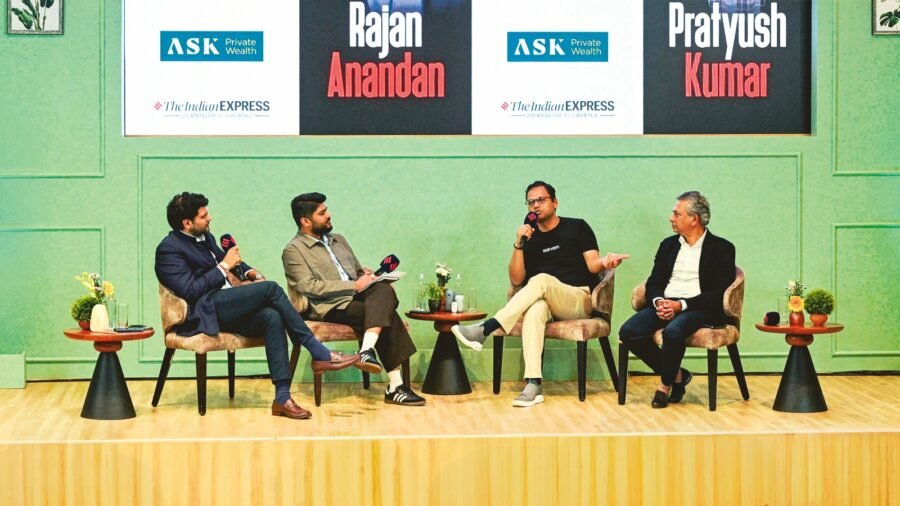
AI experts Pratyush Kumar and Rajan Anandan on India’s race to build AI, the case for smaller, cheaper home-grown models and the looming challenge of jobs and reskilling in an AI-led economy. They were in conversation with Anant Goenka and Soumyarendra Barik
Anant Goenka: Do you agree that India is sitting out the AI game? What do you have to say to people who say that?
Rajan Anandan: The reality is that global capital is leaving the Indian equity markets because we don’t have pure-play AI companies and that is true. However, when you look at what is happening in the innovation ecosystem in the private markets, especially at early stages, it couldn’t be further from the truth.
India is early in the AI game. 2026 is the year that India entered the AI race. First, computing was a big constraint. But starting at the AI summit in February in Delhi, we’ve had over $400 billion of AI capex announced by Reliance, Adani and Tata, the hyperscalers Google and Amazon, AWS specifically, as well as a whole bunch of Indian companies. Compute this year will start getting unlocked.
Story continues below this ad
Second, this is the first year where several Indian ground-up models have been launched. Sarvam has launched models trained ground up in India. You have BharatGen from IIT Bombay.
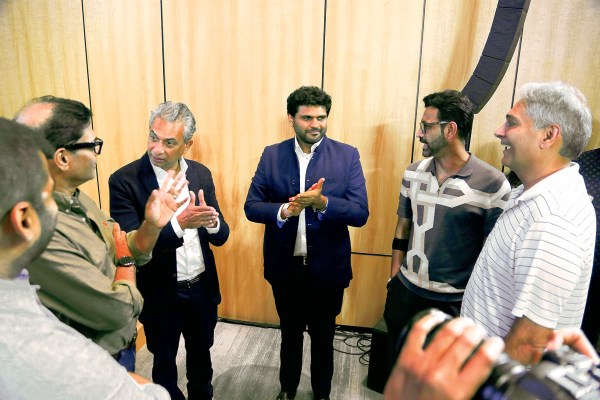 Rajan Anandan and Anant Goenka (centre) in conversation with guests at Adda in Mumbai
Third, we’re beginning to see the first big category of enterprise AI inflect. Voice AI will be the first billion-dollar revenue category for Indian enterprise.
Fourth, we’re seeing an explosion of application-level innovation, both for consumer AI in entertainment, travel, healthcare and education as well as at the enterprise level.
So essentially, if you look at it across the stack, this year we’ve really started seeing movement from models launching to big capex investments. But when you think about whether India will win or not, we should think back to the other big technology waves we’ve seen. In 2016, India wasn’t in the top 100 countries when it came to digital payments. Today, 55 to 60 per cent of real-time payments are in India. It takes a decade. In AI, it could happen sooner. The verdict on whether India has a game in AI or not will come eight to 10 years from now.
Story continues below this ad
Anant Goenka: What do you think gives India the right to win on any of these layers of the stack (energy, chips, infrastructure, models, and applications)? Because of the amount of capital, expertise and skills, China and America seem to dominate and in the chipset, it’s Korea and Taiwan.
Pratyush Kumar: AI is one of those technologies where, if you plot it on two axes — how much economic value there is from the technology and how much of a frontier tech it is — on both, AI is off the chart. We are in a post-AI world. We are never going back to not using LLMs. There’s no way India will not win in AI.
AI is a horizontal technology. So India will win. The question is when and how, because it is frontier tech. Each of those layers of the cake requires cranking
up on innovation. You can’t just suddenly get up and say, ‘Let me train a model.’ It takes expertise, engineering, compute and capital. These are all gating conditions.
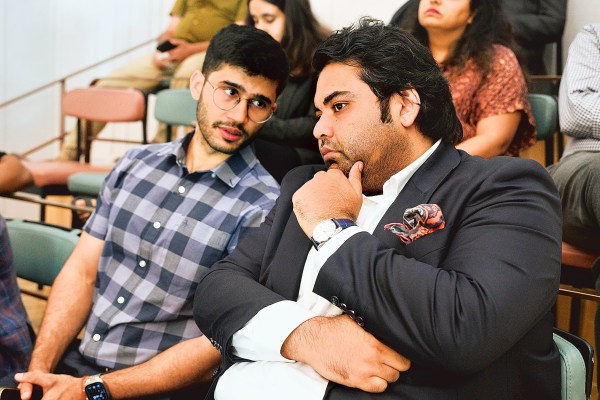 (Right) Nisarg Gagrani, Founder, Lakshya Capital with Aniket Dey
Anant Goenka: Demand is not the problem, it’s the business model that seems to be struggling from a global perspective. When you focus only on India, how will you do it at a lower cost than them?
Pratyush Kumar: Take voice AI. A company wants to reach out to its customers and answer questions they have, maybe offer them products. This needs to be low latency. It has to be superb in terms of expressiveness. You feel like you’re talking to a human.
Story continues below this ad
Right now, Sarvam models are five times cheaper than GPT mini and nine times cheaper than a Gemini Flash. Those are the alternatives you would use from frontier labs.
So the argument that you are making that there are global companies thinking for the whole world and they will build one-size-fits-all AI for the whole world is actually an argument against optimising things, for use cases for languages and for context and reducing the cost. We are already there and you just saw that on the the coding side of things.
The Chinese models are now significantly cheaper than what is available from the frontier labs, having spent and I think China is a great model. We should celebrate it more, having had much fewer GPUs than the US. It’s significantly more than India currently, but actually went and built a competitive model.
So, as I said, there’s a critical mass to the innovation to the infrastructure and capital once you cross that it’s a level playing field for taking problems and optimising for them which we’re already starting to do in the market.
Story continues below this ad
Soumyarendra Barik: If Google, OpenAI or Anthropic are looking at global deployment, how prudent is it to focus on India? Is there a limit to that strategy?
Pratyush Kumar: Absolutely not. There is context of India, but the techniques, algorithms, infrastructure and talent are not specifically focusing on only Indian problems. What matters are the areas we will focus on and hyper-optimise for.
There is this whole thing about frontier AI: Let’s get the world’s tasks in one place, build massive models and spend lots of money. We’re going to try a different approach: Get the tech ready, get the talent ready, focus on verticals and solve for them, even company-wise and use-case-wise.
Rajan Anandan: India is taking a different approach to the frontier labs and the hyperscalers like Google. They’re saying, ‘Let’s go build bigger models.’ With a 10-trillion model, a single training run costs you billions of dollars. But you don’t need a model bigger than 100 billion parameters for 90-95 per cent of what you need to do with AI in your company. Those smaller models don’t need a lot of money to train. You can build almost all of what India needs with smaller, affordable models.
Anant Goenka: Tell us why you think India can win in each of the five layers of the stack.
Rajan Anandan: Power is really important. It’s compute intensive. What do data centres need? Power. If you’re in a nation with expensive power, you’re not going to have AI. India, because of renewables, has an advantage. In the next five years, long-term storage gets solved. Nuclear will happen; just a matter of time.
Story continues below this ad
Chips, we’re very early. India’s focus initially was to try to get a few fabs going. That is happening, but these are all 28-nanometre fabs, so they’re not for advanced AI chips. We are off the list.
About data centres, I think there’s a shot that 10 years from now, the leading Indian hyperscalers will actually be Indian companies. It’ll be the Reliances, the Adanis, the Tatas.
In infra, we have a real shot. It’s just a matter of time where we get there.
For models, we need 10 companies like Sarvam. Today, we have a handful. Sarvam is obviously the leading company.
Story continues below this ad
On applications, ChatGPT, Gemini, maybe a few other leading AI apps will actually be Indian innovators.
Soumyarendra Barik: We have increasingly been hearing the phrase sovereign AI. What exactly does that mean and why is it important to define the work we’re doing within that context of sovereignty?
Pratyush Kumar: On the models piece, the number one priority should be to ensure that we solve today’s problems with whatever is available. But the second point is that we need to intensify our R&D commitment. Building models is about having the accumulated judgment and talent to build models and play in the game in the next decade. This is a very long game. Unless we recognise that we need the core innovation layer at the centre of it, the gap will widen. We should move super fast deploying whatever is best out there on price and accuracy trade-offs. But we need to have our own story which we rely on and continue to compound. Sovereign seems to be about nationalism. The problem with AI is that not only are you importing it, not only are you not enabling internal innovation, you’re actually leaking data.
Anant Goenka: Are you getting support from the government?
Pratyush Kumar: The government has been thinking right about a bunch of things. They’ve been progressive about what we should do in AI. The Rs 10,000-crore fund that the India AI Mission put together was a step in the right direction. But there’s more to be done.
Anant Goenka: Let’s get to jobs. Indian middle class 1.0 was created by the public sector; 2.0 after the private sector reform. Railways, defence and the five big IT companies account for millions of jobs. What happens to them with AI?
Pratyush Kumar: There will be a period like we are facing now when there is a lack of clarity on matching business outcomes to people and skills.
Story continues below this ad
The world is in a flux. Technology is moving so fast that people have not reacted to it fast enough. Therefore, there is a concern whether it’s going to be a jobless growth. My feeling is that there will be a whole lot more to do.
Rajan Anandan: If you take a 30-40-year view, we are going to go through the same transition. We are going from an agricultural to an industrial society, and we’re going to go to an AI-based economy.
The largest companies have never been the source of employment growth. IT services will not hire lots of people because they will leverage AI. But I am pretty bullish about the IT services industry because most enterprises need lots of help to AI-transform themselves.
There will be significant dislocation. Take Voice AI: call centres, simple calls, outbound calls, a lot of that gets automated. Those employees have to get reskilled and upskilled. I do think upskilling is going to be the single biggest thing.
Story continues below this ad
We have the world’s largest youth population. Twelve million Indians enter the workforce every year. We have to create 100 million jobs in the next eight years.
Anant Goenka: Do you feel it was the anxiety around AI that was showing in Jantar Mantar, during those protests?
Rajan Anandan: I don’t know exactly what was going on, but we have a million Indians who turn 18 every month. We have to solve that. If we don’t create opportunities for 100 million Indians over the next decade, you’re possibly going to see things like this happen.
Pratyush Kumar: I think this technology is moving too fast for the rate constant of institutions to change. That’s a structural problem — educational institutions, work institutions, government policy, legal.
Anant Goenka: Bill Gates told us that the idea of a job is from an era of scarcity which we will no longer be in. Is the idea of a job archaic to you?
Rajan Anandan: Bill Gates doesn’t live in India. We went to the wrong quorum. Honestly, I don’t know. Bill is probably absolutely right that our current definition of what a job is is going to change. There are going to be different kinds of roles. I hope that we have UBI (universal basic income) someday, but I think we’re far from that.
Anant Goenka: Are we at a fork where most of the internet will be for machines by machines and a smaller part for humans?
Pratyush Kumar: It’s very hard to talk about numbers. I have switched off from any of these predictions because there’s enough to do already. But everything that we do in the world will get intermediated by intelligence. We sort of go up the level of abstraction. Now, the level of abstraction is going to be intelligence everywhere. I don’t imagine myself doing a deal with banks anymore. It will be my agent doing a deal with the bank’s agent.
Soumyarendra Barik: Before ChatGPT or Claude, there was a unique way that you would message and I would message. Today, people sound the same. Is there something human about us that we’re leaving behind?
Pratyush Kumar: In terms of modalities — audio, image, text — and in terms of access, the floor at which humans touch technology has changed. Technology has come down to how we work, which is natural language and day-to-day access.
Imagine somebody trying to manage their finances who would otherwise have to learn Excel. You can just say, ‘I have to save this much money till Diwali. I earn so much. I need so much. How much should I keep saving?’ It will give you an answer.
So I think LLMs are enormously humanising. The challenge is that we’re on the mechanistic side of that development. One of India’s biggest contributions could be to humanise this even further — to understand what really drives human emotions, what drives sustainable pleasure. We’re on a very, very powerful technology where every human, no matter their background, can come and actually use technology with much lower barriers.
———————————————————————————————————
Rapid Fire with Anant Goenka
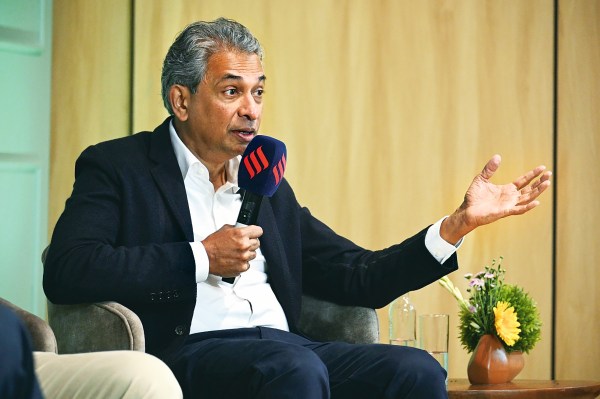 Rajan Anandan
RAJAN ANANDAN
The one AI startup no one has heard of today, but you believe everybody will soon know of?
Supernova.
BharatMatrimony, Byju’s… one lesson from each of the above investments.
Corporate governance is critical. The startup ecosystem grew very fast — in 2019, we had fewer than 10 or 12 unicorns, and went to about 100 in three years. In that period, a couple of companies didn’t have the rigour but that has now settled.
Exits from Peak XV or Peak XV’s exits — which do you spend more time thinking about?
The IPO market in India is extraordinary. Until 2019-20, we had no IPOs. This year, India has had over 100 IPOs, despite the war and the pressure on capital markets — both SME and mainboard. It’s interesting, especially for venture capitalists, because we invest in companies and then, 10 or 15 years later, we exit them.
Do you believe the future of exits is going to be IPOs?
IPOs will accelerate, but we’ll also see strategic mergers & acquisitions.
Retail investors are saying they will wait for the post-IPO because a lot of the growth has been eaten up by everybody before the company comes to IPO. Companies are seeing a fall after listing and then an entry. Is that going to be a trend?
I don’t think it’ll slow down. What you will see is valuations getting adjusted. The reality is: You are in Bombay, there are four or five large asset-management firms that basically have to decide whether you can have a successful IPO or not, and they set a price. They’re looking for good businesses at good prices.
The one biggest risk in investing in any AI company. Tough to justify valuations, shrinking product life cycles, big tech doing it cheaper or faster, a volatile regulatory environment, or something else?
If you’re an application-layer company, the big question is: What are the model companies doing? You have to have enough of an edge and just keep going faster. If you’re a model company, you’re competing with the best in the world. The premium on scale, execution and innovation is 10 times more today. The bar has gone up dramatically. That’s what it is. We don’t worry about other things. The price is what it is. Either you’re in the company or you’re not. I don’t worry as much about regulation.
The most compelling argument is that AI valuations are not a bubble.
Valuation is a concern. We are certainly not in a cheap AI market.
Your advice to Indian capital that wants to invest in the AI wave?
Try to get into Sarvam. Look for interesting companies at the application or model layer. There aren’t as many companies in the tooling layer but there are a lot in the infrastructure layer.
The one company you most regret not investing in?
Anthropic
RAJAN ANANDAN & PRATYUSH KUMAR
The one foreign AI company you keep pointing towards internally.
Pratyush Kumar: The bet Anthropic made on focusing on coding was amazing.
Rajan Anandan: Yes, coding.
One-line advice to an aspiring AI founder in India today.
Pratyush Kumar: Buckle up.
Rajan Anandan: Get going.
What would you tell a researcher who has to choose between working at Sarvam in India or Anthropic in the Valley?
Pratyush Kumar: There is a certain speed that you get with size. And Sarvam is just taking off. There’s so much more to do here. Exciting stuff to be done. It’s just the agency to do stuff.
Because there’s speed, you get to do a lot more.
Rajan Anandan: See, $1.5 billion to $100 billion… $1.5 billion was the last round. That’s about 60x. Anthropic would have to be a $60 trillion company. Which of those scenarios would you bet on?
The one policy framework that aligns Indian AI companies like Sarvam with global AI companies like Google and OpenAI?
Pratyush Kumar: We should all aim towards a world of abundance and positive outcomes. I think this concerns everybody.
Rajan Anandan: India is a wide-open playing field. That’s why it’s an exciting market, because we believe that if you win in India, you win.
Is there one policy fault line that disconnects Indian AI companies from foreign AI companies?
Rajan Anandan: Currently, I can’t think of any.
Pratyush Kumar: Not really.
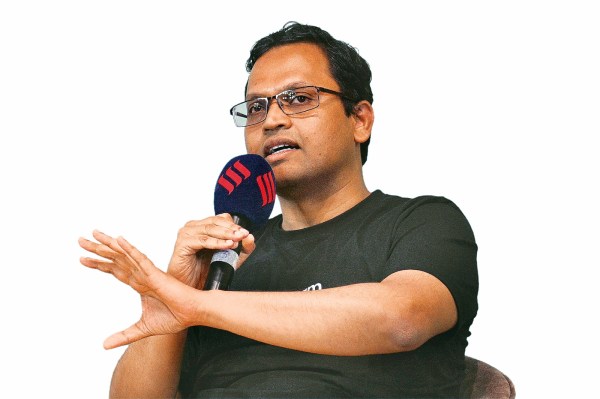 Pratyush Kumar
PRATYUSH KUMAR
🔴 What do you think will be the AI application that will change the following sectors?
🔴 Financial services
Personalised-to-one interaction.
🔴IT services
Best AI solutions provider globally.
🔴 Agriculture
We need to make it something that people want to go back to.
🔴 Healthcare
We need to solve epidemics at scale but personalised to each person.
🔴 Manufacturing
Robotics. I think that’s coming.
🔴 Do you see manufacturing growing in India or not?
One, we need to be globally competitive on the supply chains. And secondly, massively adopt technology.
🔴 First word that comes to your mind when I say the following:
🔴 DeepSeek
Great systems company.
🔴 Elon Musk
Biomodal. He tends to both surprise on the positive and the negative equally.
🔴Palantir
Smart company.
🔴 Sam Altman
Don’t know enough.
🔴Donald Trump
Definitely don’t know at all. But when I go to the Bay Area, it’s, I think, just a little bit getting into something touchy.
🔴 Sam and Elon have agreed on something after a long time, which is that they’re living in the singularity. Are they right?
This is completely bogus. Somebody should have asked if I looked at the definition of AGI and dissected it. We don’t have one.
🔴 The one foreign AI company you would invest patient capital in.
I like Google, given how much they’re doing. They’re really full-stack, and they have various components lined up.
🔴 One country aside from the US and China that has the potential to emerge as a leader in AI?
India, of course.
lIs there any other country we should keep on our radar that that has got potential?
Europe is an option There are sovereign AI companies there.
🔴 The one task you would trust the following models most with.
🔴 Grok
It does some funny videos. That’s what I have heard.
🔴 Gemini
It’s really good for world knowledge, especially grounding on the web.
🔴 DeepSeek
It’s a systems company. I don’t think the style of the model is particularly frontier on any particular thing, but really good, efficient models.
🔴 Claude
The best code.
🔴 ChatGPT
It is the application. The older models are great, great coding systems.
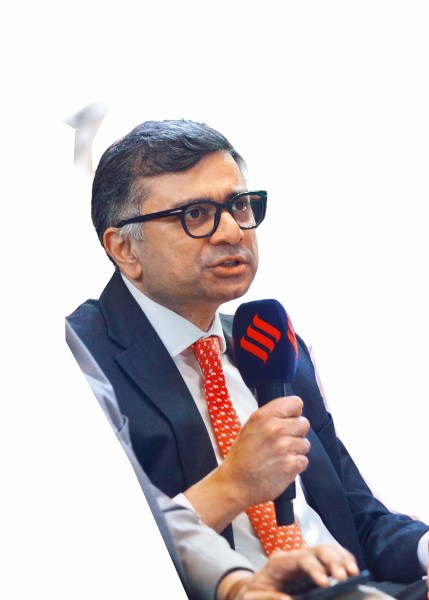 Aditya Mishra
Aditya Mishra
COO & Head, Wealth Management, ASK Private Wealth
What is the threat posed by AI in terms of cyber security and how real and near is it, especially when it comes to public infrastructure or banking infrastructure?
Pratyush Kumar: If I were to have a riskometre, I would say dwell on 10. What is the problem? It is that the models are now significantly more capable and they can run for long durations of time. So they can chain together vulnerabilities that themselves would be innocuous but find specific things that otherwise human hackers would not. At Sarvam, we have been both playing attack and defence because we are being attacked, given that we have interesting things with us and we are also building these systems. Cyber security, like coding, was a critical use case. We will have to spend a lot more ensuring every line of code, whether written by humans or AI, leads to reliable and safe systems.
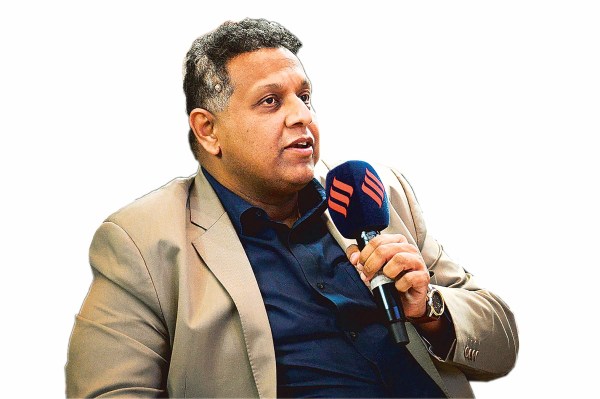 Somnath Mukherjee
Somnath Mukherjee
Chief Investment Officer, ASK Wealth Advisors
If engineering marvels like nuclear submarines took India decades to build, can technological sovereignty realistically be achieved for just ten billion dollars?
Pratyush Kumar: Physical systems like submarines rely on highly specific, complex supply chains. In contrast, digital technology moves incredibly fast. For example, OpenAI launched in 2015 and released ChatGPT just a few years later.Furthermore, China has proven that massive computing power isn’t a strict barrier. Despite having far less compute than the US, they successfully built advanced AI models. Building AI no longer requires a “magic source” exclusive to a few companies. The gap is closing rapidly as open-source models match proprietary options. Ultimately, any country can build these systems if they back them with sufficient capital.
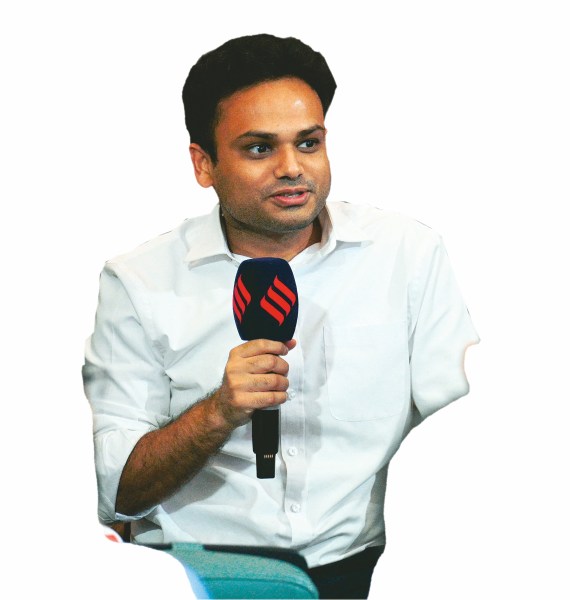 Dhananjai Bagrodia
Dhananjai Bagrodia
Investment Manager, Alchemy Capital
What do you actually use AI in your daily life for?
Rajan Anandan: There’s an app, that you perhaps don’t know of, called Equal AI. It’s not one of our companies. It answers your phone.
You know how you get so many calls. If the app doesn’t recognise who is calling, it answers the phone for you, says it is the agent and takes notes. If it is urgent, it tells you that it is critical. Few weeks from now they are going to launch a bunch of other features where it will actually do things for you. For instance, every time you have e-commerce orders, you get an SMS and the delivery person keeps calling you, hassling you. The app agent will take the call for you and take care of the delivery.
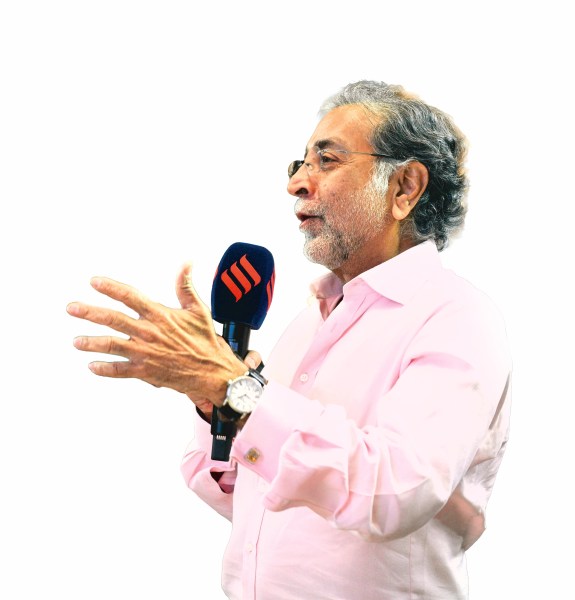 Suketu Shah
Suketu Shah
Chairman, Vagabond Holdings
In every field, AI is going to come in. What are the risks of AI?
Rajan Anandan: In the 1800s, India was 25 per cent of global GDP. By 1947, we were 2-3 per cent. Lots of things happened in between, but we basically missed the industrial revolution. That’s what happened to India. The way I think about this is that we have to be in the winner’s circle. There are few countries in the world that can credibly say they could, because they don’t have the talent, scale or economy that can even afford to spend what we are putting into RDI for deep tech. The risk really is that we don’t move fast enough as a nation… that we don’t aim to be in thewinner’s circle. This is the industrial revolution, repeat. It’ll happen faster, be more consequential and there will be winners and losers in the global race of AI.