The trouble with seeing the world through a wildfire
Synopsis
Global burned areas are significantly below average, contradicting climate change narratives. Satellite data shows a quiet fire season worldwide, with continents experiencing less burning. Fires in France and Spain are severe but do not represent a planetary inferno. Improved land management and firefighting have reduced global fire occurrences over time. Effective local solutions, not net-zero policies, are needed for fire-prone regions.
 Reuters
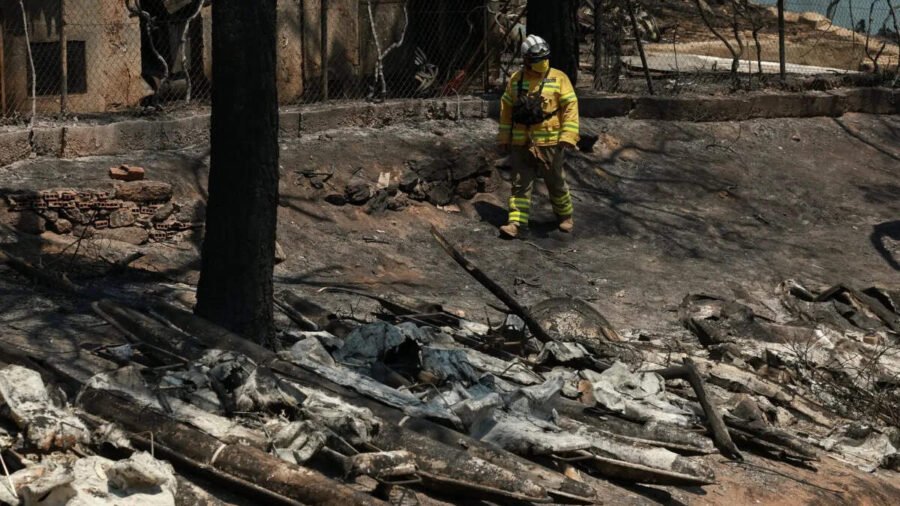
Stanford, California: Fires in France and Spain this summer have had devastating impacts. More than 2.2 lakh people fled flames west of Bordeaux. Outside Madrid, fires scorched an area twice the size of the capital and, by end-July, had driven nearly 90,000 people from their homes. The people who lost homes and livelihoods deserve sympathy – and far better fire policy.
What they do not need is the climate sermon that now follows every plume of smoke. Spain's PM Pedro Sanchez called the fires a 'painful expression' of climate change. The British and Spanish governments rushed out a joint statement declaring that 'climate change was now a national security emergency'. The verdict was in even while houses burned: only ending fossil fuels can put out the flames.
Here is what makes this so exasperating: the planet is doing the opposite of burning.
Satellite data shows that as of August 12, the world's burned area in 2026 is 41% below the 2012-25 average for this point in the year – on track to becoming the quietest global fire season in a century.
On current trends, 2026 could end up burning less than 1.5% of global land area. This would be vastly below the satellite record low in 2022 of 2.2%, and likely lower than any year since 1900.
Climate change is a global issue, so it should be assessed using global data. Pointing to horrific fires in one corner of one continent while ignoring a planet that burns phenomenally less is the definition of cherry-picking: keep the observations that fit the story, throw away the rest.
Imagine the reverse. If global burned area were running 41% above average, would anyone accept 'but the Baltics are quiet this year' as a rebuttal? Of course not. Yet, that is precisely the logic now deployed in the other direction.
The climate lobby has seized on one data quirk: in the European fire surveillance, the satellite data for Europe includes the whole of Russia, including Siberia and all, so, a quiet Russian year can flatten the continental numbers. But strip Russia out entirely and by August 19, Europe without Russia has burned 27% less than its 2012-25 average this year. Nine of the past 14 yrs saw more fire by mid-August. France's season is record-bad, and Spain's is severe.
But two countries having a dreadful summer do not make a continental inferno, let alone a planetary one. Europe is having a below-average fire year.
The same pattern holds everywhere you look. Just some more weeks before, the panic was Canada, whose smoke over New York generated apocalyptic headlines. Yet, Canada is having a below-average fire year, as has the US. Both North and South America are at all-time satellite lows.
Africa, the most burned continent, is at an all-time low, 44% below normal. Oceania (mostly Australia) is 15% below its usual burned area at this time, and Asia has burned near record-lows this year. Every continent is below normal, far below normal or setting records for how little is burning.
How is it possible that in a world burning less on every continent, we believe that the entire planet is in unprecedented flames?
Because the coverage tells us so. Infernos make the front page; record-quiet fire years make no news at all. Report only the fires and never the absence of fires, and the public will duly conclude the planet is ablaze – even as the data shows the opposite.
Nor is 2026 a fluke. In the early 1900s, nearly 4% of the planet's land burned annually, roughly double today's rate. A century of better agriculture, land management and firefighting has beaten fire back, because people have become very good at preventing it. The world's long-term fire trend is ever downward.
None of this means France and Spain don't have a real problem. They do: a record June heatwave dried out vegetation, and decades of accumulated fuel created a monster. The fixes are prosaic and proven: prescribed burns, fuel clearing, fire-resistant building codes and more firefighting capacity.
What will not help is the standard prescription of net-zero. Even if the entire rich world hit net-zero by 2050, at fantastical costs, the temperature difference by century's end would be too small to measurably change fire risk.
Telling frightened people their houses burned because of fossil fuels – and that salvation lies in decades of expensive emissions cuts – is not compassion. It is generating propaganda for extremely costly policies, while providing an alibi for failed fire policies.
The writer is president, Copenhagen Consensus, and visiting fellow, Hoover Institution, Stanford University, US
(Disclaimer: The opinions expressed in this column are that of the writer. The facts and opinions expressed here do not reflect the views of www.economictimes.com.)
Add 

(Catch all the Business News, Breaking News, and Latest News Updates on The .)
…more
Elevate your knowledge and leadership skills at a cost cheaper than your daily tea.
-
As IndiGo, Air India scramble for pilots, fresh headwinds hit hard -
When a CFO resigns, is ‘personal reasons’ explanation enough? -
FCNR (B) scheme garners USD65 bn, but why isn't the rupee gaining? -
ET Prime special: Bigger, Better or Both? Understanding business to figure out the mystery: Power Grid Corp – Part 1 -
US bond yield: Will it become a new pain point? -
Bigger or Better: BEL’s biggest shareholder is also its biggest customer – and its rule-maker. Final part -
Train station to rocket propellants, a Nagpur firm’s INR21k-cr journey -
The Nifty doesn't predict India. It records it -
ET Prime special series: Bigger or Better? Bharat Electronics’ 2013 to 2026 journey – Part 2 -
ET Prime special series: Bigger or Better? Bharat Electronics’ 2013 to 2026 journey – Part 1
Washington happy to supply India’s energy needs
By Sohail Khan · 26 Sep
Trump rejects closer US-China AI integration
By Sohail Khan · 26 Sep
NSE MD says no govt talks on new UPI MDR
By Sohail Khan · 26 Sep