Subhash Chandra’s Rs 6.5-crore settlement: What are ‘haircuts’ and how high can they get?
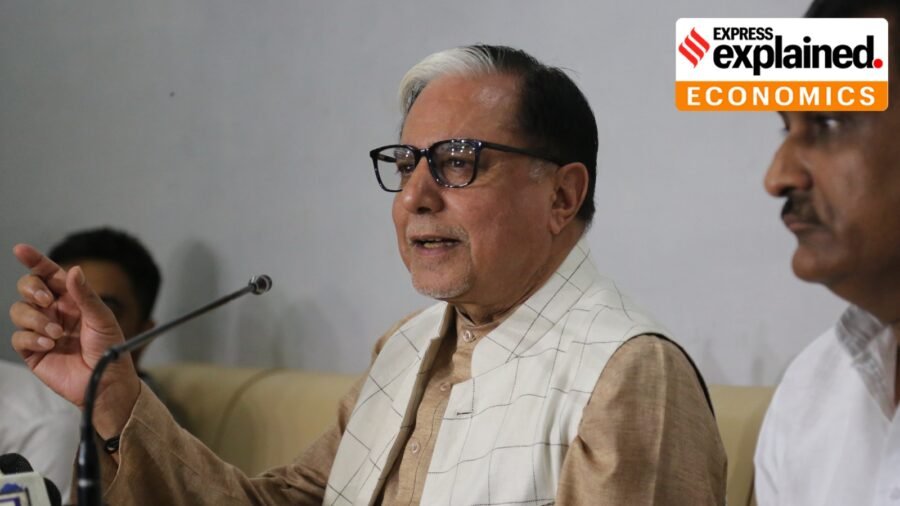
A recent National Company Law Tribunal (NCLT) order involving Zee Group founder Subhash Chandra has yet again exposed one of the most highly debated issues under the Insolvency and Bankruptcy Code (IBC) framework — deep “haircuts”.
The term “haircut” is not defined under the IBC. In banking parlance, however, it refers to the reduction in the value of an asset that has been used as collateral to protect a lender from potential losses.
The August 25 NCLT order approved a repayment plan under which Chandra would pay just Rs 6.5 crore to creditors. While the admitted claims amount to Rs 22,006.57 crore, Chandra has said the total claim against him as a personal guarantor in the personal insolvency proceedings is only Rs 3,992 crore by the objectors of the plan.
Story continues below this ad
HDFC Bank, one of the lenders with 3.2% of the total claims, is now considering an appeal at the National Company Law Appellate Tribunal (NCLAT).
How does the IBC process work? What have haircuts typically looked like under the IBC so far? How high can they get? We explain.
How does the IBC process work?
The IBC, enacted in 2016, created a time-bound mechanism to deal with companies that fail to repay their loans — by either reviving such firms through a resolution process or liquidating them if resolution is not possible.
Suppose a company fails to pay its debt. Its creditor then can approach the NCLT to initiate the “insolvency process”.
Story continues below this ad
 The tribunal concluded that the approved repayment plan could provide a better outcome than simply pushing the matter into bankruptcy. (NCLT website)
Then, at least two valuers are appointed to assign a fair value and a liquidation value to the company, based on records and physical examination of its assets.
Fair value is the total estimated value of assets under the current condition of the company. Liquidation value is the amount that creditors would get if the assets of the company are sold, mostly through auction. Enterprise value refers to what an entity would be worth if it continues operating.
After that, potential buyers are invited to submit resolution plans against the fair value and liquidation value.
The resolution plan has to be approved, first by the majority of the creditors and then by NCLT.
Story continues below this ad
Once that happens, the debt-ridden company is transferred to another party, which pays back the creditors.
The questions around the recovery mechanism
The IBC was enacted to provide a comprehensive system to rescue companies under financial stress or high debt through resolution and repayment to creditors. In its 10 years of existence, however, the often-amended mechanism has faced a fundamental question around its functioning: is resolution more important or recovery?
According to data available with the Ministry of Corporate Affairs, between the financial years (FY) 2021-22 and 2025-26, a total of 1,077 cases were resolved under the IBC, with creditors recovering Rs 2.47 lakh crore. The average recovery, however, was close to 29%.
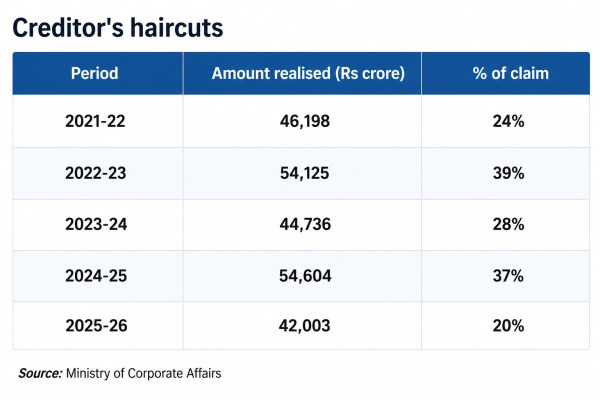 Creditors’ haircuts
In FY26, the recovery against the admitted claims was 20%, the lowest in the last five years. Similarly, the total realisation was 37% in FY25, 28% in FY24, 39% in FY23 and 24% in FY22.
This means that a bank may have claims running into thousands of crore rupees, but what they receive could be just a small part of what it is owed.
What government says
Story continues below this ad
The government’s opinion is that the primary objective of the Code is “resolution, not recovery”.
The logic is that if a company has been under financial stress for years and its assets have depleted significantly due to non-performance, the IBC process may yield low or no realisation, or even result in liquidation.
In December 2025, the Standing Committee on Finance carried out a complete review of the IBC process. The Union Finance Ministry told the committee: “It may not be appropriate to see realisation in relation to claims of the creditors. The assets available on the ground may make better sense, because the market offers a value in relation to what a company brings on the table, and not what it owes to creditors… the amount of claim often includes non-performing assets (NPA), which may be completely written off, and interest on such NPA. It may include loans as well as the guarantee against such loans.”
The ministry also said that the amount realised often does not include the value that may be realised from equity holdings post-resolution.
Story continues below this ad
Beyond realisation against claims, it is considered that the IBC has helped create credit discipline, which has contributed in reducing the gross NPAs of banks.
What banks say
Banks, however, have voiced serious concerns over haircuts.
They have suggested that the problem lies in the valuation of stressed companies and that all assets should be included and properly valued as per established standards — indicating that some assets may not be accounted for and an opacity around the process.
“One of the suggestions to reduce excessive haircuts is asset valuation systems to ensure the reflection of enterprise value instead of liquidation value,” the SBI chairman had told the standing committee.
SBI also wrote to the committee: “The role of auditor is to assess the inclusion/exclusion of assets, adoption of internationally accepted methodology, true realisability of value and ethical ways of valuation. However, at times we observe opacity in their conduct.”
Story continues below this ad
On the same asset valuation system, Bank of Baroda told the committee: “one of the crucial aspects of resolution under IBC is accurate and timely valuation of the corporate debtor’s assets… accurate valuation helps identify the true worth of the corporate debtor’s assets. This allows for maximising the recovery for creditors and potentially facilitating a successful revival plan.”
Banks have also raised questions on the methodologies used to value a company. “Valuation practices vary widely due to lack of uniform guidelines across sectors. Registered valuers often use different methodologies, leading to divergent valuation reports that confuse stakeholders,” Indian Overseas Bank told the committee.
Still, better recovery
The data shows that while recovery through IBC is low, it is still relatively better than the other recovery channels such as Lok Adalats, debt recovery tribunals and the SARFAESI (Securitisation and Reconstruction of Financial Assets and Enforcement of Security Interest) Act.
According to the standing committee’s report, the rate of debt recovery in FY23 stood at 2% for Lok Adalats, 9.9% for DRTs and 27.8% under the SARFAESI Act. The same financial year, the IBC showed a peak recovery rate of 39% for financial creditors.
Story continues below this ad
In the next financial year, FY24, the recovery rate was 1.8% for Lok Adalats, 15.2% for DRTs, 24.7% for SARFAESI. Under the IBC, it was 28.3%.
Ironically, the Lok Adalats, DRTs and SARFAESI Act are focused on enforcement and recoveries.


What could be a just, dignified and lasting peace in Ukraine?
By Sohail Khan · 29 Sep
Power from renewables should not be curtailed
By Sohail Khan · 29 Sep