Sonia Gandhi’s book controversies: From The Red Sari row to the memoir dispute
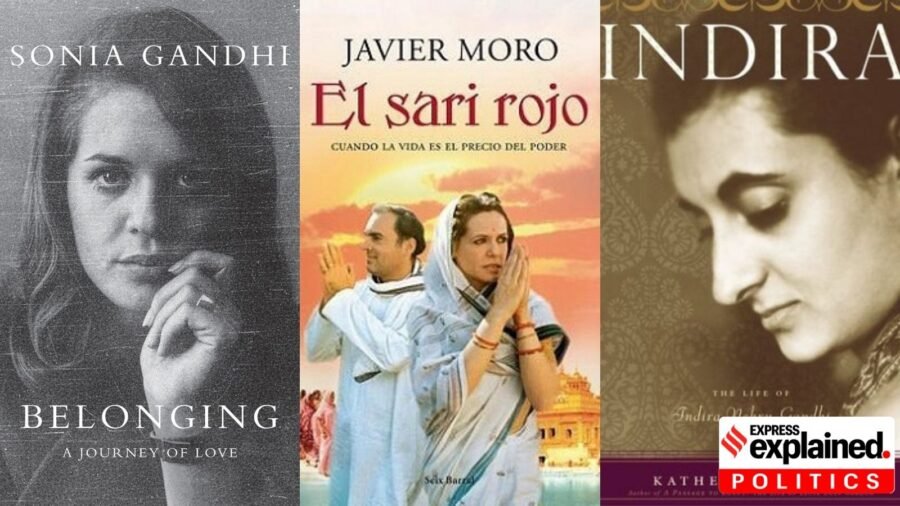
The decision of Penguin Random House India (PRHI) to drop the publication of Belonging: A Journey of Love, the much-anticipated memoir by Congress leader Sonia Gandhi, is not the first book-related controversy to involve her.
In this case, the publisher’s decision to drop publication of the book was precipitated by certain “editorial changes and deletions” that Penguin Random House India wanted to make to “a part of the manuscript” – a demand that was turned down by the author.
The memoir row and The Red Sari controversy
Years ago, when the Congress was in power, it was the party that went after the author and publisher of the book The Red Sari, which was a dramatised account of the life of Sonia Gandhi from her childhood days in Italy.
Story continues below this ad
The book was originally written in Spanish by author Javier Moro and published in Spain in October 2008. The Spanish book was called El Sari Rojo, and it was translated into Italian, French and Dutch.
An English translation was done by Peter Hearn. The name The Red Sari apparently referred to the sari that Jawaharlal Nehru had woven for Indira Gandhi, and which Sonia had worn for her wedding.
Why Congress objected to The Red Sari
However, the Congress did not take kindly to a dramatised account of its tallest leader’s life. Moro said that Sonia’s lawyers, including Congress leader Abhishek Singhvi, “have just written to my Italian and Spanish publishers to demand the withdrawal of the book from the stores. Nobody understands very well why, but that’s what they are up to”.
He added that the Congress leaders “did not like the recreation of her life in Italy as told in my book”.
Story continues below this ad
Singhvi, who said he was handling the legal matter for Sonia and who affirmed that Sonia was aware of the issue, told the media at that time, “It is time Moro stopped distorting facts and misrepresenting details. He knows well that both he and his publishers have been sent legal notices informing them that the published work is completely unauthorised, defamatory and salacious.”
When asked whether the book is a novel, not a biography, Singhvi replied, “There is no question of fictionalising a living person.”
Speaking to over the telephone from Spain on June 1, 2010, Moro said, “Sonia’s legal counsel even objected to a part in the book where Sonia wonders, after Rajiv’s assassination, whether she should return to Italy on her mother’s advice. I think they would like to believe that Sonia had been thoroughly Indianised by then and would not even consider going back to Italy.”
He added, “They would much prefer that she had been born in Delhi – and from a Brahmin family, if possible.”
Story continues below this ad
Moro claimed that before the publication of the novel, the manuscript had been sent to Sonia through her sister Nadia, who knew Spanish, but there was no response from Sonia’s side.
The book traced Sonia Gandhi’s life from her birth in December 1946. She was, it said, christened Edvige Antonia Albina Maino. But her father Stefano called her Sonia – a mark of gratitude to a Russian peasant family who sheltered Stefano, who served in Mussolini’s army, after the army’s defeat at the hands of the Russians. This had made him decide to give his child a Russian name.
The book could not be published while the Congress was in power, but hit the stands in India in 2015, after Narendra Modi became Prime Minister.
The Indira Gandhi biography that sparked another political row
Another book, albeit not about her, also led to some problems for Sonia Gandhi. In 2001, her sister-in-law Maneka Gandhi won a libel suit against author Catherine Frank and publisher HarperCollins over the book Indira: The Life of Indira Gandhi, which made some objectionable claims, including against Maneka and her late husband Sanjay Gandhi.
Story continues below this ad
By this time, Maneka was a minister in the Atal Bihari Vajpayee government, and the matter quickly turned political when Maneka accused Sonia of being behind the writing of Frank’s book, as the author had apparently thanked her for “all the inputs”. She accused Sonia of trying to bolster her image by pulling down that of other members of the Nehru-Gandhi family.
The Congress, then in opposition, hit back. Party leader Ambika Soni told the media that after having won a small legal battle and getting one paragraph of Frank’s book deleted, Maneka was pretending that she had wiped out an entire book written at the instance of someone. She also called out Maneka, “a junior minister”, for attacking the Leader of the Opposition.
Countering Maneka’s claim that she had upheld the honour of the family, Soni accused her of having left Indira Gandhi and making virulent attacks on her during her lifetime. Soni also accused Maneka of having switched to the BJP, which was an adversary of the Congress and its first family, for power.

Stocks down again — but what are the outliers in India’s share market slide?
By Sohail Khan · 29 Sep
Cash transfers alone cannot tackle the problem of educated unemployment
By Sohail Khan · 29 Sep
Rabbit vs hare: Why one runs and the other hides
By Sohail Khan · 29 Sep