Restoring lakes by going beyond quick fixes
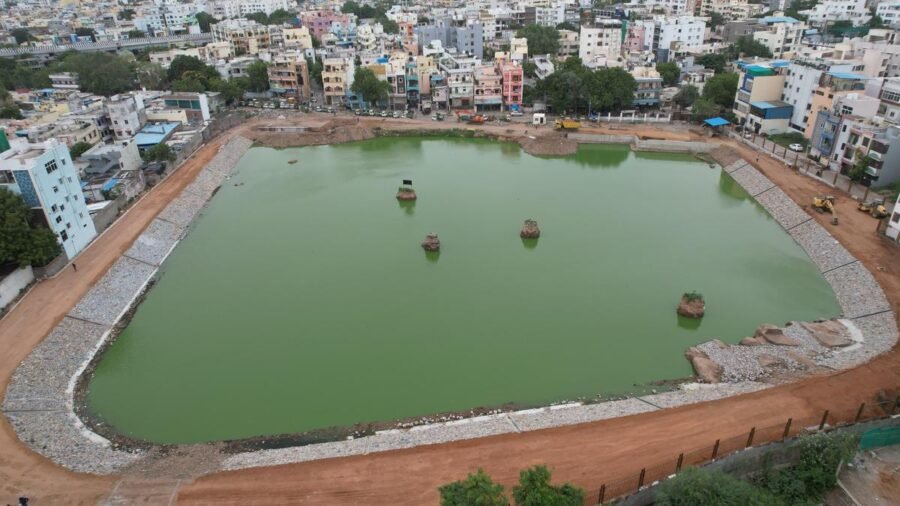
Covering nearly 6% of the planet’s surface, wetlands — including urban lakes — are among the most productive ecosystems on Earth. They store a disproportionately large share of the world’s carbon, often outperforming terrestrial forests per unit area. Beyond carbon sequestration, they contribute immensely to biodiversity, climate regulation, and human well-being. Yet today, lakes are disappearing at an alarming pace. Many of our remaining urban wetlands are either biologically dead or heavily eutrophic. In losing them, cities are systematically eroding their natural defences against climate change, undermining public health, and threatening the very foundations of urban liveability.
The widespread destruction of water bodies is a direct consequence of rapid, unplanned urbanisation. As land pressure intensifies in crowded localities, developers and municipal bodies view these natural landscapes as vacant land rather than critical ecological infrastructure. This mindset makes lakes highly vulnerable to encroachment and systemic disappearance.
Compounding this physical destruction is a deep-rooted institutional and public apathy. Heavily polluted water bodies have become convenient spots for untreated sewage, industrial effluents, and municipal solid waste. This collective inaction reveals a grim truth: lakes are dying not only because they are encroached upon, but because they are taken for granted.
The sheer volume of data capturing this damage is overwhelming. Reports by the Comptroller and Auditor General (CAG) have flagged large-scale shrinkage in J&K, including over 500 lakes since 1967. Down south, the crisis is equally acute. Hyderabad lost roughly 61% of its lake area since 1979, with 268 water bodies completely disappearing between 2002–2012 as detailed in one study. As cities grapple with intensifying heat islands and unpredictable urban flooding, there is a desperate need to treat these lifelines as ‘urban climate buffers’ and ‘sponge systems’ rather than as liabilities.
Taken for granted
Half a century ago, land in Indian cities was relatively affordable, urban expansion was moderate, and lakes were respected for their functional civic assets. Today, land prices have multiplied manifold in the past five decades. In cities such as Hyderabad, Bengaluru, and Mumbai, peri-urban land that once served as agricultural fields or natural lake catchments has mutated into prime real estate. This exponential spike has transformed lakes into a perceived “opportunity cost.” Encroachment becomes economically incentivised, leading to wetlands being filled, fragmented, and repurposed for housing, highways, and commercial complexes.
India’s recent achievement of expanding its tally of designated Ramsar sites reflects a formal, high-level recognition of wetland conservation. However, international designations must not be mistaken for local conservation success. On the ground, the reality remains fiercely complex, plagued by ambiguous boundaries, ongoing encroachment, and disrupted catchment areas. While initiatives such as the Atal Mission for Rejuvenation and Urban Transformation, the Jal Shakti Abhiyan, and Mission Amrit Sarovar provide useful policy skeletons, their on-the-ground impact is routinely diluted.
This failure stems from fragmented accountability, weak inter-departmental coordination, and a deeply flawed tendency to prioritise beautification over genuine ecological recovery. Municipal bodies often prioritise visible beautification over ecological repair — promenades, lighting, and fencing — while ignoring feeder channels, catchments, and water quality.
Real restoration demands raw institutional intent, as demonstrated by a recent Telangana initiative — the newly formed Hyderabad Disaster Response and Asset Protection Agency (HYDRAA). The agency has actively reclaimed encroached lakebeds, cleared illegal structures within Full Tank Level zones, and initiated restoration work across dozens of water bodies. Crucially, by desilting long-blocked feeder channels and restoring natural hydrological flows, the agency nearly doubled the water spread of the severely choked Nalla Cheruvu from 16 to 30 acres.
In parallel with State action, grassroots citizen movements have also shown exceptional results from community involvement. Passionate “lake champions” in Bengaluru and Hyderabad have successfully revived dying water bodies such as in Puttenahalli, Jakkur, and Kudikunta.
But these successes remain too isolated. Without institutionalised legal backing, sustained state funding, and unyielding statutory enforcement, local wins will remain exceptions rather than becoming a replicating model.
Beyond quick fixes
India’s urban future is shaped by a complex crisis of land, law, and governance. Resolving this crisis requires deep structural reform over cosmetic fixes. First, water bodies must be formally integrated into city planning. Second, lake boundaries and catchments need absolute legal protection, with strict, consistent penalties for encroachments. Streamlining fragmented governance under unified, accountable authorities is vital. Finally, citizen engagement must be institutionalised within governance frameworks to ensure permanent local ownership. Cities that reduce lakes to landscaped backdrops will eventually pay the price in floods, heat stress, and water scarcity while those that restore them as living ecosystems will secure their resilience in a warming, water-stressed future.
Mohan Chandra Pargaien is Adviser to SCCL, Telangana and former Indian forest officer with over three decades of experience in natural resource management

Why Anup Jalota calls his sea-facing home the ‘best vacation place in the world’
By Sohail Khan · 26 Sep
I have a ferritin face: What experts want you to know about low iron
By Sohail Khan · 26 Sep