Red warning labels for unhealthy packaged snacks: What has FSSAI proposed?
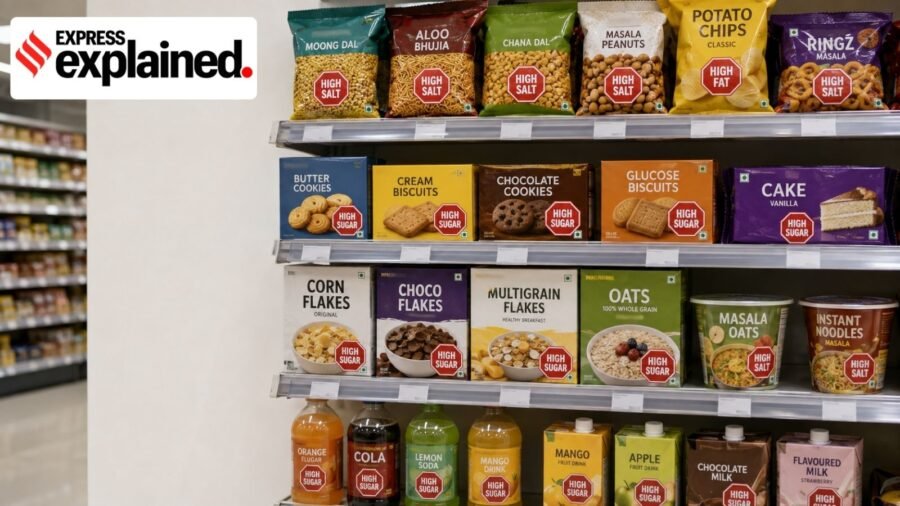
Prompted by the Supreme Court, the Food Safety and Standards Authority of India (FSSAI) has proposed introducing a red hexagonal front-of-pack label to warn consumers if packaged foods are high in salt, sugar or fat.
“The proposal is intended to provide a simple, prominent and easily comprehensible warning to consumers regarding food products which are high in specified nutrients of concern,” a compliance affidavit filed by Kavitha Ramaswamy, Joint Director, FSSAI, before the Supreme Court on Friday said. The apex court is hearing a plea by a Kerala-based non-profit organisation, 3S and Our Health Society.
The plan to introduce the Front of Pack Nutrition Labelling (FOPNL) will be executed in two phases, as per the affidavit. In the first phase, only products with a high content of at least two of the nutrients will have the warning label. In the second phase, the warning will extend to products high in even one nutrient.
What is the proposal?
Story continues below this ad
The FSSAI affidavit proposes a red hexagonal front‑of‑pack warning label for packaged foods high in two or more nutrients of concern—added saturated fat, sugar, or salt—based on thresholds specified under the Dietary Guidelines for Indians, 2024, issued by Indian Council of Medical Research-National Institute of Nutrition.
“The warning label shall indicate the applicable declarations such as ‘high fat’, ‘high sugar’, ‘high salt’ and/or ‘highly sweetened beverage’, as the case may be, to enable consumers to readily identify products high in the specified nutrients,” the affidavit states.
The warning, it added, will be displayed in a “font size one point larger than that used in the nutrition information table on the back of the pack”.
What’s exempted?
Single-ingredient food products, and “food products which are inherently rich in fat, sugar or salt, such as ghee, edible oil, salt, sugar, jaggery and honey, subject to the applicability of other requirements under the food safety and labelling regulations”, will be exempted from the labelling requirement, the affidavit stated.
Story continues below this ad
The Authority said that the two-phase plan is “to facilitate consumer acceptability and provide industry adequate time for reformulation”. It added that the proposal is “intended to address the need for an effective and consumer-friendly FoP labelling mechanism and to facilitate informed food choices, particularly in relation to children and other vulnerable group of the population”.
Advocate Rajiv Shankar Dvivedi, appearing for the petitioner, said, “We have received the FSSAI compliance affidavit. We have prepared a revised draft, which has been circulated on the petitioner’s website. We have invited comments from the public on the said rejoinder (affidavit). After getting all the comments, we will file our rejoinder.”
When court disagreed with ‘traditional Indian food’ defence
Hearing the matter in February this year, the Supreme Court had asked the Centre to consider introducing FOP labels.
When the court heard it again on August 23, Additional Solicitor General Brijender Chahar, for the Centre, said it was difficult to go by international standards of packaging. He sought to explain that one-third of MSM enterprises are based on traditional foods and following such labelling would run the risk of marking almost all traditional Indian food products unhealthy. “Namkeen and even eggs would have red symbol, meaning unhealthy,” he said, adding that it was not necessary to blindly imitate the international format as those foods are distinct in character from Indian ones.
Story continues below this ad
The Supreme Court, however, did not agree. It said: “We do not approve the stance of the Union when it says that it is not possible to match with international standards, more particularly, developed countries. Should India remain as an underdeveloped country?”
The court said it understood there may be industry pressure and asked if the authorities did not want people, especially children, to grow up healthy.
It further pointed out that “the right to life under Article 21 encompasses the right to health. When the Constitution guarantees this right, it casts a corresponding duty on the State to not only refrain from actions that impair the health but also to take affirmative steps to protect it. Furthermore, Article 47 of the Constitution casts a duty on the State to improve public health as its primary duty.”
The Supreme Court will hear the matter next on September 10.


What could be a just, dignified and lasting peace in Ukraine?
By Sohail Khan · 29 Sep
Power from renewables should not be curtailed
By Sohail Khan · 29 Sep