Pratap Bhanu Mehta writes: Trump, Modi and the trouble with being wounded strongmen
India and America are facing a new spectre: The prospect of a deeply wounded elected strongman. A wounded strongman is a leader who rode to electoral success on personalised power as an answer to many of society’s major challenges. What happens when the aura collapses? Leaders like Narendra Modi and Donald Trump were regarded by their followers as geniuses, with deep insights into the demands of history that ordinary mortals could not fathom. They could do no wrong. But then the tide turns, and the emperor suddenly has no clothes. Even their die-hard followers don’t expect much; they cling on because of sunk costs, or fear, or simply their loathing for anyone else. The bottom line is: Both are deeply wounded. But at the same time, they are going to be in power for the next two to three years. Their authority and capacity to govern may have diminished. But their ruthlessness and stakes in power have not. They are still administratively empowered and have the state apparatus at their disposal. This is a novel challenge for us.
The failures that lead to their diminished aura are all real. They are also at a dead end on how to address these failures. The headline numbers in both the United States and India don’t look bad. But the deep anxiety about the economy in both countries is palpable. In the US, it is concern over the debt, inflation, jobs, tariffs, and all-round uncertainty. In India, the headline growth number can barely disguise deep unemployment and social discontent. The economy is officially successful, but that success is not translating into better individual life prospects. As quotidian governance begins to collapse, the leaders appear even more disinterested in mundane administration. The corruption is now openly and palpably talked about. For Trump, there is no easy way to rein in the deficit, tame inflation, reduce tariffs, or maintain low interest rates. For Modi, there is no easy way of producing productive jobs. His governing style is not conducive to ordinary private investors, and his ideology is deeply destructive to education. There is no easy exit from the economic stasis.
Advertisement
Both Trump and Modi promised a foreign policy in which the leader would strike a new direction. Their sheer will would allow their countries to overcome the constraints of the past and ride the world in a blaze of national glory. Trump’s foreign policy has been catastrophic, making both America and the world less secure. Modi’s failures are subtler. But India is now less respected in the neighbourhood and the Global South; it has less room for strategic manoeuvre, and its overall security environment has not improved. The foreign policy does not provide a compensatory theatre for greatness.
There are big differences between the contexts of Trump and Modi: Modi has a powerful party, an ideological organisation, and an ideology that can survive his power. He is also dealing with weaker institutions. But both have run out of ideas; their paranoia makes their talent pool small; and their administrative style cannot deal with complex governance challenges. In truth, even strongmen rule through a clever combination of co-option, repression, and ideology. But most importantly, they cannot acknowledge political weakness without that weakness becoming a self-fulfilling reality. But their aura of strength is indispensable; give up on that, and everything else collapses.
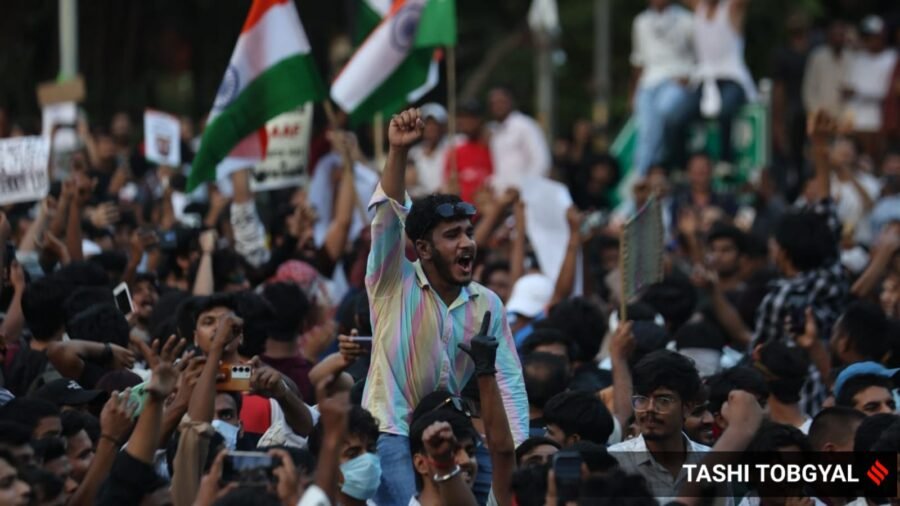
But what happens when strength cannot be projected through popularity or actual achievement? How do you demonstrate strength when you cannot fix the economy, have failed to navigate the turbulence of world politics, and do not believe in institutions that can actually govern? The only answer is more repression and de-institutionalisation. In Modi’s case, it is apparent: There is a surface concession to the Cockroach Janta Party and its demands. But institutionally, the search for more repressive instruments will only intensify. A wounded regime can have an enormous administrative apparatus for coercion at its disposal. Both strongmen have not been averse to using citizenship scrutiny, tax and regulatory enforcement, investigative agencies, welfare eligibility, and playing favourites with business. Both are beginning to toy with the legitimacy of the electoral mechanism, though in different ways. Trump might still try to delegitimise the election process. In India, the legitimacy of the electoral process is now potentially hostage to the cruel and possibly selective procedures of the Election Commission.
Advertisement
Modi’s ecosystem can employ more vigilante street power, targeting students, minorities, and dissenters. Just imagine, as reported, churchgoers in Mumbai are being put in a position of having to self-declare that they are attending prayer voluntarily, as a response to disruptions, allegedly by groups like Bajrang Dal. The epitome of repression is when citizens are being asked to carry proof of their innocence at every turn. The Cockroach Janta Party, notwithstanding this trend towards repression, is not diminishing.
Trump may not be able to resort to vigilante street actors without further losing legitimacy. It is an open question how much of the coercive apparatus of the state — ICE or federalisation of law enforcement — Trump can actually deploy. Modi has one more arrow in his arsenal: Communalism, the sense that he can address every cultural grievance. Trump can also try the politics of cultural grievance, but the axis of that grievance is less clear-cut than Modi’s Hindutva. There is one final move wounded autocrats might be tempted to make. Since they have failed ordinary tests of competence, they might need a deeper crisis which might change the canons by which their usefulness is judged: A state of emergency of some kind. Can they manufacture one?
How much destruction the wounded strongmen can unleash will depend on a lot of factors: The persistence of counter-mobilisation, the nature of the opposition, etc. But it would be a mistake to think that political weakness means a loss of coercive power. Weakness just might be a reason to use power more ruthlessly. As PG Woodhouse might say, we might find ourselves in a novel pickle indeed.
The writer is contributing editor,

When tech becomes a tool for gender violence
By Sohail Khan · 27 Sep
A caution about letting religion trump politics
By Sohail Khan · 27 Sep
Before you buy baingan, press it: How to spot fresh brinjal at the market
By Sohail Khan · 26 Sep