Politics has descended into a crusade of mutual demonisation, and Parliament has followed
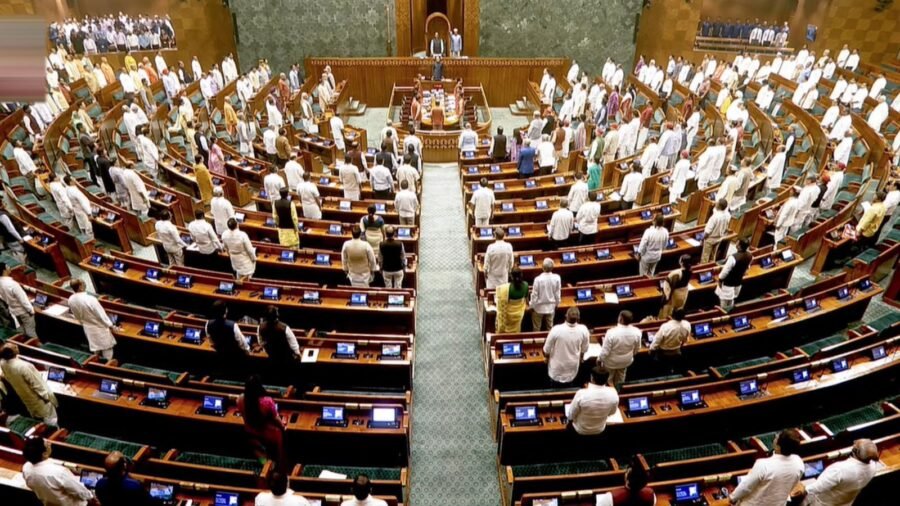
The recently concluded Parliament session has confirmed yet again that urgent action is needed to restore the “temple of our democracy” to something better than utter dysfunctionality. Our collective failure to strike a balance between partisan politics and mature statesmanship remains the most glaring weakness of our parliamentary democracy. The Opposition remains adamant that certain issues must be discussed, but faces a government that considers compromise a sign of weakness. The Opposition persistently chooses disruption if it won’t be heard; the government refuses to reach out and accommodate even some of its demands. Time, taxpayers’ money and meaningful debate are all lost. So also are opportunities for MPs to question ministers, to raise constituency issues in Zero Hour or issues of national importance under Rule 377, and to place on record their views on the bills that the government cheerfully passes amid the din.
The relationship between the government and the Opposition has devolved into an unprecedented bitterness. It was not always so. A foundational civility once governed our public life: Atal Bihari Vajpayee took delight in recounting how Jawaharlal Nehru treated him with immense courtesy as a young Opposition backbencher, how Rajiv Gandhi ensured he received medical care in the US, and how Narasimha Rao dispatched him to Geneva to represent India at a critical UN summit on Kashmir. Such bipartisan grace is today unimaginable.
Advertisement
Instead, Indian politics has descended into a crusade of mutual demonisation. Each side claims the mantle of absolute virtue while writing off the other as irredeemable. To the ruling party, dissent is branded as “anti-national”; the Opposition, in turn, casts itself as an outnumbered band of Pandavas battling a ruthless, resource-rich Kaurava establishment. But democracy cannot survive without a basic presumption of mutual good faith: the belief that even our fiercest rivals care about the nation’s welfare, even if we disagree profoundly on how to serve it. When we treat political adversaries as existential enemies, the common ground required for governance vanishes.
This breakdown of democratic trust is a collective failure. The ruling party was just as uncompromising when it was out of power. The very leaders who once championed parliamentary obstruction as a vital tool for enforcing executive accountability discovered, upon taking office, that where you stand depends on where you sit. Suddenly, disruption became an unpardonable sin. Unsurprisingly, the Opposition, having suffered under those tactics for years, rejects the sermon. If the traditional Golden Rule urged us, “Do unto others as you would have them do unto you,” the new code of Indian politics is far simpler and far more destructive: Do unto them what they did unto you.
There is also a glaring disconnect between parliamentary performance and electoral success. Representatives are elected (and re-elected) for reasons that have almost nothing to do with their ability to skewer a minister during Question Hour or dissect a flawed bill with forensic precision. Instead, voters judge their MPs by the constituent services they render and the raw, local political muscle they command. The talent that ought to be showcased on the floor of the House has migrated to television studios. In turn, when party whips corral MPs into the well of the House to disrupt proceedings with organised shouting rather than reasoned debate, party leaders signal that they value partisan aggression far above parliamentary excellence.
Advertisement
At one time, political parties valued different skills in their leaders: The mass mobilisation of the “politics of the street” and the debating prowess of the “politics of Parliament”. When the “politics of the street” has invaded Parliament, the “politics of Parliament” has no place to go, impoverishing our democratic discourse and rendering the possibility of national consensus on progress untenable. Some good work continues in parliamentary committees, mostly away from the media glare, and in the absence of the cameras that place a premium on disruptive grandstanding. But what the public sees is disruption, the absence of dialogue and a complete breakdown in communication. Disillusionment with the functioning of Parliament is rife across the country.
This generational freefall in legislative standards has only been exacerbated by the ruling dispensation. The current government displays a barely concealed contempt for the legislature, preferring to ride roughshod over the Opposition rather than engage it. Unlike Jawaharlal Nehru, who attended Parliament daily and treated it as the beating heart of Indian democracy, Prime Minister Narendra Modi rarely deigns to grace the House with his presence. Over recent years, the government has reduced Parliament from a consultative chamber in a deliberative democracy to a mere noticeboard for announcing executive decisions and a rubber stamp for legalising them.
This systematic diminishing of Parliament strikes at the very core of our democratic order. Tragically, its own custodians are allowing the institution to be hollowed out, bringing us dangerously close to a point where the public will no longer even miss it when it is effectively rendered meaningless. But if Parliament is allowed to lose all purpose, what will remain of our democracy?
Democracy requires a rare, delicate balance. It demands that politicians maintain fierce ideological convictions during an election, yet actively cooperate for the collective progress of the nation once the ballots are cast. This principle is essential to build a healthy political culture, drawing on timeless lessons from democratic history, global precedents, and the evolving nature of public service. When both sides concur that national interests should be prioritised over partisan rivalries, governance can shift from zero-sum obstructionism to constructive collaboration. This approach does not mean giving up party ideology or abandoning one’s principles. Instead, it recognises that while political parties offer different paths toward progress, the ultimate destination remains the welfare, safety, and prosperity of the nation.
An obvious solution, successfully used elsewhere, is to grant the Opposition one day a week or two hours a day to raise any issue it deems essential, while allowing the work of Parliament to proceed undisturbed the rest of the time. Does no one in the government have the imagination or the vision to effect such a compromise?
The writer is a fourth-term Congress MP from Thiruvananthapuram
The Koran and politics of purdah
By Sohail Khan · 22 Sep
Persistent antagonism towards Urdu
By Sohail Khan · 22 Sep
How ‘kaata wash’ helps preserve the delicate Dhakai jamdani sari
By Sohail Khan · 21 Sep