PM’s I-Day speech — Reforms, AI skilling for youth, free online coaching and a warning on ‘dimagi Naxal’
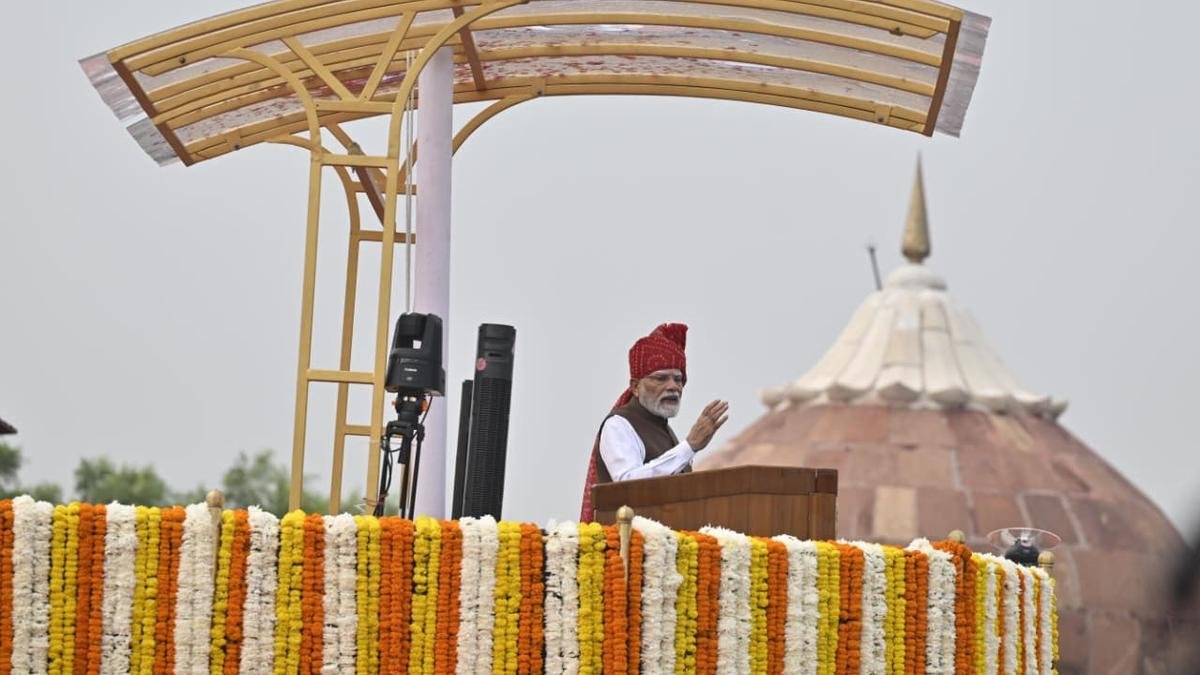
Addressing the nation from the ramparts of Red Fort on its 80th Independence Day, just days after massive youth protests rocked the capital, Prime Minister Narendra Modi’s speech included a seven-point economic reform plan and an outreach to Gen Z youth, promising AI skilling programmes and free online coaching in an attempt to address post-globalisation anxieties. He also warned the country about the threat of “dimagi Naxals” — intellectual or ideological Naxals — in society, even after the eradication of armed left wing extremism.
At the first Independence Day that saw Vande Mataram preceding the national anthem, the Prime Minister directly addressed challenges facing the youth, from employment worries to the incursion of of Artificial Intelligence in everyday life.
Independence Day LIVE updates
More than one crore youth will be provided AI skills in a “mission mode” drive over the coming year, he said. India’s digital public infrastructure will be used to provide free online coaching to students wishing to take various competitive exams, and there will be a nationwide sports talent hunt among children between five and 15 years of age ahead of the 2036 Olympic Games, he added.
Mr. Modi recalled that, when he had first promoted his ‘Make in India’ initiative, advocates of globalisation had reacted as though it was heresy. In the current global economy, however, every country is thinking for itself, he pointed out.
‘Identify, isolate intellectual Naxals’
This acknowledgement of GenZ anxieties that spilled over into the recent Jantar Mantar protests was, however, spiked by a warning about “intellectual Naxals”.
“For years, people with a Maoist ideology had established themselves in the corridors of power and influenced policymaking, including as advisors on government committees. We have succeeded in eliminating armed Naxalites from the forests and freeing the country from that grave threat, but these ideological Naxalites are waiting for opportunities,” Mr. Modi said. “They are trying to revive the paths of violence and anarchy, and are making various attempts to drag society in the wrong direction. We must identify these ideological Naxalites and isolate them. At the same time, we must connect the country’s young generation with the mainstream effort to build a developed nation,” he added.
Freedom’s Progress Through the Years
He announced a full review and restructuring of civil defence infrastructure. “The nature of warfare is changing. There is no guarantee that wars will now be fought only along the borders,” the Prime Minister said. “A new form of warfare is emerging… Attacks can target a refinery, the banking sector, or a data centre. Infrastructure can be destroyed and factories can be targeted. We had announced Mission Sudarshan Chakra, [a multi-layered defence infrastructure system, with AI and cybersecurity components] last year, and work on it is going on rapidly,” he added.
“The nature of warfare is changing. There is no guarantee that wars will now be fought only along the borders. A new form of warfare is emerging… attacks can target a refinery, the banking sector or a data centre. Infrastructure can be destroyed and factories can be targeted. We had announced Mission Sudarshan Chakra (a multi-layered defence infrastructure with AI and cybersecurity components) last year (2025), and work on it is going on rapidly,” the PM said. A full review and restructuring of the way the civil defence infrastructure functioned would be undertaken, he also announced.
Economic reforms
A large part of the Prime Minister’s speech was devoted to what he termed ‘Saptadhara’ or the seven economic streams where his government was committed to reforms for growth. This includes manufacturing power with emphasis on quality; agriculture and food processing; technology and innovation as evidenced by the opening of the private sector for space exploration, and operationalisation of seven or eight semiconductor plants in the next year or two; the PM GatiShakti plan for multi-modal connectivity; enhanced domestic capabilities in armament production; a green and blue economy, with a coastline changed for full utilisation and increased energy storage; and the projection of India’s soft power, including via yoga, tourism, and animation.
The government has targeted the creation of 100 GW of nuclear energy capacity by 2047, Mr. Modi said, adding that five new reactors will be made operational in the next six to seven years.
Mr. Modi praised the government’s handling of the economy through several global crises. “After beating the COVID-19 pandemic, there was conflict and war everywhere. People had begun fearmongering. Many said there would be no vaccines, no one would be saved. They said no one would get fuel, diesel, fertilizer; people spread all kinds of rumours, and some people derived pleasure in this fearmongering,” he said. “However, despite these challenges, we have followed the spirit of ‘Nagrik Devo Bhava’ (the citizen is equivalent to God), and our preparations have helped us,” he added.
Bishnoi comes out in support of Rao Inderjit, says ignoring seniors will weaken BJP
By Sohail Khan · 16 Aug
Independence Day 2026: A hidden lake of lotuses, and the India I keep seeking
By Sohail Khan · 16 Aug

Leave a Reply