Over 100 Indians among hundreds missing in Nepal flash flood fury
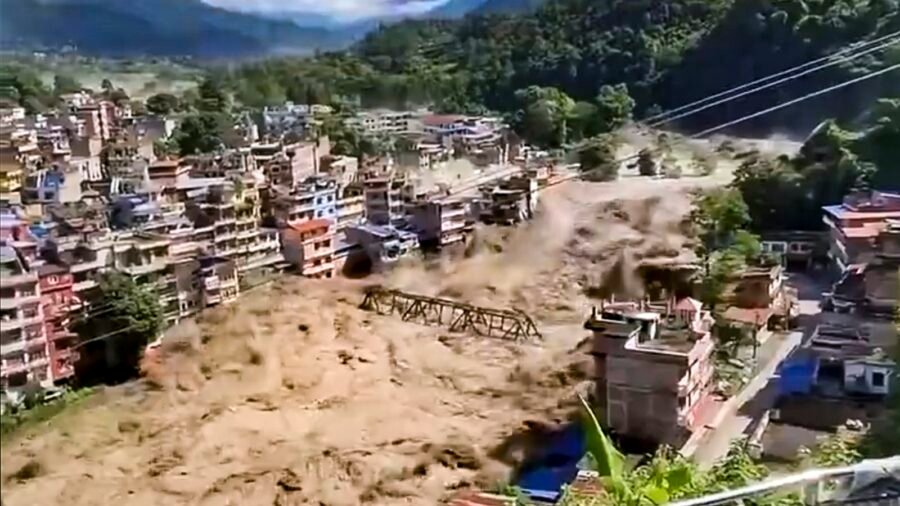
Over 150 people were killed while at least 484, including 105 Indians and 37 Non-Resident Indians (NRIs), were reported missing after massive flash floods in Nepal’s districts bordering Tibet on Wednesday.
According to official figures, 391 foreign nationals and
93 from Nepal had been reported missing until 7 pm (local time). These included at least 60 working in hydel projects in the area.
Sources said most of the Indians reported missing were headed to Kailash Mansarovar.
Story continues below this ad
The remaining tourists are from the United States, Malaysia, United Kingdom, South Africa, Australia and the Netherlands.
Among the dead were 44 from Nepal’s Army, 28 from the police and 13 from the Armed Police Force. The authorities fear higher casualties and widespread destruction.
Initial reports from the affected areas and the National Disaster Risk Reduction and Management Authority said the border river flood, which began a little after 9 am local time, swept away many settlements across the 60-km road from Gyirong in Tibet, down to Rasuwa and Dhading districts in Nepal, both bordering Tibet, and Nuwakot district.
With these areas being part of Nepal’s old trade route with Tibet, they are thickly populated. Rasuwa is known for its trekking routes, with 108 lakes in the region including the sacred Gosaikunda Lake. Some of the missing were trekking to the Gosaikunda Lake, coinciding with the local festival of Janai Purnima on Friday.
Story continues below this ad
Though the monsoon season is less favorable for trekking in Nepal, it’s a major season for Kailash Mansarovar Yatra, along the Rasuwa (Nepal)-Gyirong (Tibet) route.
Dozens of multi-storied buildings, trucks and vans were buried under the mud in Nuwakot, one of the worst-affected areas. Critical infrastructure, including at least a dozen hydropower projects, was also destroyed, affecting about 700 MW of power generation. Gorkha, Nawalparasi and Chitwan were among the other districts affected.
Climate experts at the Kathmandu-based International Centre for Integrated Mountain Development (ICIMOD) said an avalanche from a glacier likely caused the flash floods. Initial reports suggested that an earthquake in the area could have triggered an avalanche and caused the floods, Nepal’s Foreign Minister Shisir Khanal also told Parliament on Wednesday, according to local media reports.
“Preliminary assessment based on video footage and information from affected areas suggest that a large volume of ice and rock debris may have entered the Lhende Khola, a tributary of the Bhote Koshi River. Researchers say the event could have generated a sudden surge that carried water, sediment and large boulders downstream,” ICIMOD said in a press release.
Story continues below this ad
World · Himalayas · Factbox
Deadly disasters in the Himalayas over a dozen years
A massive flash flood has struck the Nepal-Tibet border. Reuters lists some of the region's biggest disasters of the past dozen years — a toll some analysts blame on climate change and rapid development.
Updated · Aug 26, 2026
Flash flood on the Nepal-Tibet border kills at least 157
The toll climbed sharply to at least 157, police say — up from an initial count of nine — as villages were washed away and roads, bridges and power projects were damaged. The number may still rise.
The past dozen years
August 2025 · Uttarakhand, India
4 deaddozens missing
Sudden flooding and landslides in the Indian state.
September 2024 · Nepal
66+ deadflooding & landslides
Persistent downpours triggered widespread flooding and landslides.
November 2023 · Uttarakhand, India
All 41 rescuedroad-tunnel cave-in
41 low-wage workers were trapped in a collapsing road tunnel and freed after 17 days. No cause was given.
October 2023 · Sikkim, India
179 deadglacial lake outburst
Torrential rain burst a glacial lake, causing devastating floods in the northeastern state.
January 2023 · Joshimath, India
~200 evacuatedtown subsidence
Cracks spread through hundreds of buildings, later demolished as unsafe. Officials blamed rapid construction.
October 2021 · Uttarakhand, India
46+ deadunseasonal rain
Heavy rain flooded roads and washed away bridges.
February 2021 · Uttarakhand, India
200+ deadDhauliganga flash flood
A flash flood swept away two hydroelectric projects, sending water, rock and debris down the valley.
September 2014 · Kashmir
~464 deadworst floods in 50 years
The Jhelum river surged in unusually heavy rain, killing about 200 Indians and 264 Pakistanis.
Reuters notes that some analysts link the rising frequency of these disasters to climate change and widespread development across the fragile mountain region.
The Aug 26, 2026 toll is provisional and may rise. Figures are as reported by Reuters; “at least” and “about” qualifiers reflect the original wire.
Source: Reuters, August 26, 2026. A developing story.
· Global Desk
From its origin in Tibet, the Bhote Koshi river empties into Nepal’s Trishuli river that eventually flows into India as the Gandak river. The swollen Trishuli river engulfed the surrounding areas, leaving a wide swathe of destruction on either side of its course. At least half-a-dozen bridges over the river were swept away, including in the Malekhu area, affecting connectivity to the two tourist sites of Chitwan and Pokhara.
Security footage captured on the Chinese side of the Nepal-Tibet border showed many people fleeing before a torrent of rock, mud and water destroyed buildings, vehicles and took many lives.
China’s official Xinhua news agency said the mudslide occurred on the Nepal side and hit the Gyirong port, cutting roads, communication and power links in the Shigatse region near the border, but did not elaborate.
Chinese state broadcaster CCTV said the mudslide in Gyirong County near the border killed at least three and left 265 missing. A rescuer told CCTV that it would take at least four hours for the team to reach the site due to the 1.5-metre deep sediment that blocked pathways leading to the affected area. The debris had surged upstream from the Nepalese side of the crossing, the rescuer said.
Story continues below this ad
The exact cause of the mudslide could not be immediately determined, but the German Research Centre for Geosciences (GFZ) said there was a 4.4 magnitude quake approximately seven minutes before the time shown on the security footage time-stamp.
An initial study of Planet Labs satellite imagery indicated that a landslide of snow and rock triggered a debris-laden flood in the Lhende Khola, about 20 km northeast of the Nepal-China Rasuwagadhi border crossing, Nepal’s National Disaster Risk Reduction and Management Authority said on X.
An ice-rock avalanche in the Lhende Khola on the Nepal side was the trigger, but the cause remains unconfirmed, said Qianggong Zhang, head of climate and environmental risks, at ICIMOD. “With a blockage still lodged upstream on the Nepal-China border river, authorities warn a second flood may occur,” Qianggong said.
Prime Minister Balendra Shah called an emergency meeting of the Cabinet. “Instructions have been given… to move the people living in the lower areas to safer places,” he said.
Story continues below this ad
Former King Gyanendra Shah also issued an appeal, calling for a coordinated safety campaign and tripartite cooperation between Nepal, India and China for long-term initiatives to contain floods.
Last August too, the same regions in Nepal had seen similar flash floods when a glacial lake in Tibet overflowed because of high temperatures. Nine people were killed, and critical infrastructure, including a bridge connecting Nepal and China, was damaged at the time.
“The Lhende Khola has flooded twice in fourteen months, this time triggered by an ice-rock avalanche from a glacier on the Nepal side that blocked the river and released a sudden surge downstream,” said Saswata Sanyal, a disaster risk reduction specialist at the climate research group.
With Agencies

Piecemeal steps won’t work, Rahul Gandhi doubts stand vindicated: Congress
By Sohail Khan · 27 Sep
National highway cut off; 16 airlifted by IAF as floods worsen in Bastar
By Sohail Khan · 27 Sep