Only 100–500 left: Why the Timor green pigeon is disappearing
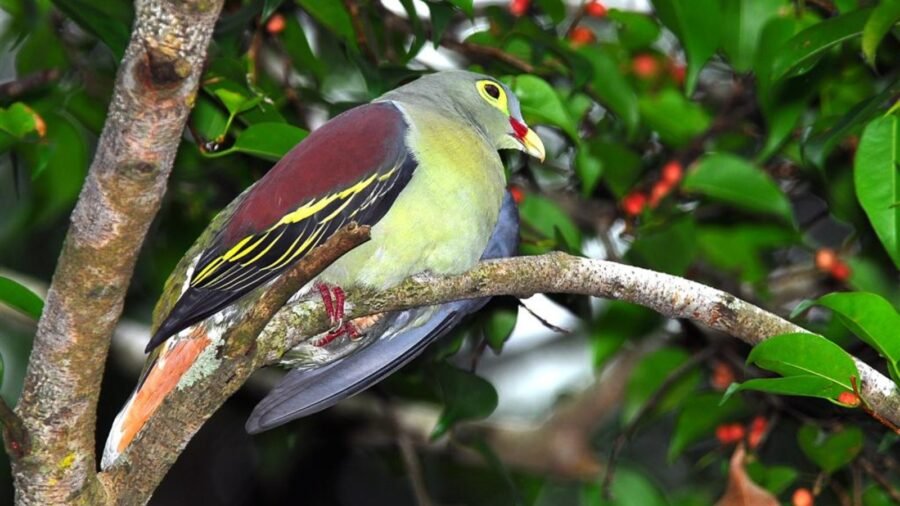
The Timor green pigeon, a little-known bird found only on Timor, Rote and nearby islands, is edging dangerously close to extinction. A Mongabay report, citing a new study published in Oryx, estimates that only 100–500 mature Timor green pigeons may remain globally, with the population likely closer to the lower end of that range. The researchers recommend reassessing the species’ IUCN Red List status from Endangered to Critically Endangered.
The decline is particularly stark in Indonesia, where researchers believe the species may already be functionally extinct. Only six records have been made in Indonesia this century, while most of the remaining birds are concentrated in Timor-Leste, particularly in Lautem District and Nino Konis Santana National Park.
Wildlife photographer and environmentalist Indrajit Ghorpade sees the Timor green pigeon as another example of a broader pattern in which human activity pushes wildlife towards extinction. “The Timor Green Pigeon is one more victim of what I strongly believe is a common cause-and-effect pattern. One more species that faces extinction for reasons that are ‘man-made’,” Ghorpade says.
What is the Timor green pigeon?
The Timor green pigeon is a forest-dwelling pigeon endemic to Timor, Rote and surrounding islands in eastern Indonesia and Timor-Leste. It is closely associated with lowland forest habitats, particularly areas with suitable fruiting trees.
The species has been recognised as threatened for decades. For Ghorpade, the alarm over its numbers should be viewed in the larger context of shrinking habitats and increasingly fragmented wildlife populations.
“The criteria for making this species vulnerable to extinction is that their numbers and populations have reached alarmingly low numbers,” he says. “And as I have understood this is because their habitats have been destroyed by over 80%.”
Hunting has played a devastating role
Ghorpade says the bird has also historically been hunted as game. “They are considered ‘game birds’ and hunting for centuries has diminished their populations,” he says.
The species has an additional vulnerability that makes hunting particularly destructive. Researchers found that Timor green pigeons may not respond strongly to gunfire. Hunters in Lautem reportedly call the species tule, meaning “deaf”, because birds may remain in the canopy even after one bird has been shot. This can allow several birds from the same flock to be killed during a single hunting session.
Story continues below this ad
Ghorpade points to the same behavioural vulnerability. “Based on data, that is apparently not gun-shy and do not panic and disperse when being fired upon. Making more kills per hunt,” he says.
Why losing breeding birds can make the decline worse
Ghorpade says the Timor green pigeon’s breeding population is already under pressure. “Their breeding in terms of healthy breeding individuals is low,” he says. “Gene pool transfer due to fragmentation and isolated pockets of living birds means every generation is weaker, prone to diseases and shorter life spans.”
He adds that the absence of breeding pairs can have a cascading effect on future populations. “No breeding pairs mean reduction in the next generation populations. This cascading effect reduces numbers,” Ghorpade says.
Why habitat fragmentation matters
The Timor green pigeon has not simply lost individual patches of forest. Its remaining habitat has also become increasingly fragmented. Ghorpade says this pattern is common across threatened wildlife.
Story continues below this ad
“The biggest threats facing the Timor Green Pigeon are almost similar to almost all species that are living on the brink. Rare. Endangered or threatened,” he says.
He identifies the major drivers as “habitat loss, hunting and poaching and lack of sensitivity, ignorance and lack of awareness of the need to conserve, preserve and protect our natural world.”
A problem that extends far beyond one pigeon
Ghorpade compares its situation with threatened species across very different ecosystems, from polar bears affected by climate warming and shrinking Arctic sea ice to India’s grassland species, riverine gharials, and pollinators such as bees and hummingbirds.
“The cause-and-effect syndrome are very similar,” he says. For him, the common thread is human pressure on natural ecosystems. “Keeping all ecosystems, all life forms healthy and thriving. So much can be done and achieved if there is dedication, seriousness and a passion for nature and our natural heritage,” Ghorpade says.
Story continues below this ad
Can the Timor green pigeon still be saved?
Ghorpade believes conservation requires more than simply declaring an area protected. “The voices like the voices of wildlife who cannot communicate with us humans need to be heard. Not only heard, but acted upon,” he says.
He also places responsibility firmly on humans. “The empathy of the respect for nature, the neglect and not acting as protectors, trustees, guardians of our planet are just not acceptable,” Ghorpade says. “As the buck stops with us, and there is no ‘plan B’.”
Explore more captivating stories about pets and animals here, and make us your daily stop for the latest from the animal kingdom.

Sussanne Khan says she felt ‘more love’ for Hrithik Roshan’s mother after losing her own
By Sohail Khan · 28 Sep
COP31 hosts Australia and Türkiye face the fossil-fuel question
By Sohail Khan · 28 Sep