One shot to lower bad cholesterol? An Expert Explains how new gene-editing therapy works
A new experimental therapy from US pharma major Eli Lilly and its subsidiary Verve Therapeutics — involving a single shot infusion that may bust LDL (low-density lipoprotein), or bad cholesterol, at one go and which sharply lowered LDL by 62% for as long as 18 months after treatment in a trial — continues to make waves among cardiologists. The therapy works by permanently switching off a cholesterol-related gene called PCSK9 inside the liver, taming LDL forever.
LDL is called “bad cholesterol” because high levels make it stick to artery walls and form hard fatty deposits called plaque. These deposits narrow the arteries and block blood flow, elevating the risk of heart attacks and strokes.
VERVE-102 is not a traditional drug. It is a form of in vivo (administered directly to the patient’s body) gene editing, which allows scientists to alter DNA and modify gene function. Instead of temporarily blocking cholesterol production with medicines, researchers use genetic instructions delivered through an intravenous infusion to permanently alter liver cells from producing it altogether.
Professor David E Newby, British Heart Foundation Duke of Edinburgh Chair of Cardiology and a co-author of the VERVE-102 phase 1 trial, told , “In traditional treatment, you keep taking the medicine to keep the effect of lowering LDL. In VERVE-102, you make a one-time targeted change to DNA inside liver cells to keep the effect going.”
“The goal is to permanently reduce the liver’s ability to produce PCSK9 after a single intravenous infusion. We are hoping that a ‘one-and-done’ cholesterol treatment could eventually replace conventional medicines,” he said.
The study is exciting because it shows that a concept once considered futuristic — a one-time genetic treatment for lifelong cholesterol control — has begun to enter human clinical testing. The challenge now is proving that the benefits of making such a change last a lifetime truly outweigh the risks. For now, it is a promising potential future option for selected high-risk patients, rather than a replacement for existing treatments such as statins, ezetimibe, PCSK9 inhibitors, or inclisiran.
Why target PCSK9?
PCSK9 is a protein involved in regulating LDL cholesterol in the blood. Scientists discovered that people who naturally have certain loss-of-function changes in the PCSK9 gene tend to have lower LDL cholesterol throughout their lives and a lower risk of coronary heart disease. This provided an important clue: reducing PCSK9 activity could be a safe and effective way to lower cardiovascular risk.
Story continues below this ad
That discovery was later supported by drug trials. Medicines such as PCSK9 monoclonal antibodies can substantially reduce LDL cholesterol and cardiovascular events. Traditional medicines temporarily block PCSK9 or reduce its production. Their effects therefore require continued treatment. VERVE-102 is designed to change that battle with daily compliance of drugs.
The study produced a roughly 60% reduction in LDL cholesterol after a single infusion in patients. How would that reduce their actual risk of heart attack or stroke?
This is very large. For every 1 mmol/L (millimoles per litre, or a unit used to measure the concentration of substances in your blood) reduction in LDL cholesterol, your risk falls by 20-22%.
So, if you start with a LDL cholesterol of 4.0 mmol/L, that is approximately 155 mg/dL (milligrams per decilitre, or a unit used to measure the concentration of a substance such as blood sugar or cholesterol in one-tenth of a litre), and it goes down to 1.6 mmol/L (60% reduction), then you halve your risk.
Story continues below this ad
After four weeks, the highest-dose group showed particularly strong reductions: PCSK9 levels fell by about 88%, LDL cholesterol fell by about 62%, LDL cholesterol decreased by approximately 78 mg/dL on average.
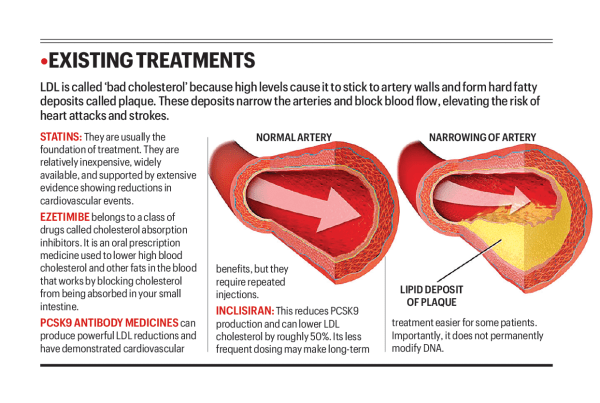 Existing treatments for LDL, or bad cholesterol.
We know that lowering LDL cholesterol reduces cardiovascular risk, but VERVE-102 itself has not yet been shown to prevent heart attacks or strokes. How cautious should patients be about interpreting the current results?
We always would want large trial data and this is needed. However, all the cholesterol-lowering trials so far have shown us that lower cholesterol means less cardiovascular events.
Moreover, drugs that block the PCSK9 protein have also been shown to reduce heart attacks. So, it is highly likely but unproven yet for this new approach.
Story continues below this ad
Some participants were followed for at least one year, and the longest follow-up reached 18 months. The reductions in PCSK9 and LDL cholesterol appeared relatively stable during this period. However, an 18-month period is very different from proving that an effect will last for decades. That needs further research.
One-time treatment sounds extremely attractive to patients who struggle with taking tablets or returning for injections. But does convenience justify the possibility of a permanent genetic change?
This is key. I take statins and it is a pain. Repeat prescriptions, remembering to take them, and so on. If safe, this would be revolutionary. This is a permanent change and we do not yet know the long- term consequences as we will need to closely observe these people.
However, there are naturally occurring mutations of this gene, too, and people who have them have less heart disease and live longer. Hence the trial.
Story continues below this ad
Who do you think should ultimately be considered for a treatment like this? Would you reserve it for people with familial hypercholesterolemia or very-high cardiovascular risk?
We would start with these people first as they have the most to gain and we can then observe if there are any problems before more widespread use.

Sussanne Khan says she felt ‘more love’ for Hrithik Roshan’s mother after losing her own
By Sohail Khan · 28 Sep
COP31 hosts Australia and Türkiye face the fossil-fuel question
By Sohail Khan · 28 Sep