NTA paper-setting process: From question bank to sealed sets, how exam papers are prepared
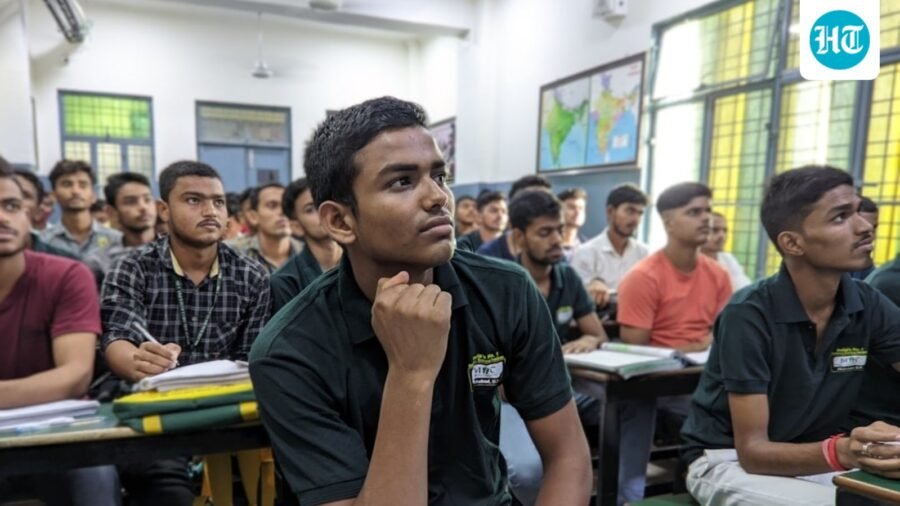
The re-examinations will be held on September 9, with English from 9am to noon and Commerce from 3pm to 6pm.
Updated on: Aug 17, 2026, 06:50:02 IST
Prefer HTon Google
Share via
Copy link
The National Testing Agency (NTA) follows a multi-stage process to prepare examination papers, beginning with the creation of a large question bank and ending with the printing, packing and secure storage of multiple question-paper sets.
The process has come under scrutiny after NTA decided to re-conduct the UGC-NET examinations for English, Commerce and Sociology following complaints of “multiple errors” in the three papers held between June 22 and June 30. NTA said the “defects” in question papers were extensive and “cannot be cured merely by dropping questions after the challenge process” and that papers with such defects “do not meet the standards of fairness and error-free examination”.
The re-examinations will be held on September 9, with English from 9am to noon and Commerce from 3pm to 6pm.
Deep Dive
Powered ByAsk
Here is how NTA's question-paper preparation process works:
Question bank first
The process begins with item writing, under which subject experts from reputed academic institutions prepare questions and answer options. Experts are not told whether the questions they prepare will eventually be used in an examination.
According to the government's affidavit filed in the Supreme Court on August 4, the question bank contains at least five times the number of questions actually required for an examination.
The questions are then taken up for moderation by another group of subject experts. Moderators select questions for multiple paper sets and check them for syllabus coverage, correctness of answers and broadly uniform difficulty levels.
The process is designed so that no single person has access to the complete question paper that will eventually be administered.
Independent vetting
The next stage is vetting. Vetters independently solve the question sets finalised by moderators and their answers are compared with those proposed by the moderators.
Where there is a mismatch, the examination director concerned resolves the issue through a meeting between the moderators and vetters.
The government's affidavit says different stages are ideally handled by different experts, with multiple sets finalised “entirely separately” and with no overlap in either questions or the experts working on them.
Translation and back-translation
After the sets are finalised, they are translated into the languages in which the examination is conducted. Subject experts translate the questions, following which other subject experts carry out back-translation into English to check accuracy and ensure that the context has not been lost.
The government said most NTA examinations are conducted in 13 languages. An “air-gapped” AI-assisted translation environment has also been created. The AI system prepares a first-cut translation, which is then checked by human translators.
The entire question bank is translated into 12 Indian languages, rather than only the questions eventually selected for the examination. Translators therefore receive a much larger pool of questions and cannot identify which ones will ultimately appear.
The translation environment has no internet access, personal devices, external storage media or cloud connectivity. The time for which individual translators handle the questions is also restricted.
How the paper sets are prepared
People familiar with NTA's paper-setting process said separate panels of senior faculty are brought to NTA's Delhi premises for about a week. They surrender mobile phones and other digital devices before entering, while reference material is made available within the premises.
Each panel consists of a convenor and four subject experts. The panels work separately and do not know what questions are being prepared by other panels.
The panels prepare large pools of questions rather than the final examination paper. The final sets are generated through algorithm-based randomisation.
“Until the final generation stage, no one knows the exact paper composition,” a central university faculty member involved in NTA's paper preparation said.
How spelling mistakes and repeated questions could occur
A central university faculty member involved in UGC-NET paper-setting said repetition could occur if portions of an earlier question set were reused and subsequently mixed with questions from a new set.
“Suppose we get a set prepared. Sometimes, two sets are commissioned for a subject. They may prepare one new set but use an earlier set, thinking that the previous set had not been opened or used. By then, however, that earlier set may already have been uploaded after being freshly mixed,” the faculty member said.
“So, this time, they may have picked half the questions from a new set and half from a previous set. When the questions were mixed, the previously used questions could have been picked up randomly. That is how the repetition could have happened,” the faculty member added.
A state university faculty member involved in UGC-NET question setting attributed errors in words to problems during typing, proofreading and translation.
“The errors in words are due to typos and oversight by persons responsible for proofreading and translation – mostly contractual staff,” the faculty member said.
Printing, packing and secure storage
Once the question sets are translated and finalised, they move through printing, packing, transportation and secure storage in parallel, according to the government's affidavit.
The process also allows NTA to replace a potentially compromised set. If information about a possible compromise reaches the agency before the examination, another set can be substituted.
The final decision on which set will be administered is taken on the morning of the examination. Only one set is administered, while the other sets remain sealed.
The entire process — from a question bank containing several times the required number of questions to separate moderation, vetting, translation, randomisation, printing and sealed storage — is designed to restrict access to the final paper until the examination.
See Less

BJP leader PC George makes U-turn on allegations of misappropriation of election funds
By Sohail Khan · 17 Aug
Kerala’s baby cradle scheme hits milestone: 1,000th infant rescued
By Sohail Khan · 17 Aug
Hanur shootout: Kin call off stir after MLA assures ₹15 lakh relief
By Sohail Khan · 17 Aug
Leave a Reply