Not delving into religious rights, only dealing with well-being and health of captive elephants, Supreme Court says
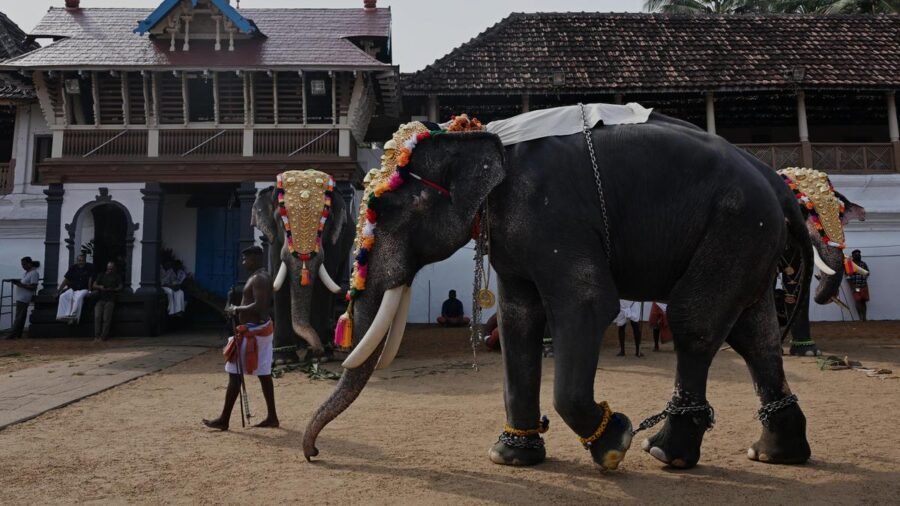
The Supreme Court on Tuesday (August 18, 2026) said elephants serving in temples must be respected and treated as manifestations of divinity while issuing a series of directions concerning the upkeep, health, well-being of captive elephants across the country.
A Bench of Chief Justice Surya Kant, Justices Joymalya Bagchi and V. Mohana clarified that the Court was not delving into religious rights or the faith behind the use of captive elephants in temples, but was only concerned with the employment of best practices in management of captive elephants by private individuals, circuses, temples, Forest Departments, zoos and rehabilitation centres.
Additional Solicitor General Aishwarya Bhati, for the Ministry of Environment, Forest and Climate Change, produced a February 25, 2026 office memorandum on the proceedings of the Captive Elephants Healthcare and Welfare Committee (CEHWC) that pointed out that the number of captive elephants have increased from 2,675 to 2,725. Of this, 1,678 were owned by private individuals, 47 by circuses, 96 belonged to temples, 768 by forest departments, 63 by zoos and 332 were in rehabilitation centres.
Senior advocate K. Parameshwar, intervening for temple managements in Kerala, said the petition is rekindled everything a festival was due in the State.
He said the captive elephants in Kerala are tagged, their movements are monitored and rules concerning their health and welfare are scrupulously followed. He said the use of elephants in temple festivals in Kerala was and essential part of faith.
Senior advocate Aparna Bhat, appearing for the NGO, Wildlife Rescue and Rehabilitation Centre, said the petition did not touch upon anything religious. It was focused exclusively on the mental and physical tortures suffered by captive elephants which are used in commercial and religious activities. Ms. Bhat submitted that captive elephants suffered mistreatment in violation of the Captive Elephant (Transfer or Transport) Rules, 2024.
The petition has sought an update on the number of captive elephants whose DNA profiling was done and stored on the Gaj Suchna mobile application, a genetic database of captive elephants.
The Bench however prima facie did not agree with the NGO’s plea that no new elephants should be made captive anymore.
“Are you aware of abandoned elephants? In the North-East, every second day a calf is found. To say that there should be no further captive elephants may not be wise,” Justice Joymalya Bagchi addressed Ms. Bhat.
The February 2026 office memorandum said a new sampling kit would be distributed to the States for DNA profiling and data capturing in respect of captive elephants.
Further, it said a handbook titled ‘Principles of Captive Elephant Management’, to be used as a field manual, has also been decided to be published. Other guidelines have also been decided to be issued for the proper care of captive elephants, besides an advisory regarding measurement and trimming of tusks of captive elephants.
The Court directed the CEHWC to file a comprehensive action report, finalise the pending issues and take necessary action for implementation of the decisions already taken by it at the earliest.
The Court separately directed the Ministry to submit a status report on the current status of the DNA profiling of all captive elephants, from those maintained by private individuals to the animals in rehabilitation centres.
“Our present concern is not with respect to the ownership of captive elephants. Rather, we lay emphasis on the upkeep, well-being and healthcare of these elephants. We therefore direct the Union of India to issue mandatory guidelines, as required, and take up the matter with the States concerned to introduce an effective and transparent mechanism regarding the establishment of elephant clinics with specialised facilities, where it shall be compulsorily prescribed for all owners of captive elephants to take the elephants for periodic check-ups,” the Court ordered.
It directed that the medical record of each and every captive elephant must be maintained.
The CEHWC should also lay down minimum standards for housing and upkeep of elephants in captivity. Owners should ensure proper transfer of captive elephants, the Court ordered.
“Transportation of captive elephants shall not be permitted unless it is duly documented in accordance with the applicable rules, containing complete particulars of the transfer and the purpose of such transfer,” the Supreme Court directed.

Monsoon revival brings relief to Keralam; more rain likely from September 23
By Sohail Khan · 21 Sep