NALSAR row: Can Bar Council of India stop enrolment of law graduates?
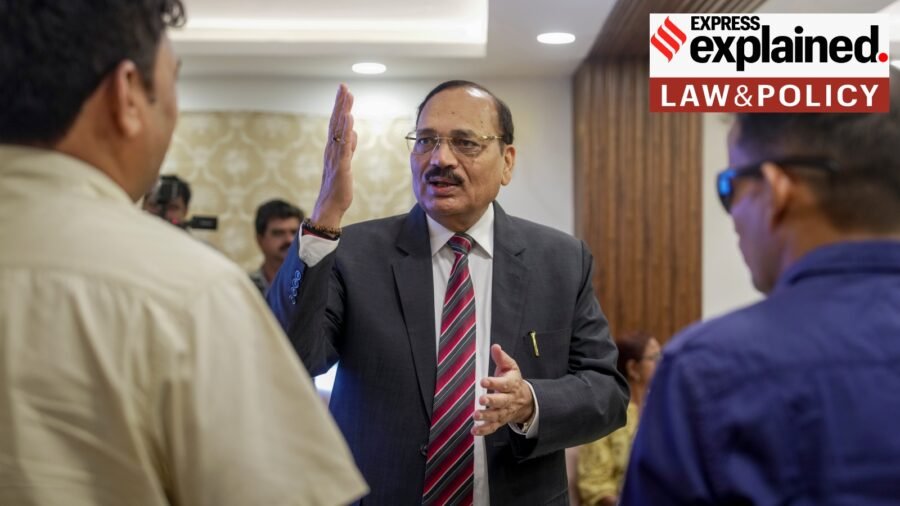
On Thursday (August 13), the Bar Council of India (BCI) directed state bar councils to not enrol graduates of NALSAR University of Law’s 2026 batch over their protest against the convocation invitation to Chief Justice of India (CJI) Surya Kant. Within hours, however, the BCI withdrew the order and closed the proceedings.
The episode raises larger questions over what powers the BCI actually possesses under the Advocates Act of 1961. Can the BCI actually tell state councils to stop enrolment? We explain.
What was the NALSAR-CJI row?
The row began when around 450 students of NALSAR objected to the CJI attending their convocation as chief guest. The BCI then wrote to state bar councils, telling them to hold off on enrolling anyone from the batch, citing an inquiry it wanted to run against what it called “an organised campaign” against the CJI.
By evening, however, BCI chairperson Manan Kumar Mishra reversed course, saying the council was satisfied that the batch had no role in any “disturbance or movement” and closed the matter.
On Friday, the CJI himself stepped in, castigating the BCI. “Students have the right to protest. Students have written a letter to me. It’s a dialogue between students and me. The BCI action was absolutely unnecessary. Totally uncalled for. BCI has nothing to do with this,” Justice Surya Kant said while hearing a plea challenging the now-withdrawn directive.
How did the BCI pass the order? And how was it withdrawn?
BCI’s rules contain mechanisms that allow urgent decisions to be taken quickly.
Ordinarily, the council is expected to meet after notice to its members. But its rules permit meetings to be convened at short notice where urgency demands it.
Story continues below this ad
There is an even faster route — decision-making by circulation. Instead of convening a meeting, a proposal can be circulated among members and acted upon once the required approval is obtained, subject to later confirmation by the council.
The chairman also possesses limited independent powers. Rule 18 allows the chairman to pass interim orders in matters arising out of the council’s supervisory jurisdiction. Because such orders are interim, they may also be modified or withdrawn without a full BCI meeting.
There is a formal review provision too. Section 48AA of the Advocates Act states that the BCI or any of its committees, except a disciplinary committee, may “of its own motion or otherwise review any order” within sixty days.
Does BCI enrol advocates?
The Advocates Act creates a two-tier structure: State Bar Councils under Section 3 and the Bar Council of India under Section 4
Story continues below this ad
Section 7 empowers BCI to lay down “standards of professional conduct and etiquette for advocates”, supervise State Bar Councils, promote legal education and recognise universities whose law degrees qualify for enrolment as an advocate. Section 49 gives it broad rule-making powers.
But none of those provisions actually gives the BCI the power to enrol a person as an advocate. That function belongs to State Bar Councils. Section 6 lists among its functions of a state bar council the power “to admit persons as advocates on its roll”.
The carve-out
The BCI, however, is not completely absent from the enrolment process. Section 26 of the Advocates Act creates a narrow carve-out.
If the enrolment committee of a State Bar Council proposes to reject an application, it must refer the matter to the BCI along with “a statement of the grounds in support of the refusal of the application”. Section 26(3) then requires the State Bar Council to dispose of the application “in conformity with the opinion of the Bar Council of India”.
Story continues below this ad
Section 26 deals with individual applications that a State Bar Council has already proposed to reject. It does not expressly contemplate a blanket freeze on an entire graduating class before any applications have even been filed
The Advocates Act also contains specific grounds for disqualification.
Section 24A bars enrolment of a person convicted of an offence involving “moral turpitude”, offences under the Untouchability Act, or dismissal from government service on similar grounds. The disqualification lapses after two years.
The BCI’s communication on Thursday acknowledged that it was not proceeding under Section 24A. Instead, it said that allowing enrolment while an inquiry was pending could create a “fait accompli”.
Safeguards before enrolment is denied
Even when enrolment is denied, the Act builds in checks.
Story continues below this ad
Section 26(2) requires a state council to lay down its grounds for refusing to enrol someone in writing. The BCI’s role kicks in only after a state council has proposed such a denial.
Where the BCI wants to remove a name already on the roll over fraud or misrepresentation, it must first give that person a hearing.
Senior Advocate K K Manan told : “We are living in a democratic country. To criticise or to do any agitation, it is our fundamental right given by our constitution. Nobody can take that away. BCI should withdraw it, failing which we will start our agitation against BCI.”
The limits of BCI’s powers
The BCI regulates legal education, recognises law degrees, supervises State Bar Councils and exercises disciplinary jurisdiction over advocates. But many of those powers begin only after a person enters the profession.
Story continues below this ad
Chapter V of the Advocates Act deals with disciplinary proceedings against advocates. Sections 35 to 37 concern misconduct by advocates and appeals from disciplinary orders. Those provisions apply to persons already enrolled on a state roll.
A law graduate who has not yet been enrolled is not an advocate. The disciplinary framework does not naturally extend to such a person.
The BCI’s authority over universities also operates through a different channel. Section 7 empowers it to promote legal education and recognise law degrees. It may inspect institutions and, in appropriate cases, take action affecting recognition.

The Koran and politics of purdah
By Sohail Khan · 22 Sep
Persistent antagonism towards Urdu
By Sohail Khan · 22 Sep
How ‘kaata wash’ helps preserve the delicate Dhakai jamdani sari
By Sohail Khan · 21 Sep