Manifesting Modi’s mantra in Muzaffarnagar
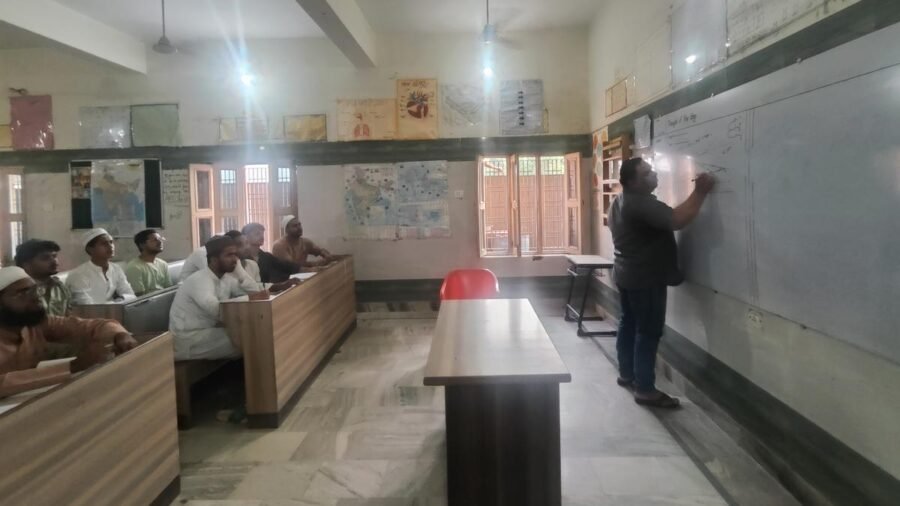
After initial hesitation, young Hafiz Abdus Samad allows entry into his world and whispers, “I want to join IFS, Indian Foreign Service.” The 14-year-old from Mewat wants to change the perception of his backward region in Haryana. “I want to serve in the UAE and tell the world that in India one can follow his or her religion without discrimination.”
Samad is among the hundreds of Huffaz at Vision International Academy learning that modern science and mathematics are not at odds with Islamic teaching. Huffaz are students of madarsas who have memorised the Arabic verses of the Quran by heart. But these teenagers don’t just have the spiritual capital. Clad in kurta pyjamas with skull caps decorating their little heads, they express themselves in broken English, can reflect on the physics behind a pendulum, know a thing or two about Premchand’s stories and can appreciate Rohit Sharma’s casual aggression and Babar Azam’s cover drives.
A brainchild of philanthropist Ameer Ahamed, the boarding school is tucked into the heart of sugarcane plains and madarsa tradition in Phulat, a sleepy village in Khatauli, just off the frenetic Delhi-Dehradun Expressway. Once known as the birthplace of 18th-century Islamic scholar and reformer Shah Waliullah, Phulat made news in the last few years when revered Muslim preacher Maulana Kaleem Siddiqui was convicted and sentenced to life imprisonment for forcibly converting people to Islam by an NIA Court in 2024.
Interestingly, Mr. Ahamed says Mr. Siddiqui offered the land when other madrasas in the region shut the door on him. A postgraduate in management from Aligarh Muslim University, Mr. Ahamed is a Keralite who made a fortune in the Gulf by re-engineering sick units.
After passing the baton to the second generation in the family, Mr. Ahamed became a full-time social worker, starting VIA in 2017 with 76 students. “I noticed these young Hafiz have something in them which the community has not explored. We have done some psychometric tests on them, and they revealed that their IQ level is no different from that of the best students of their age, and their memorising capacity is exceptional. However, they often remain confined to madarsas and end up doing menial jobs.” Along with some senior professors in AMU, Mr. Ahmaed created a bridge course that combines spiritual education with modern education for madarsa children.
Talking to a cross-section of students, some see the outside world as a dangerous, discriminatory place and want to move from madarsa to AMU to Jamia to the Gulf, maybe to a place where their beard and cap don’t make them odd ones out. One of them defends Taliban rule in Afghanistan, another one speaks in favour of patriarchy even though he could not pronounce it. But then there is Mustafa, son of a sugarcane farmer from the neighbouring Jaula, one of the centres of agitation against farm laws, who wants to be a chartered accountant. Md Qasib and Shees Tyagi are enraged by rising unemployment and a lack of infrastructure and opportunities, but want to change their surroundings by becoming doctors and engineers. “We respect the diversity in culture and climate of our country. No other country has it, and it needs to be preserved,” says Qasib.
Mr. Ahamed admits mindsets will take time to change. “Perceptions are changing. Moral education is an important part of the curriculum. We realised a young Huffaz doesn’t necessarily know the spirit of the Holy Quran. Islam is not about a beard and pyjama. Here, they learn about the country, the Constitution, and the basics of comparative religion to build understanding and respect for other faiths. And for one day of the week, we ask them to dress up in a pant-shirt.”
Wasi Miyan Khan, a senior teacher at the school, has a PhD from Jamia Millia and has taken theology lessons at Deoband school. “My goal is to use their strong memory to clear board exams by inculcating curiosity and inquisitiveness.”
After Mr. Siddiqui’s arrest, Mr. Ahamed says he faced intensive scrutiny from the authorities, but eventually everything was found “clear and transparent.” “I am following PM Narendra Modi’s mantra of national service where a Muslim has Quran in one hand and computer in other.”
He also faced resistance from maulanas who felt he was encroaching into their territory. Responding to attempts at polarisation in the State, ahead of Assembly elections, Mr. Ahamed, who spends a lot of time in the region, advises Muslims to stay away from politics and concentrate on education. “UP Muslims have to realise they have to invest in modern education. I see them investing in mosques and other charities but not as much in education.”
In the early 1960s, he reminds, Kerala Muslims were no different from UP Muslims. “Then in 1964, Dr P.K. Abdul Gafoor started Muslim Education Society with a few friends for social and educational upliftment of the community. Muslim League initially felt he would take away their vote bank, but then the likes of C.H. Mohammad Koya saw merit in his vision and the IUML and MES worked hand in hand.”
Talking of the Kerala model of coexistence, Mr. Ahamed says, “We learn how to educate from Christians and a service mentality from upper caste Hindus. Your success depends on how much you mingle with others. I feel the contribution of Muslims to the country’s GDP has to increase. And for that the Muslims of UP have to be empowered. Once that happens, no one will dare question us.”
Awaiting CBSE affiliation, Mr. Ahamed is keen to replicate the Academy’s vision in other parts of the country, starting with a girls’ school in Muzaffarnagar. “Over a period of time, we intend to make it a day boarding school and open it to non-Muslim students of the area as well.”

Partnership in crime, incubated behind bars in Telangana
By Sohail Khan · 21 Aug
Charter plane with 8 aboard crashes in US’s Alaska, search and rescue mission underway
By Sohail Khan · 21 Aug
HC steps in after CRPF deployed in tense Shillong
By Sohail Khan · 21 Aug
Leave a Reply