ISS crew steps up spacewalk preparations, tests AI and virtual reality tools
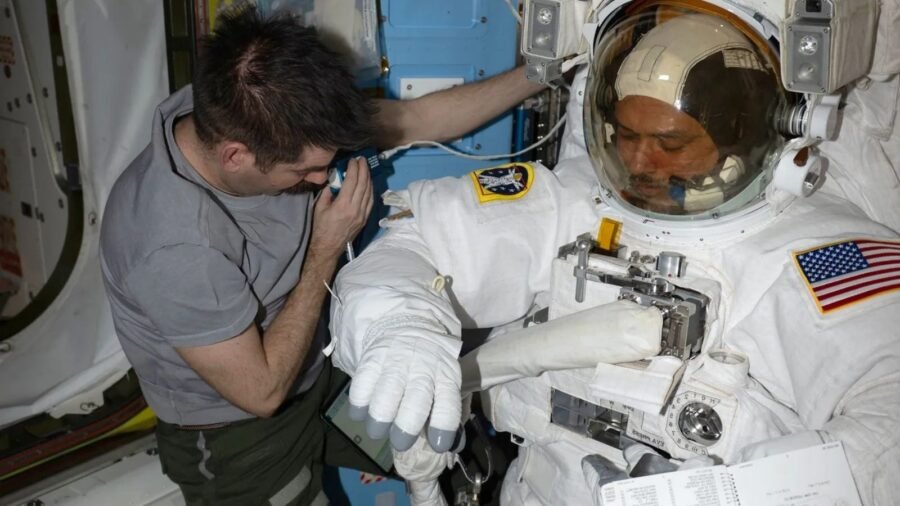
The Expedition 75 crew aboard the International Space Station (ISS) continued preparations Thursday for a spacewalk scheduled for August 18, while also conducting experiments involving virtual reality and artificial intelligence.
Nasa astronauts Anil Menon and Sophie Adenot of the European Space Agency are scheduled to venture outside the station next Tuesday to replace a failed high-speed space-to-ground antenna. The spacewalk is expected to last about six-and-a-half hours.
Astronauts prepare for antenna replacement
Menon and Adenot will begin the spacewalk after switching their spacesuits to battery power at 8.35 am EDT (6.05 pm IST). The astronauts will exit through the Quest airlock and travel to the Z1 truss segment above the Unity module, where the antenna is installed.
The astronauts will first remove the existing antenna and place it on an external stowage platform. They will then retrieve a spare antenna from the platform and install it on the Z1 truss before securing the old equipment.
NASA astronauts Jack Hathaway and station commander Jessica Meir will support the spacewalk from inside the station. They will help Menon and Adenot put on and remove their spacesuits and operate the Canadarm2 robotic arm.
Menon will be positioned on the robotic arm’s latching end effector during part of the operation, while Adenot will remain tethered to the station’s truss and assist with the antenna replacement.
Spacesuits and emergency procedures checked
Spacewalk preparations have been underway throughout the week. On Thursday, Menon and Hathaway checked the functionality of Menon’s spacesuit, including refilling its tanks and liquid-cooling ventilation garment with water.
Story continues below this ad
Meir and Adenot also reviewed the specialised tools needed to make the electrical and data connections between the replacement antenna and the Z1 truss.
The crew held discussions with mission controllers and robotics specialists to review safety procedures, technical instructions and Canadarm2 manoeuvres ahead of the spacewalk.
On Wednesday, the crew also conducted emergency response training. All seven Expedition 75 astronauts and cosmonauts reviewed their roles in the event of a pressure leak, chemical leak, or fire.
The crew used tablets to review emergency procedures and coordinated with mission controllers on Earth to simulate the actions required to protect themselves and the station.
Story continues below this ad
Crew conducts VR and AI experiments
While the Nasa and ESA astronauts focused on the spacewalk, the station’s Roscosmos crew continued scientific experiments using advanced technology.
Flight engineers Pyotr Dubrov and Anna Kikina took turns wearing virtual reality headsets and responding to computer-generated visual stimuli. The experiment is designed to study how the human sense of balance and direction adapts to microgravity.
The cosmonauts also carried out other station maintenance and observation activities. Dubrov conducted an automated Earth photography session, while Kikina and Andrey Fedyaev continued work involving artificial intelligence tools intended to improve crew efficiency during future space missions.
The crew also carried out photographic inspections of the windows in the Zvezda service module, Nauka science module, and Poisk mini-research module.
Story continues below this ad
With the August 18 spacewalk approaching, the Expedition 75 crew is expected to continue reviewing procedures, checking equipment and coordinating with ground teams to ensure the antenna replacement can be carried out safely.

US govt sites as targets, evading CAPTCHAs: What OpenAI’s runaway agents got up to
By Sohail Khan · 27 Sep
HP OmniPad 12 review: A promising comeback that needs more polish
By Sohail Khan · 27 Sep
Movies feel different on the right screen, and these 5 TVs are made to bring that magic home
By Sohail Khan · 27 Sep