Is Claude down – or am I just waiting? Why enterprise AI needs more than one model

Resilience, intelligent failover and honest failure communication matter as much as model quality.
Updated on: Aug 19, 2026, 11:47:22 IST
Prefer HTon Google
Share via
Copy link
AI is now part of the working day
AI stopped feeling like a futuristic add-on for us some time ago. It has become part of the working day – helping teams write codes, create designs, test ideas, review architecture and move enterprise work forward. Once a tool enters that routine, reliability stops being a technical footnote.
That matters because AI now supports software delivery and daily decisions that run businesses.
When seven hours produces nothing
On August 17, I asked Claude assistant to do a machine-learning architecture review for Personalized Notifications. The task looked ordinary. Seven hours later, it was still running without a usable result. By the next morning, I tried another tool (Codex), which completed the work in minutes. The expensive part was not the tokens, it was the lost time. Even the spinner appeared to be reconsidering its career choices.
Uptime is not productivity
I naturally checked Claude's status dashboard. Status pages are valuable, but they cannot always answer the question a developer is really asking: "Can I get useful work done right now?" A service may be online while a task remains trapped in digital meditation.
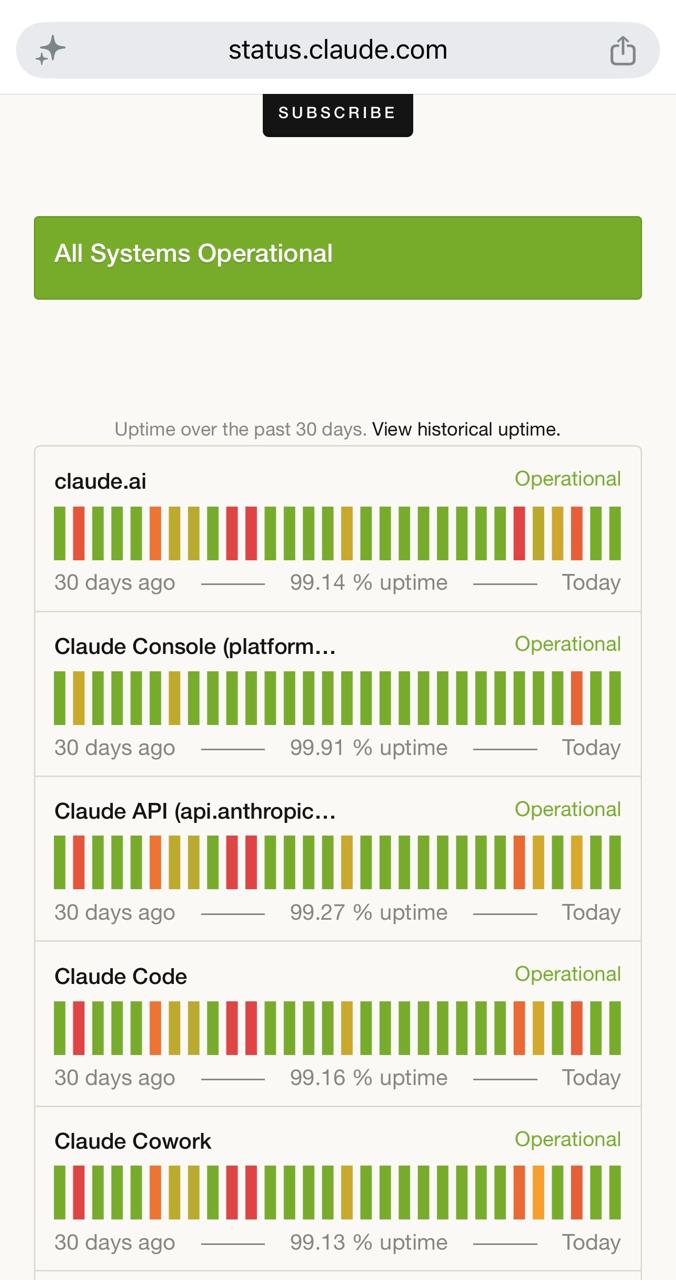
The bigger lesson is not that one provider is good and another is bad. Every AI service will experience outages, congestion or inconsistent performance. I remain impressed by what this industry has built. But admiration should not prevent architecture. One model cannot be the strategy.
For coding, platforms such as AWS-built Kiro and GitHub Copilot already offer model choice and automatic selection. For wider enterprise work, Amazon Quick and Microsoft 365 Copilot show how assistants can connect knowledge, data and everyday workflows without relying on uptime of single model.
Resilience is a product feature
The next step is resilience by design: intelligent routing, policy-based failover and continuity across models. The platform should choose an alternative based on availability, security, data residency, latency, cost and task complexity – without asking a developer to conduct an emergency model audition at 2 am.
Great design must also communicate failure clearly. Users need honest status messages, sensible time estimates, safe cancellation and an easy retry path. Almost all AI products do not show error/warning messages to end users in case of any issue.
This is not a vendor comparison. It is a call to treat AI as production infrastructure. The winning enterprise AI platform will not be the one that never stumbles. It will be the one that keeps people productive when it does.
Get Current Updates on India News, Elections 2024, Lok sabha election 2024 voting live , Karnataka election 2024 live in Bengaluru , Election 2024 Date along with Latest News and Top Headlines from India and around the world.
See Less

Best places in India to see tigers in the wild
By Sohail Khan · 28 Sep
China’s space diplomacy brings Pakistani astronauts closer to orbit
By Sohail Khan · 28 Sep
What a US diesel export ban could mean for energy markets globally, and India
By Sohail Khan · 28 Sep