India’s talent edge can turn global crisis to gain

Synopsis
India is expanding greements with countries including those in Europe, Japan, Israel, Russia and the UK to create formal pathways for Indian workers amid growing global skill shortages. With ageing populations and shrinking workforces driving demand for foreign talent, India’s large workforce stands to gain from opportunities in healthcare, caregiving, engineering, IT, manufacturing and other sectors.
 iStock
From Europe to Japan, India is building a wider network of agreements and arrangements to facilitate the movement of its workers abroad.
The prize for India is not just more jobs for its workforce, but potentially more dollars flowing home through remittances. The opportunity is growing as ageing populations and shrinking workforces leave countries across the world facing shortages of skilled workers. India, meanwhile, has a large talent pool that is increasingly in demand.
The next challenge is ensuring this demand translates into real opportunities for Indian workers. With labour mobility becoming an important part of India’s economic engagement with major markets, the country needs structured and compliant migration channels that can connect its talent with jobs abroad while ensuring workers have the right skills, protections and support.
Growing number of labour-mobility pacts
Calling it "a very important pillar" of international cooperation, External Affairs Minister S Jaishankar recently said that India has signed 28 Migration and Mobility Partnership Agreements (MMPAs) or their equivalents with 26 countries. The minister also revealed that talks with other countries were underway.
In recent years, India has increasingly used mobility pacts to deepen economic ties and create more opportunities for its workers abroad. These efforts go hand in hand with India’s wider push to expand its Free Trade Agreements (FTAs) and strengthen ties with major global markets.
Read more: India's next billion dollars from abroad may depend on easier visas
India and the European Union signed a mobility pact in 2026 to ease movement of Indian students, workers and professionals across the bloc’s 27 member countries. The EU has also committed to “an uncapped mobility for Indian students,” according to officials.
New Zealand has also opened new pathways for Indian students and workers. Indian students can work 20 hours a week, while certain science, technology, engineering, and mathematics (STEM) graduates can get three-year post-study work visas and doctorate holders four years. The India-New Zealand Free Trade Agreement (FTA), signed in 2026, includes a new Temporary Employment Entry (TEE) Visa pathway pact that provides for 5,000 skilled Indian professionals to work in New Zealand for up to three years and 1,000 young Indians to use a Work and Holiday visa each year.
Russia and Japan are also opening up to Indian workers as both countries face labour shortages and demographic challenges. India and Russia signed an Agreement on Temporary Labour Activity in December 2025, while the two countries also highlighted cooperation on manpower exchange, vocational training and youth employment.
The August 2025 India-Japan Action Plan on Human Resources aims to facilitate the movement of 500,000 people over five years, including 50,000 skilled and semi-skilled Indian workers, particularly in healthcare, manufacturing, caregiving, hospitality and services, according to the Ministry of External Affairs.
India and the UK signed a migration partnership in May 2021, allowing up to 3,000 Indian professionals aged 18–30 to live and work in the UK for up to two years each year. The 2026 India-UK Comprehensive Economic and Trade Agreement (CETA) seeks to make temporary business travel between the two countries easier, helping companies expand trade and operations. The deal does not create a new visa route for Indians seeking jobs in the UK. Instead, it keeps existing routes for business visitors, intra-company transfers, trainees and expansion workers, while expanding access for contractual service providers and self-employed professionals in sectors such as architecture and engineering.
Between 2023 and 2026, India and Israel signed six mobility agreements to facilitate the movement of Indian workers to the West Asian nation, including in manufacturing, caregiving and other sectors. Under the latest pact signed in 2026, the two countries agreed to facilitate the deployment of up to 50,000 additional Indian workers to Israel over five years in specific labour-market sectors.
But signing mobility agreements is only the first step.
Suchita Dutta, Executive Director, Indian Staffing Federation, said the addressable opportunity runs into the tens of millions. However, Dutta said the number who actually benefit will depend on how effectively formal staffing channels these flows, adding that “structured, compliant placement is what turns a quota into a career.”
Why global demand for Indian talent is rising
Demographic ageing is becoming a major driver of labour demand across advanced economies, as shrinking working-age populations put growing pressure on employers. At the same time, countries are struggling to find workers with the right skills.
The World Economic Forum’s Future of Jobs Report identifies skills shortages as one of the biggest barriers to business transformation and estimates that nearly 40% of workers’ core skills will change by 2030.
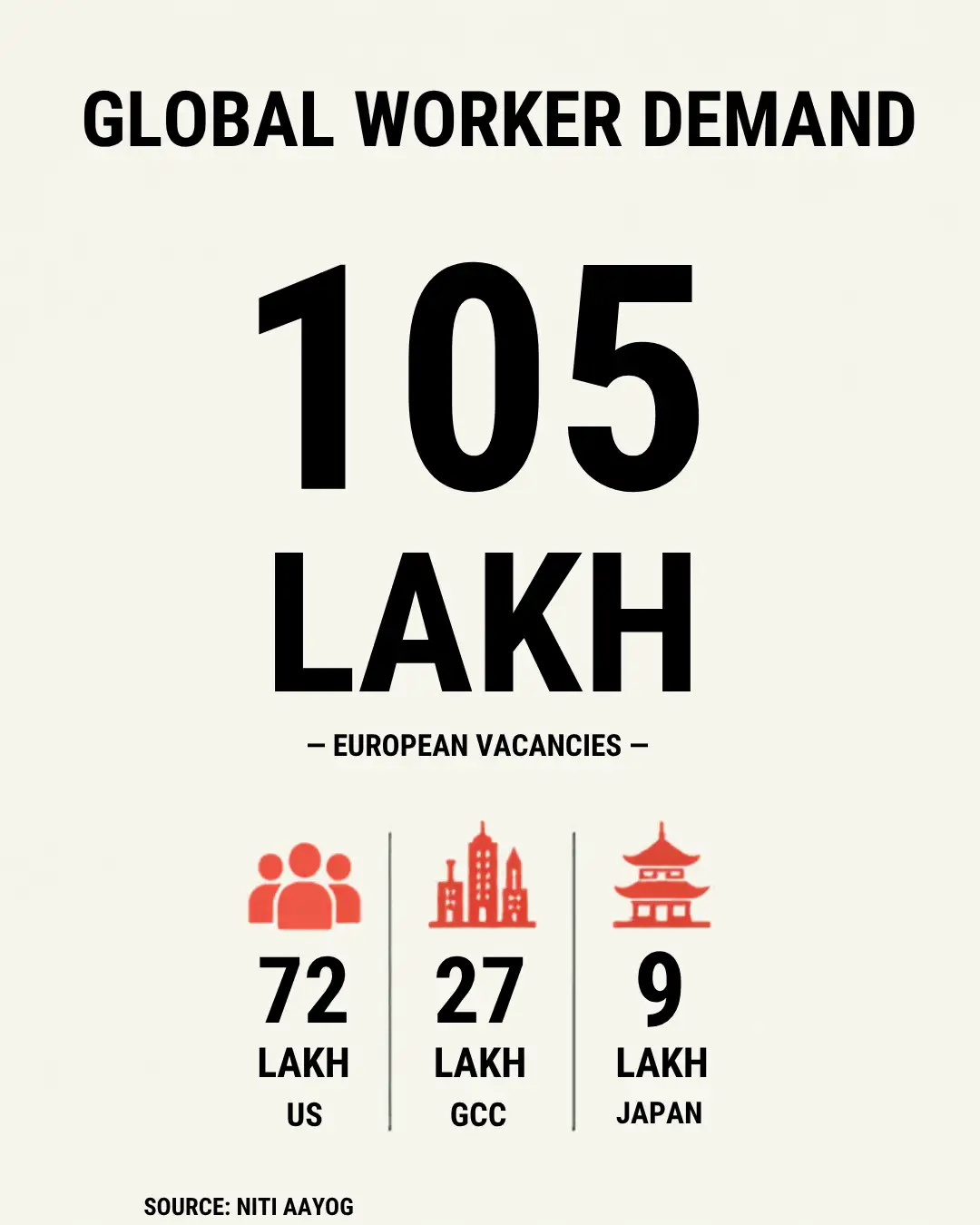
The scale of the shortage is visible in vacancy numbers. Data presented in Niti Aayog’s working paper titled ‘States' Framework: Advancing International Mobility for Skilled Workers’ shows that Europe has roughly 105 lakh vacancies, followed by the US with about 72 lakh, and the GCC region with nearly 27 lakh. Japan has more than 9 lakh vacancies, while the UK has over 8 lakh, Canada around 5 lakh and Australia about 2 lakh.
Germany is a clear example of this growing demand. According to the Bertelsmann Foundation, a German think tank, the country needs around 300,000 skilled foreign workers every year, with more than 260,000 positions currently unfilled in shortage sectors.
Healthcare leads the demand, followed by construction, IT and engineering.
Similar opportunities are emerging elsewhere.
“The largest underused opportunity is the care economy. Our youth, particularly young women, can be trained and placed in nursing, childcare and eldercare roles in countries with ageing populations, generating both remittances and dignified employment that does not currently exist at this scale in India's formal labour market,” said Mitali Nikore, Founder and Chief Economist, Nikore Associates.
Australia’s Mobility Arrangement for Talented Early-professionals Scheme (MATES) targets renewable energy, mining, engineering, ICT, AI, fintech and agritech, while New Zealand is looking for workers in IT, engineering, healthcare, education and construction.
For Indian workers, the opportunity is also closely linked to wage differences. The PRAYAS International Migration and Mobility Mapping Report (2026) shows that higher incomes abroad remain a key reason skilled and semi-skilled Indians choose to migrate, while poverty, debt and limited job opportunities act as major push factors.
“Labour mobility agreements open formal, legal channels for young, skilled and semi-skilled workers to move into economies facing genuine labour shortages, rather than leaving them underemployed at home in jobs below their qualification or working fewer hours than they want,” Nikore said.
Labour mobility as a tool to boost remittances
In FY25, India received $135.4 billion in remittances, according to the Economic Survey, making it the world’s largest recipient of remittances for yet another year. During the same period, India’s gross foreign direct investment (FDI) inflows stood at approximately $81.4 billion, as per a PIB release.
The latest Economic Survey also highlighted the contrast, noting that remittances have surpassed gross FDI inflows in most years, underscoring their importance as a key source of external funding.
Also Read|India leads in global remittance inflows as overseas workforce and student migration grow
Remittances can also act as a counter-cyclical force, often increasing during periods of economic downturn and providing immediate financial support to millions of households. Unlike private debt or equity flows, remittances are non-repayable and counter-cyclical, often rising during economic downturns.
.jpg)
“The increase in remittance as per NITI Aayog’s projection of $160 billion till 2029 depends on how many more Indians can move abroad through safe, formal channels rather than informal or irregular routes, and how much of what they earn they can remit without exploitative recruitment fees or wage theft eating into it first. Structured mobility agreements are the mechanism that determines whether that growth in remittances actually materialises,” said Nikore.
India’s remittance map is also changing. Southern States such as Kerala, Tamil Nadu, Karnataka and Maharashtra historically accounted for the majority of remittances, collectively receiving 46% of inflows in 2018. By 2020-21, the combined share of Kerala, Tamil Nadu and Karnataka had fallen to 25%, while Maharashtra emerged as the top recipient, according to data shown in the paper by NITI Aayog.
Way forward
Still, challenges persist.
Suchita Dutta says four areas need particular attention: “First, qualification recognition — nonrecognition of Indian degrees remains the largest barrier; binding Mutual Recognition Agreements, such as the UK CETA should become the norm. Second, social-security portability.”
Third, Dutta said, visa predictability and faster processing also need greater attention. “Even strong pacts stall on process; agreements should carry firm visa issuance timelines and close the lag between signing and gazetting rules.”
Fourth, she said, transparent recruitment and worker welfare — formalising recruitment through licensed, accountable staffing channels integrated with e-Migrate, and enforcing that the employer, not the worker, bears sponsorship and skilling costs.
Niti Aayog’s working paper notes that expanding international mobility for skilled workers requires a coordinated framework in which institutional capacity, regulatory compliance, employer participation and worker welfare work together.
Such an approach can help India move from reactive, placement-driven migration to a more predictable and capability-led system that responds to changing global labour demand.
(Join our ETNRI WhatsApp channel for all the latest updates)
Add 

(Catch all the Business News, Breaking News, and Latest News Updates on The .)
…more
Elevate your knowledge and leadership skills at a cost cheaper than your daily tea.
-
From survival to 193 mn subscribers: Is Vi finally making a comeback? -
ET Prime special series: 2013 to 2026. Not years, but evidence: Power Grid, Part 2 -
Behind the sugar price drop: Exports, imports and a non-factor called ethanol -
As IndiGo, Air India scramble for pilots, fresh headwinds hit hard -
When a CFO resigns, is ‘personal reasons’ explanation enough? -
FCNR (B) scheme garners USD65 bn, but why isn't the rupee gaining? -
ET Prime special: Bigger, Better or Both? Understanding business to figure out the mystery: Power Grid Corp – Part 1 -
US bond yield: Will it become a new pain point? -
Bigger or Better: BEL’s biggest shareholder is also its biggest customer – and its rule-maker. Final part -
Train station to rocket propellants, a Nagpur firm’s INR21k-cr journey

India’s August rains fall 16% below average
By Sohail Khan · 31 Aug
Tax raid found Rs 16L cash; man wins case in ITAT
By Sohail Khan · 31 Aug
PM praises Mumbai man for 800-year history website
By Sohail Khan · 31 Aug
Leave a Reply