India vs Sri Lanka 2nd Test: How Rishabh Pant’s audacity lifted India in Colombo
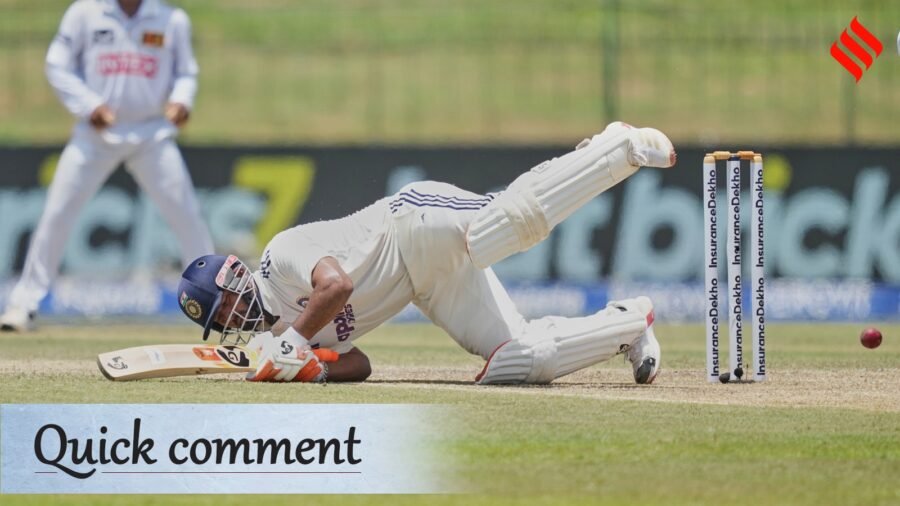
Rishabh Pant has never done things the conventional way. On Monday in Colombo, with his left forearm still strapped after retiring hurt for 3 the previous evening, he did it again. He walked back immediately after lunch, but the damage was done. His 63 may not have been a hundred, but for India, it was worth its weight in gold.
Pant walked out to bat early in the first session on Day 2 after Saransh Jain had fallen cheaply. There were doubts over whether he could play his normal game, whether he could withstand Sri Lanka’s attempts to test the injury. The answers came emphatically. More than the runs, there was an audacity to the way Pant batted, as if the strapped forearm were an inconvenience rather than a reason to retreat.
Asitha Fernando repeatedly bent his back, sending bouncers towards Pant’s body and shoulder. Pant ducked under some, swayed away from others and was struck again. On one occasion, he was caught between ducking and swaying, taking the ball on the shoulder as it lobbed dangerously close to the stumps. He kept batting. His left hand remained taped, his gloves repeatedly coming off and going back on. Yet he took on deliveries most batsmen would have been happy simply to survive.
Story continues below this ad
The defining moment came in the fifth ball of the 90th over. Kumara went short and into Pant, precisely the delivery Sri Lanka had been using to test him. He rocked back, got into position and hooked it over fine leg. It sailed onto the roof.
He pulled Fernando’s short balls through backward square, tapped Kumara behind point and rotated the strike when the bowlers strayed. The injured forearm made conventional batting difficult, but that only seemed to sharpen his instinct for improvisation and risk.
Then came the spinners, and Pant found another way to disturb their rhythm. Keshara Nuwantha kept bowling around middle and leg, trying to cramp him. Pant used the crease, going deep to create room for the pull and staying down for the sweep, stepping out when the ball was tossed up and occasionally using the reverse sweep.
Against Prabath Jayasuriya, he was particularly inventive. He reverse-swept through deep point, paddled another fine down the leg side and then skipped down the track to loft the left-arm spinner straight back over his head. When Jayasuriya erred in line towards leg, Pant went deep in his crease and whipped him through backward square. It was not merely shot-making; it was a display of audacity from a batsman carrying an obvious physical limitation.
Story continues below this ad
The 50 came in 82 balls, with Pant going deep in his crease and pulling Nuwantha through midwicket. It was not quite a textbook pull, but it found the boundary. Then he accelerated. Jayasuriya was driven over mid-off before Pant came down the track and whipped him over wide long-on for his second six.
Then, on the very first ball after lunch, Pant did what Pant does. Nuwantha tossed one up. Pant shimmied down the pitch, got too close to the ball and attempted another big shot. He struck it flat towards deep mid-off, where Lahiru Udara held a sharp catch.
The dismissal summed up both the brilliance and risk of his innings. Yet India could hardly complain.
India was 307 for 6 when Pant resumed. By the time he departed, the score had reached 419 for 7. His 112-run partnership with Dhruv Jurel transformed the complexion of the innings and put India firmly ahead in the game.
Story continues below this ad
Pant had done something similar before. In Manchester, after Chris Woakes struck his toe, he walked out in obvious discomfort and still made 54. In Colombo, the physical challenge was different, but the response was similar: play through the pain, absorb the punishment and make the bowlers pay.
His score may appear modest beside the hundreds that define great Test innings. But context matters. This was not a 63 accumulated in comfort. It was 63 earned while Sri Lanka repeatedly attacked the body of an injured batsman, and it came when India needed someone to seize control.
The maverick had done his job. Those runs carried greater weight than the score suggested. Pant did not need to bat until tea. He did not need to make a hundred. He needed to show that the injury would not stop him – and turn that belief into runs. By the time he walked back, India were firmly in the driver’s seat.

India at Asian Games 2026 Day 6, September 24: Full schedule, venue, fixtures & time
By Sohail Khan · 24 Sep
Wednesday’s MLB clinching scenarios: Guardians, White Sox on verge of making postseason
By Sohail Khan · 24 Sep
Why is Lonzo Ball not playing in the NBA? Has former Cavs guard announced his retirement?
By Sohail Khan · 23 Sep