IIT Kharagpur at 75: How India’s first IIT was born in a former colonial prison
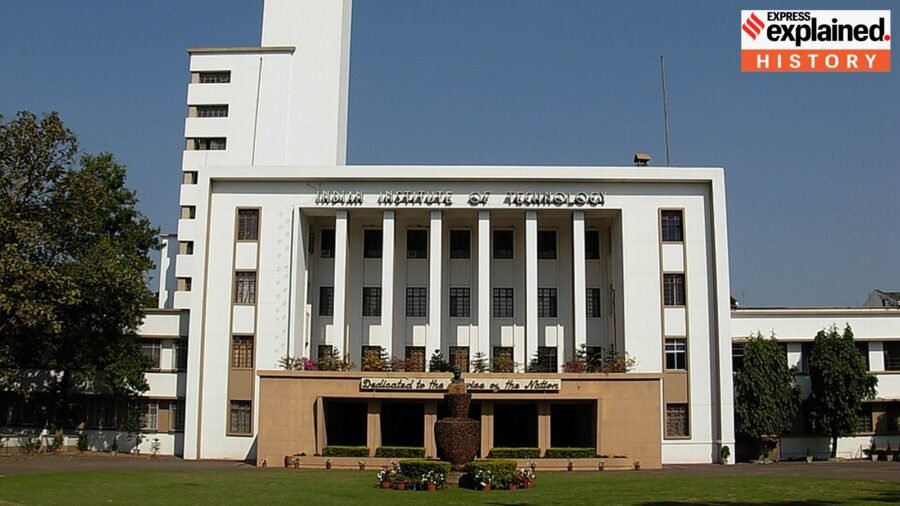
The first Indian Institute of Technology, IIT Kharagpur, is celebrating its 75th anniversary today. On August 18, 1951, Maulana Abul Kalam Azad formally inaugurated the college, marking the beginning of an institution that would become synonymous with elite technical education in India.
After Kharagpur, in the same decade, the IITs Bombay, Madras, and Kanpur were set up, with more following in later years.
But the origins of the IITs go back to a time when India was still under British rule.
The idea before Independence
In the mid-1940s, as the World War II was drawing to a close, the colonial government was thinking about the kind of technical manpower India would need for post-war industrialisation. In 1946, Sir Jogendra Singh, Member of the Viceroy’s Executive Council, Department of Education, Health and Agriculture, set up a 22-member committee, headed by industrialist Nalini Ranjan Sarkar, to consider the establishment of higher technical institutions in India.
This Sarkar Committee report contained the seeds of the IITs.
The interim report said that in the aftermath of World War II, now that engineers and technical experts would be in great demand in Europe and America, it would be almost impossible “to secure from abroad, the services of the right type of engineers, architects, technologists and planners, etc. to carry out India’s post-war projects. The initiation of a programme of higher technical education and research in India should therefore be pushed forward with the utmost speed and determination.”
The committee recommended setting up, on the lines of the Massachusetts Institute of Technology, “not less than four Higher Technical Institutions, one in the North, one in the East, one in the South and one in the West.” The one in the east should be set up in or near Calcutta, and the western in or near Bombay, the report added.
Story continues below this ad
Right from the planning stage, the institutions were supposed to be more than ordinary engineering colleges. They were expected to undertake research, train researchers and technical teachers, and produce graduates comparable with those from leading institutions abroad.
Nehru and the IITs
After Independence, the government led by Jawaharlal Nehru made higher technical education an important part of its vision for building a modern India.
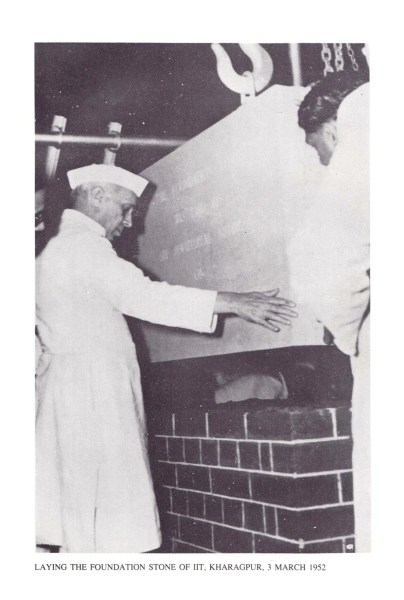 Nehru laying the foundation stone of IIT Kharagpur on March 3, 1952.
In Bengal, work on the new college had moved swiftly, with Chief Minister BC Roy and Dr. Humayun Kabir working actively. On March 3, 1952, Nehru laid the foundation stone of IIT Kharagpur’s new building.
IIT Kharagpur’s website says, “Initially the IIT started functioning from 5, Esplanade East, Calcutta and very soon shifted to Hijli in Sept. 1950. The present name ‘Indian Institute of Technology’ was adopted before the formal inauguration of the Institute on August 18, 1951, by [then education minister] Maulana Abul Kalam Azad.”
Story continues below this ad
The government was already thinking beyond Kharagpur. In July 1956, Nehru was personally involved in discussions over the location of the next technological institute, considering Kanpur and Allahabad. He also said India should assume that the new institute would be “similar to Kharagpur Institute.”
Nehru addressed the institute’s first convocation around four years later, where he said, “It always produces a deep sense of satisfaction to see buildings and institutions coming up. There are some kinds of growth which you cannot see, but the visible growth of our big national laboratories and these Institutes and other places fills me with joy… when people are engaged in big undertakings, they imbibe something of the bigness of the undertaking and grow bigger. It is given to all of you to grow bigger and bigger.”
From Hijli jail to IIT
The location of IIT Kharagpur has historical significance. Under the British rule, here stood the Hijli Detention Camp, established in 1930 to hold Indian prisoners, with jails overflowing as the Independence movement heated up.
Two unarmed detainees were shot here by the colonial police in 1931, provoking widespread outrage. The camp was later used again to detain freedom fighters without trial.
Story continues below this ad
Former President the late Pranab Mukherjee, in his 2012 convocation address at IIT Kharagpur, referenced this history. “The original location of this Institute is the very spot where two great soldiers of the freedom movement, Santosh Kumar Mitra and Tarakeswar Sengupta, had served their sentence. (It is recalled that when they were shot dead by the Police of the day on Sept. 16, 1931, Netaji Subhash Chandra Bose himself came to the Hijli detention camp, as it was known, to take charge of their mortal remains. This incident had galvanised national leaders including Gurudev Rabindranath Tagore.)”
When IIT Kharagpur’s first session began in August 1951, it had 224 students and 42 teachers, with 10 departments. Classrooms, laboratories and the administrative offices were housed in the old detention-camp buildings.
From one institute to a national system
IIT Kharagpur’s institutional status was soon elevated. In September 1956, Parliament passed the Indian Institute of Technology (Kharagpur) Act, declaring it an institution of national importance and providing for its incorporation and autonomy.
In the 75 years since, IIT Kharagpur has produced many notable alumni, including Sundar Pichai, CEO of Google and Alphabet, Arvind Kejriwal, former Chief Minister of Delhi, and Arjun Malhotra, co-founder of HCL.

Sussanne Khan says she felt ‘more love’ for Hrithik Roshan’s mother after losing her own
By Sohail Khan · 28 Sep
COP31 hosts Australia and Türkiye face the fossil-fuel question
By Sohail Khan · 28 Sep